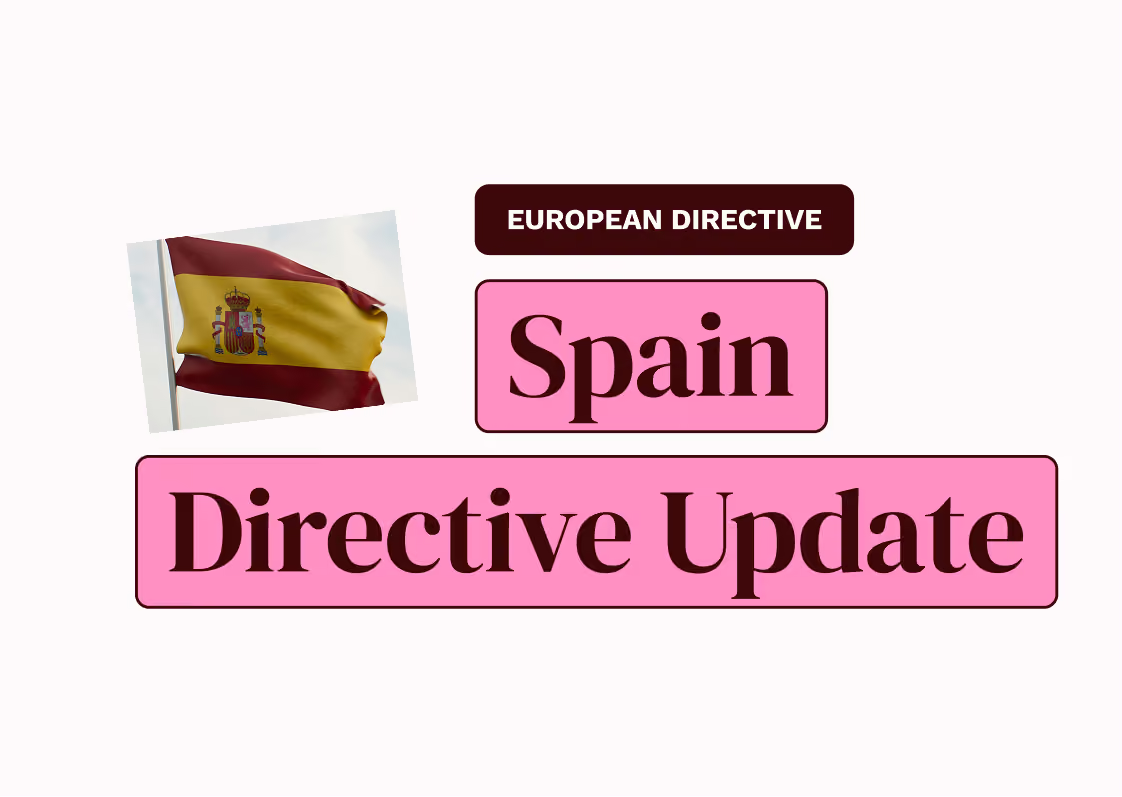
Spain transposed the EU Pay Transparency Directive through Real Decreto-ley 39/2026, which came into force on 19 November 2026.
The new law builds on an already well-developed pay-transparency framework, so Spanish employers aren’t starting from scratch. But it adds new obligations around reporting, employee pay information and recruitment, while strengthening some of the existing requirements around pay data and job evaluation.
That means employers will need reliable compensation data, clear job structures and processes that can support a higher level of transparency in practice.
Here’s what HR and compensation teams need to know about the new rules.
Transposition status in Spain at a glance
Spain’s pay transparency law in detail
Spain’s new law updates its existing pay-transparency framework, adding new requirements around recruitment, employee information rights, pay-setting transparency and gender pay gap reporting. Reporting applies from 50 employees.
Here are the main employer obligations to be aware of:
Analysis: What Spain’s law means in practice
1. Spain is building on an existing pay-equity framework
For many employers in Spain, the Pay Transparency Directive won’t mean starting from zero. Companies already have requirements around pay registers, pay audits, equality plans and job evaluation, so much of the basic infrastructure may already be in place.
Employers with existing equality plans also benefit from a transitional provision: their current pay audits remain valid until the plan expires or is revised.
The new law asks employers to work with more detailed information and makes more of that information visible to employees and through external reporting. That means many companies’ existing systems may not be detailed enough for this level of transparency, even if they were sufficient under the previous rules.
Spanish employers must therefore pressure-test the systems they already have, particularly their pay data, job structures and pay-equity processes.
2. Employers will need more granular and accessible compensation data
Spain’s gender pay gap reporting rules go further than the Directive in a few important ways:
- Employers with 50 or more workers are in scope, compared with the Directive’s mandatory threshold of 100 employees.
- Employers need to report both annual and hourly pay figures.
- Pay must be broken down into individual components rather than broader salary and variable-pay categories.
For employers with 50–249 workers, the three-year reporting cycle also covers the previous three years of data, rather than just the previous calendar year (as required by the Directive).
The requirements for Spain’s existing pay registers are also becoming more demanding. Registers must include both mean and median pay, calculated annually and hourly, with a separate breakdown for each pay component. Employers must consult worker representatives at least 10 days before creating or updating the register and retain the register and supporting data for four years.
There are also requirements around access to historical reporting data. On request, employers subject to reporting must provide four years of category-level pay gap data, along with the calculation methodologies used, within two months.
That means HR and payroll teams need to think beyond the next reporting deadline. They’ll need consistent compensation data across multiple years, a reliable way to retrieve historical records and documented methodologies that allow them to reproduce and explain their calculations. Companies relying on disconnected systems or manual fixes may have considerably more preparation work to do.
3. Existing job classifications may not be enough for equal-value analysis
Spain’s equal-value rules require employers to look at the real content of a job, not just its title or existing classification. Job valuation must follow three core principles:
- Adequacy (adecuación): The factors used to assess a role should reflect characteristics that are actually present in the job.
- Totality (totalidad): The assessment should take the whole role into account, so no relevant task, responsibility or working condition is overlooked or undervalued.
- Objectivity (objetividad): The factors should be clear, applied consistently and free from gender stereotypes.
Employers must also consider the tasks involved, the qualifications and professional requirements, what it takes to perform the job and the conditions in which the work is carried out. Spain’s legislation explicitly recognises a wide range of factors that contribute to a job’s value, from physical hardship and dexterity to care skills, responsibility for other people’s wellbeing and the ability to resolve conflicts.
That means an existing grading structure may not always be detailed or consistent enough for equal-value analysis. Employers should check whether their job architecture supports fair comparisons between roles, particularly where job descriptions are vague, levels are applied inconsistently or similar roles are structured differently across teams.
4. Employee pay information rights will become an ongoing HR process
The new employee information rights add another operational task for HR. Under the new law, employees can request their individual pay level and average annual and hourly pay levels by sex for workers doing the same work or work of equal value. Employers must remind staff of this right at least annually and respond to each request within two months.
Companies need a clear process for deciding which comparison group applies, finding the relevant data, calculating the figures and responding to the employee. They also need to be ready for follow-up questions: if the information provided is inaccurate or incomplete, employees can request clarification and must receive a reasoned response within 15 days.
In Spain, this process also needs to accommodate former employees, who can exercise their right to pay information for up to one year after leaving the company.
The underlying methodology therefore needs to be explainable, not just technically correct. A consistent process will be much easier to manage than rebuilding the analysis from scratch for each request.
Key preparation steps for employers in Spain
Spanish employers already have a strong pay-transparency framework to build on, but the new rules raise the bar in several areas. Focus on these priorities first:
- Check your compensation data can support the new reporting and pay register requirements, including the required level of detail, historical coverage and access to supporting records.
- Review your job architecture and job descriptions against Spain’s equal-value criteria, including adequacy, totality and objectivity.
- Test how reliably you can group employees doing the same work or work of equal value for reporting and information requests.
- Set up a clear process for handling pay information requests from current and former employees, including comparison-group methodology and the deadlines for responses and clarifications.
- Update recruitment processes so job offers include starting pay and the applicable collective agreement, and remove questions about candidates’ current or previous pay.
- Review employment contracts and policies for clauses that prevent employees from discussing their own pay for equal-pay purposes.
Learn more about the Pay Transparency Directive
Spain’s new rules build on an existing pay-transparency framework, but they also introduce more detailed reporting, stronger employee information rights and new requirements around recruitment. For employers, the main challenge will be making sure the data, job structures and processes behind pay decisions can support that higher level of transparency.
For a broader view of how the Directive is being implemented across Europe, see our guide to how EU countries are implementing the Pay Transparency Directive.