Key points:
- Pay equity ≠ pay transparency: Pay equity is the internal analysis, pay transparency is the external disclosure. You need both working together to comply with the EU Pay Transparency Directive's June 2026 deadline.
- The workflow has five steps: Data integration, market benchmarking, internal structure, action and remediation, and compliance disclosure, and the quality of each step depends on the one before it.
- Three types of solution, one right fit: HRIS bolt-ons are convenient but shallow, global enterprise platforms are powerful, but overkill for most, and EU-first specialist tools hit the sweet spot for European companies with 250–5,000 employees.
- Non-EU companies aren't off the hook: The Directive applies to any organisation with EU-based employees, regardless of where it's headquartered – so if you have a European workforce, you're in scope.
Search "pay transparency software," and something a little odd happens: you’ll get a ton of results that talk about "pay equity software" instead. The two terms sound similar, but they describe different things – and if you're preparing for the EU Pay Transparency Directive's June 2026 deadline, understanding that difference matters more than ever.
Regardless, we’re here to actually talk about the subject you searched for. We'll cover what pay transparency software actually does, how its two core functions (pay equity analysis and compliance disclosure) connect into a single workflow, which types of solutions exist on the market, and what to look for when choosing one.
Whether you're a VP of Total Rewards at a 2,000-person company racing to meet the Directive deadline, or an HR manager evaluating tools for the first time, you're in the right place.
Let's get into it.
What is pay transparency software?
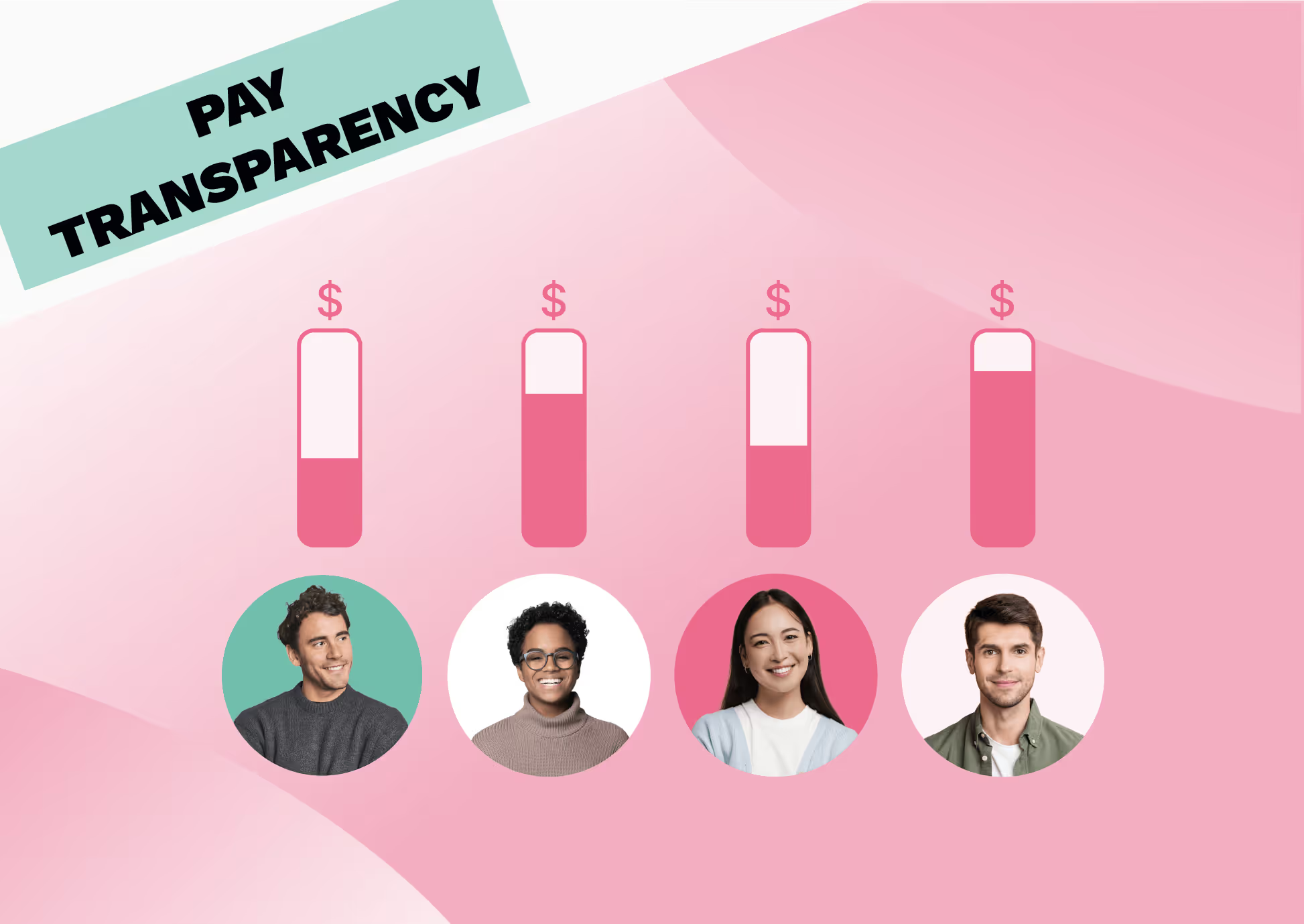
Pay transparency software helps organisations automate compliance with pay transparency laws, identify gender and ethnicity pay gaps, and analyse compensation data to make sure people are paid fairly.
Simple enough. But the category actually has two connected halves; knowing the difference will save you a lot of confusion when you're evaluating tools.
- Pay equity analysis is the internal work: are we paying people fairly? It uses statistical models to compare compensation across demographic groups, controlling for factors like job level, tenure, and location, so you're comparing like with like.
- Pay transparency compliance is the external output: are we telling people what we pay, and why? This covers things like salary range disclosure in job postings, responding to employee right-to-information requests, and gender pay gap reporting to regulators.
🤔 Most articles only focus on the pay equity angle for software. While important, it completely ignores the needs of HR departments and Finance, who need accurate salary ranges and reporting compliance. Remember: one feeds the other. You can't communicate pay confidently until you've analysed it properly.
With that out of the way, here’s what you should look for in a good pay transparency tool:
- Audit-ready compliance reporting.
- Root cause analysis to identify why gaps exist.
- Scenario modelling to simulate remediation costs before spending anything.
Why it matters in the UK and EU
Apart from the obvious benefits of being a more ethical workplace and showing that you value equitable pay practices, pay transparency software can also keep you on the right side of regulators. That’s because whether you’re in the EU or the UK, both territories have their own rules regarding pay equity:
‼️The Directive applies to non-EU companies with EU-based employees, too. If you have even a small EU workforce, you're in scope. Same thing for companies wanting to attract European talent. Get your ducks in order now, and your continental cousins will come flocking.
A standardised workflow for pay transparency
Understanding what pay transparency software does is one thing. Understanding how all the pieces fit together is where it gets genuinely useful.
Most HR teams struggle with connecting pay analysis, remediation planning, salary range disclosure, compliance reporting, and employee communication into one coherent process – without losing data quality along the way.
Here's how it works end-to-end.
1. The platform: Data integration
Everything starts with getting your compensation data in one place.
Employee records, job titles, salary figures, and demographic information all need to be centralised before any meaningful analysis can happen. For most HR teams, this is where the process stalls – manually exporting CSVs from one system, cleaning them up in spreadsheets, and hoping nothing gets lost or mislabelled along the way.
The most practical solution is a compensation platform that connects directly to your existing HRIS via pre-built integrations, pulling data automatically rather than waiting for someone to remember to run an export. Figures, for instance, integrates with 40+ HRIS platforms – meaning the data flowing into your pay analysis is always current, without anyone manually transferring a thing. For HR teams who typically spend weeks on data preparation alone before a compensation review, that's a significant amount of time reclaimed.
Critically, internal roles need to be mapped to a standardised levelling framework at this stage. If "Junior Designer" in your Berlin office is classified differently from the same role in Paris, your analysis will be comparing apples to oranges before it even begins.
"The most common reason pay equity projects stall is the data. Companies underestimate how much time goes into cleaning and standardising compensation data before you can do anything meaningful with it. Get that foundation right first, and everything else becomes much easier."
– Virgile Raingeard, CEO, Figures
2. Benchmark: Market context
Before you can identify pay gaps, you need to define what "fair" actually looks like – and that means looking outside your own organisation.
Market benchmarking tells you what other companies are paying for the same roles, at the same level, in the same location. Without this external reference point, you're essentially setting pay in a vacuum. You might be wildly above market for some roles and quietly underpaying for others, and you'd have no reliable way to know which is which.
In practice, this means taking your standardised job levels from step one and mapping them against an external salary dataset. Look for data that's broken down by location, industry, and company size – a software engineer's market rate in Amsterdam is not the same as in Kraków, and a benchmark that doesn't account for that will lead you astray.
Data quality matters enormously here. Crowdsourced salary data (think self-reported surveys) can be useful for a rough sense of the market, but it tends to be inconsistent and slow to update. Enterprise-grade sources like Mercer are updated more frequently and draw on verified compensation data from thousands of companies, which is why platforms like Figures use them as their benchmark foundation.
The output of this step feeds directly into the next one, so let’s jump right to it!
3. Salary bands: Internal structure
Once you have market context, the next step is building salary bands – the internal pay grids that define what each role should pay across levels and locations.
This is where you get to use all the benchmarking information you’ve been gathering, and isn’t that exciting? Bands give you a defensible pay range for every position, so two people doing the same job in different offices are working within the same expected bracket. They also become your source of truth for new job postings and internal promotions – both of which are direct requirements under the EU Directive.
Without salary bands in place, pay transparency is difficult to communicate in any meaningful way. You can't tell a candidate what a role pays if you haven't defined what it should pay, nor can you properly explain to a current employee why this is the range of their salary increase.
4. Compensation review: Action and remediation
With clean data, market context, and salary bands in place, the software runs statistical models to identify unadjusted and adjusted pay gaps.
- The unadjusted gap is the raw difference in average pay between groups.
- The adjusted gap controls for legitimate factors – role, level, tenure, location – and surfaces the residual difference that can't be explained by those factors. That's the number that requires action.
Once gaps are identified, the next question is: what will it cost to fix them? Good pay transparency software lets HR model different "what-if" scenarios, testing how various budget allocations would close a gap before any money is spent. This turns a compliance risk into a manageable financial plan you can take to your CFO.
Figures handles both through its Pay Equity module – the Foundations tier covers gap detection and EU-aligned compliance reporting, while the Pay Equity Expert add-on adds adjusted gap analysis, individual-level recommendations, and remediation scenarios linked directly to specific employees.
5. Transparency disclosure
The final step is the public or employee-facing output required by the EU Directive. This includes:
- Generating compliance-ready reports, particularly where gaps exceed the 5% threshold that triggers mandatory joint assessment.
- Producing accurate salary ranges for new job postings.
- Providing clear, data-backed responses to employees exercising their right to information.
💡 82% of companies joining Figures' platform currently exceed the EU Directive's 5% pay gap threshold. The good news is that you still have time to fix it, as long as you start tackling your pay gaps now.
Top-rated pay transparency software: which do I need?
Once you understand what pay transparency software does, the next question is usually: "But there seem to be very different types of products; which one is actually right for us?"
It's a fair question. Pricing varies enormously, and the tools on the market do quite different things under the hood.
At a broad level, there are three types of solutions to be aware of:
- HRIS bolt-ons: Systems like Workday or Personio may offer transparency modules as part of their existing setup. Convenient if you're already using them, but they often lack native, high-quality benchmark data and the EU regulatory depth that dedicated tools bring.
- Specialist platforms: Purpose-built tools that focus exclusively on the compensation lifecycle. These typically offer deeper statistical analysis, purpose-designed compliance reporting, and pre-built connectors to your existing HRIS. They layer on top of what you already have rather than replacing it.
- Payroll and EOR add-ons: Platforms that include basic multi-jurisdiction reporting, useful for distributed teams using Employer of Record services, but generally lighter on analytics.
Pricing in this category varies significantly because you're often buying different levels of data credibility.
Most specialist European platforms operate on a SaaS subscription based on employee count. A major differentiator is whether the tool draws on crowdsourced salary data or enterprise-grade sources like Mercer, with the latter offering more defensible, regularly updated benchmarks.
Here's a quick guide to the main players by company profile:
💡Security certifications are a real differentiator in this category – and a common procurement blocker with works councils and data protection officers. Look for SOC 2 Type 2, ISO 27001, and GDPR compliance when evaluating any platform handling compensation data.
Choosing the right platform for your team
The right tool depends almost entirely on two things: your company's size and the complexity of your regional requirements.
For large, global enterprises managing compliance across fifty or more jurisdictions, global specialists like beqom or Syndio are often the standard choice. They offer the statistical depth, legal defensibility, and multi-region coverage that organisations at that scale need.
But for UK and European companies with 250 to 5,000 employees, there are better, more cost-effective options that don’t feel like regulatory overkill.
You need local regulatory expertise, fast implementation, and a tool that HR generalists can actually use, not a platform built for a team of labour economists.
Figures is built specifically for this profile. It offers the complexity and nuance of enterprise-level tools, while feeling like a natural addition to your HR stack. It combines enterprise-grade Mercer benchmark data with a workflow that covers the full compensation lifecycle, from benchmarking and salary bands through to equity analysis and Directive-ready compliance reports.
Book a free demo and see whether the workflow fits your setup.
FAQs about pay transparency software
Which pay transparency software helps with the EU Pay Transparency Directive compliance?
Several specialist platforms are built with the Directive in mind, but depth varies. At a minimum, look for a tool that generates compliance-ready gender pay gap reports, handles the 5% threshold analysis, produces employee right-to-information letters, and supports salary range disclosure for job postings.
EU-first specialists like Figures are designed specifically around these requirements, with reporting templates ready for submission to government portals.
Do I need separate software if I already use a payroll platform?
Most payroll and HRIS systems are built for record-keeping, not analysis. They can tell you what people are paid, but they typically can't run statistical gap analysis, model remediation scenarios, or generate EU-compliant reports.
For most European companies, a dedicated specialist tool layered on top of their existing HRIS will get them further, faster.
Does the EU Pay Transparency Directive apply to non-EU companies?
Yes. The Directive applies to any company with EU-based employees, regardless of where the organisation is headquartered. US or UK-based companies with even a small EU workforce are in scope and will need to meet the same reporting and disclosure obligations as EU-headquartered employers.

Summarize this article with AI
No time to read it all? Get a clear, structured, and actionable summary in one click.