


Key Points:
- Cleaning up confusion: the EU Pay Transparency Directive requires salary disclosure before the first interview, not necessarily in job ads.
- The standards differ: Some member states are implementing stricter rules, creating a fragmented compliance map for multi-market employers.
- Compliance extends far beyond job postings: Companies with 100+ employees must report gender pay gaps, and any gap over 5% triggers mandatory pay assessments.
- Early adoption creates a competitive advantage: Only 50% of firms include salary ranges in ads. Building transparent, documented compensation structures now positions you as a fair employer and streamlines recruitment.
The June 2026 EU Pay Transparency Directive deadline is inching closer and closer with each passing month. But, there are plenty of HR and Talent Acquisition leaders managing multi-market hiring, scratching their heads around some of the requirements.
Do salary ranges have to be in your job advertisements, or can you disclose them before the first interview instead? And what about asking candidates for their salary history? Unfortunately, the answers aren't entirely straightforward.
That's because the EU Directive sets a baseline rule, but individual member states are implementing their own versions, some stricter, some more flexible. What's compliant in the Netherlands might not meet requirements in Ireland or Poland. Don't worry, though, we're here to help!
We'll clarify the critical difference between the EU's baseline requirements and the national laws emerging across member states. You'll understand exactly when and how to disclose salary information. Let's get started!
Salary in job ads: what the EU Pay Transparency Directive requires
The EU Pay Transparency Directive requires employers to provide the initial salary or salary range in job vacancy posts or at first contact.
This is actually a pretty huge distinction.
It means you can include salary ranges in your job ads, but you don't have to do so implicitly. You can simply provide salary ranges when you're inviting applicants to a job interview… though you do need to ensure you're disclosing the salary range before the interview begins.
Oh, and while you're at it, make sure you don't ask candidates about their salary history at any stage of the recruitment process. This prohibition is total and applies from the moment you first contact a potential candidate through to the final offer stage.
Why these rules exist:
- The EU's gender pay gap currently sits at 13%.
- Pay secrecy perpetuates discrimination by allowing historical inequities to compound.
- Transparency empowers employees to identify and challenge unfair pay practices.
- Banning salary history questions breaks the cycle of underpayment following workers throughout their careers.
🤔Hold up. While you do have the option to keep your job ads salary-range-free, we strongly recommend you err on the side of including them. Applicants don't have to waste their time applying for roles that don't match salary expectations, and employers get a pool of applicants who already agree to their salary range. Everyone's a winner!
Now that we've got that little tidbit out of the way, let's add one of our favourite things – nuance.
The challenge: EU Directive vs. national laws
The primary "gotcha" for multi-market employers is that individual countries can (and are) "gold-plating" the EU's baseline rule, often requiring more transparency sooner. Good for them… though it can be bad for employers who aren't knowledgeable on the differences.
Think you can create a single job ad template for all your EU markets? Think again… you must do your research and adjust accordingly. While the majority of your ad can stay the same: skills, requirements, and company description, the compensation part of it might vary from country to country. Each member state is interpreting the Directive through its own legislative lens, adding requirements, setting different timelines, and establishing unique enforcement mechanisms.
This creates a compliance puzzle where what's perfectly legal in one country falls short in another.
What about the UK?
If you're from the UK, don't even think of Brexitting this article first. We want you to be properly informed, so here it is.
First, the UK is not bound by the EU Pay Transparency Directive (obviously) and currently has no equivalent law mandating salary ranges in job ads.
However, the UK continues to have its own separate gender pay gap reporting requirements for organizations with 250+ employees… albeit with toothless requirements for organisations with large gaps. They simply have to publish their reports to the public, but aren't legislated to fix the gaps.
However, if you're a UK company that wants to compete for European talent, you'll want to ensure your pay transparency policies are a little more continental. You'll have trouble attracting European applicants if you don't administer the same levels of fairness they'd find closer to home.
Compliance snapshot: how member states differ
Now for the member states. We won't include all 27 countries that make up the bloc, just some notable examples. Have a look:
| Country/Entity | Salary disclosure requirement | Status |
|---|---|---|
| EU Directive (Baseline) | Disclosure required before the first interview. | Final (Deadline June 2026) |
| Ireland | Salary level or range required in the job advert. | Proposed (Bill 2024) |
| Netherlands | Mandates pre-interview disclosure (like the baseline). | Delayed (New law expected Jan 1, 2027) |
| Poland | Flexible: disclosure required in ad, or pre-interview, or pre-contract. The law only applies by the time a job offer is made. | Partially Enacted (Effective Dec 24, 2025) |
| United Kingdom | None (not bound by the EU Directive). | Not Applicable (non-EU member) |
See the pattern here? Well, we hope not, because there isn't one. Like Magellan, each country is charting its own course. Unfortunately, that creates a fragmented compliance map that demands market-specific expertise.
Employer obligations beyond job advertisements
Job ad transparency is just the opening act before the headliner takes the stage. The EU Pay Transparency Directive imposes significant ongoing reporting and compliance requirements that extend far beyond your recruitment process.
‼️If we haven't made it clear already, the EU directive is simply the baseline. Some territories will have more stringent rules when it comes to pay gap reporting, employee rights, and more!
Gender pay gap reporting for all companies with 100 or more employees
The reporting frequency depends on your organization's size:
- Companies with 250+ employees: must report annually from June 2026.
- Companies with 150-249 employees: Must report every three years, starting from 2027.
- Companies with 100 -149 employees: Must report every three years, starting from 2031.
🤔While reporting every three years is the requirement, we recommend calculating pay gaps regularly. Pay gaps can grow a lot within that time frame, but constant monitoring allows you to develop a remediation strategy if gaps exceed the 5% rule, which is coming up next.
The "5% Rule" (Joint Pay Assessment)
Here's where things get serious. If your reporting reveals a gender pay gap of over 5% that cannot be justified by objective, gender-neutral criteria, you must conduct a joint pay assessment and take corrective action.
Employees who have faced systemic underpayment can receive compensation, including corrective backpay and bonuses in kind.
Employee's right to information
Employees will have the right to request information on average pay levels for work of equal value. This means your team members can ask what colleagues in comparable roles are earning, broken down by gender.
Transparency works both ways. While you're disclosing pay externally to candidates, your current employees gain new rights to understand internal pay structures.
The business case for pay transparency in job ads
So, we haven't hidden the fact that we prefer companies that do post salary ranges, but what does that actually do for your business? Well, other than earning or unending love and admiration, posting salary ranges brings a few key benefits too:
- Win the talent war: candidates overwhelmingly state that seeing a salary range affects their decision to apply. Despite this, only 50% of firms include them. When half your competitors stay silent on salary, transparency becomes a competitive advantage.
- Build trust from the first interaction: the 2024 Global Human Capital Trends research shows a direct link between organizational transparency and workforce trust.
- Increase efficiency: posting ranges stops wasting time when compensation expectations are misaligned from the start. No more discovering salary mismatches three interviews deep.
"Many companies see pay transparency as a compliance burden. The smartest ones recognize it as a recruiting advantage. When you're confident in your compensation structure, transparency becomes your strength – not something to hide until the last possible moment."
– Virgile Raingeard, CEO at Figures
And to show you that we practice what we preach, here's an example compensation section from an existing job ad for Figures:
💰 Compensation & Perks 🎁
You can find all details about our compensation policy here.
- On-market salary. We target the market's 50th percentile using data from the best benchmark on the market.
👉🏼 The estimated salary for this role, for someone Annecy-based, is between €54,000 and €65,000 base salary.
- Above-market equity. We allocate 14% of our company towards employee grants, which is considerably above market practices (the average equity pool size is a bit less than 10%).
👉🏼 0.16% to 0.26% ownership of the company, depending on your seniority level (≈ €750k-1.3M in case of a €1B exit).
However, to get to this point, we had to put in a lot of work to establish good pay transparency practices in the first place. You might have the best intentions in posting your ranges, but you could be doing more harm than good if you're starting from shaky foundations. We'll show you what we mean.
5-step pay transparency implementation plan
Building compliant, competitive salary ranges is mainly about creating a compensation structure you can defend, explain, and use to attract talent.
Step 1: Build your foundation
You can't be transparent externally if you are inconsistent internally. Start by implementing a solid job architecture and leveling framework:
| Level | Title example | Experience | Decision authority |
|---|---|---|---|
| IC1 | Marketing Coordinator | 0-2 years | Executes predefined plans |
| IC2 | Marketing Manager | 2-4 years | Plans campaigns with approval |
| IC3 | Senior Marketing Manager | 4-7 years | Budget allocation up to €50k |
| IC4 | Lead Marketing Manager | 7+ years | Full budget ownership |
Adapt this to each job family. Without this foundation, you'll struggle to explain why two people with similar titles earn different amounts.
Step 2: Define fair and competitive ranges
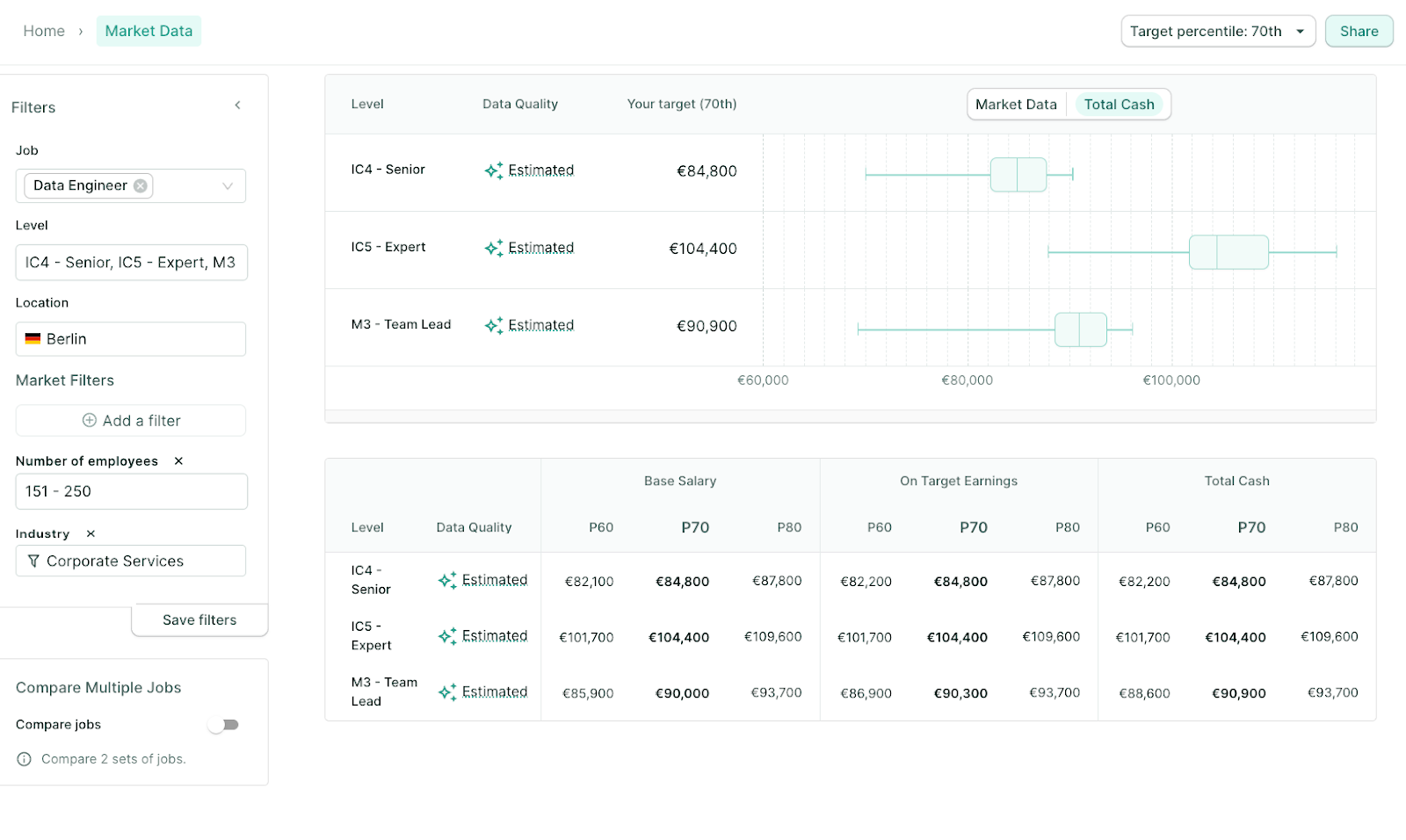
Use reliable, multi-market compensation data to benchmark your roles. For a 200-person company hiring across Germany, France, and the UK, you need market data that reflects geographic differences, industry norms, and role-level expectations.
Generic salary surveys won't cut it. You need data that's recent, market-specific, and detailed enough to benchmark against companies of similar size.
This is where Figures can help. Thanks to some additional power from Mercer, you can pull from 3.5 million data points to benchmark your salary ranges against the market.
Step 3: Document and justify
The Directive requires pay to be based on objective, gender-neutral criteria. You must document these criteria before a challenge arises.
What counts as objective criteria:
- Skills and qualifications required.
- Physical or mental effort demanded.
- Responsibility and decision-making authority.
- Working conditions (travel, shifts, etc.).
What doesn't count:
- Years of service alone.
- Negotiation skills.
- Previous salary history.
- "Cultural fit" assessments.
Document how each factor influences your ranges. When an employee questions a gap, you'll need specifics, not generalities.
Step 4: Operationalise your strategy
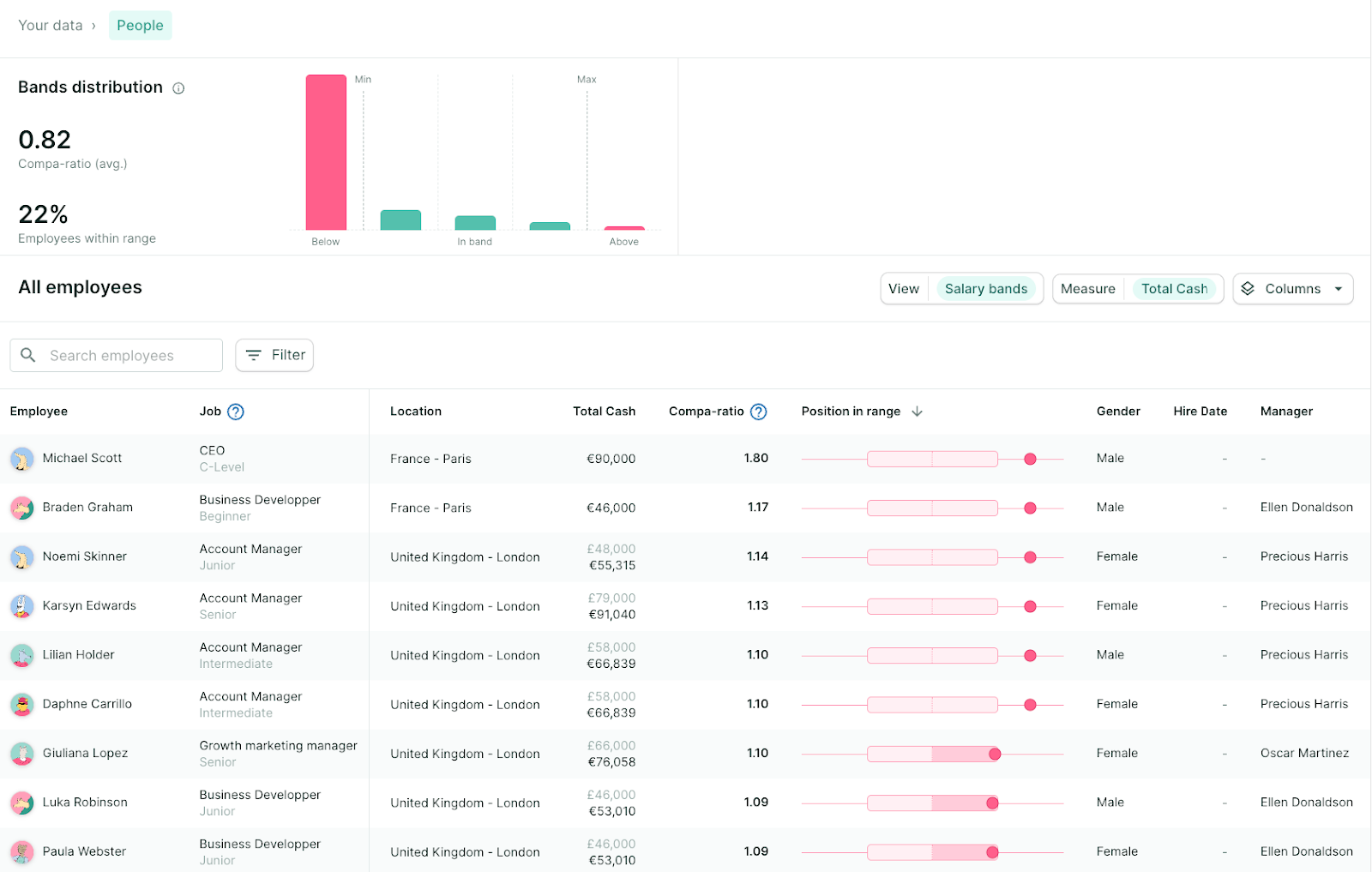
Use a central platform to manage, document, and embed your compliant salary ranges directly into your HRIS, ensuring consistency across all EU markets.
Spreadsheets won't scale when you're managing different disclosure requirements in Ireland, Poland, and the Netherlands. Figures' compensation management platform connects your pay structure to over 30 HRIS systems. You can review salary bands, see who's up for comp reviews, and how an employee's salary shapes up to similar roles.
Step 5: Develop an internal communications strategy
Prepare your existing employees for the shift. When you start posting salary ranges publicly, your current employees will notice. Some will realise they're being paid below the advertised range.
Your managers need ready answers for:
"Why are you advertising my role at €55,000-65,000 when I only earn €52,000?"
"That's a fair question. Our salary ranges reflect what we'd pay someone entering that role today based on current market data. Your current salary was set when you joined in [year] based on market conditions then. Let's schedule time to discuss your progression and whether an adjustment makes sense based on your performance and time in role."
"Can I see what everyone else in my department earns?"
"Under the new regulations, you have the right to request average pay information for roles comparable to yours, broken down by gender. You won't see individual salaries, but you can understand whether pay is equitable. I can walk you through the process to request this information from HR."
"How do I request a pay review based on this information?"
"Let's start by reviewing your current role level, responsibilities, and performance. Then we can look at where you sit within the range for your position and discuss what progression looks like. I'll set up time for us to have that conversation properly."
Compensation management platforms like Figures can be a great help here, as they enable HR teams to answer questions with accurate data. Something Slimmer AI found out.
They moved from 30+ hours of manual benchmarking to defining compliant salary bands in under two hours. More importantly, having trusted data allowed them to confidently hold "compensation sessions" to educate their entire team on how pay is determined.
"We aim to be transparent about pay," explains Elsa Berg, People Lead at Slimmer AI. "It's important to educate your team to know what an increase in compensation entails."
From mandatory disclosure to strategic advantage
The shift to pay transparency is inevitable. The real work isn't just posting a number in an ad; it's proving that the number is fair, equitable, and based on objective criteria.
Don't wait for June 2026. Start building your objective, documented, and compliant pay structures today.
After all, the companies that treat transparency as a strategic advantage rather than just another compliance burden have the most to gain. With that in mind (and sorry for beating a dead horse), post your salary ranges on your job ads!
And if you're serious about fair compensation and transparency, see how Figures helps you operationalize pay transparency and manage your compensation structure across every market. Book a free demo to get started.

Summarize this article with AI
No time to read it all? Get a clear, structured, and actionable summary in one click.




.avif)
.avif)

