The EU Pay Transparency Directive sets new standards for pay transparency across Europe, but the practical rules depend on how each Member State transposes it into national law.
Slovakia has now transposed the Directive, turning those broad requirements into concrete rules employers need to follow. In fact, Slovakia is the first of the 27 Member States to fully transpose the Directive into final, in-force legislation, ahead of most others, which remain at draft stage or have only partial measures in place.
Below, we break down what Slovakia's law says, where it adds country-specific detail, and what employers should pay close attention to when preparing.
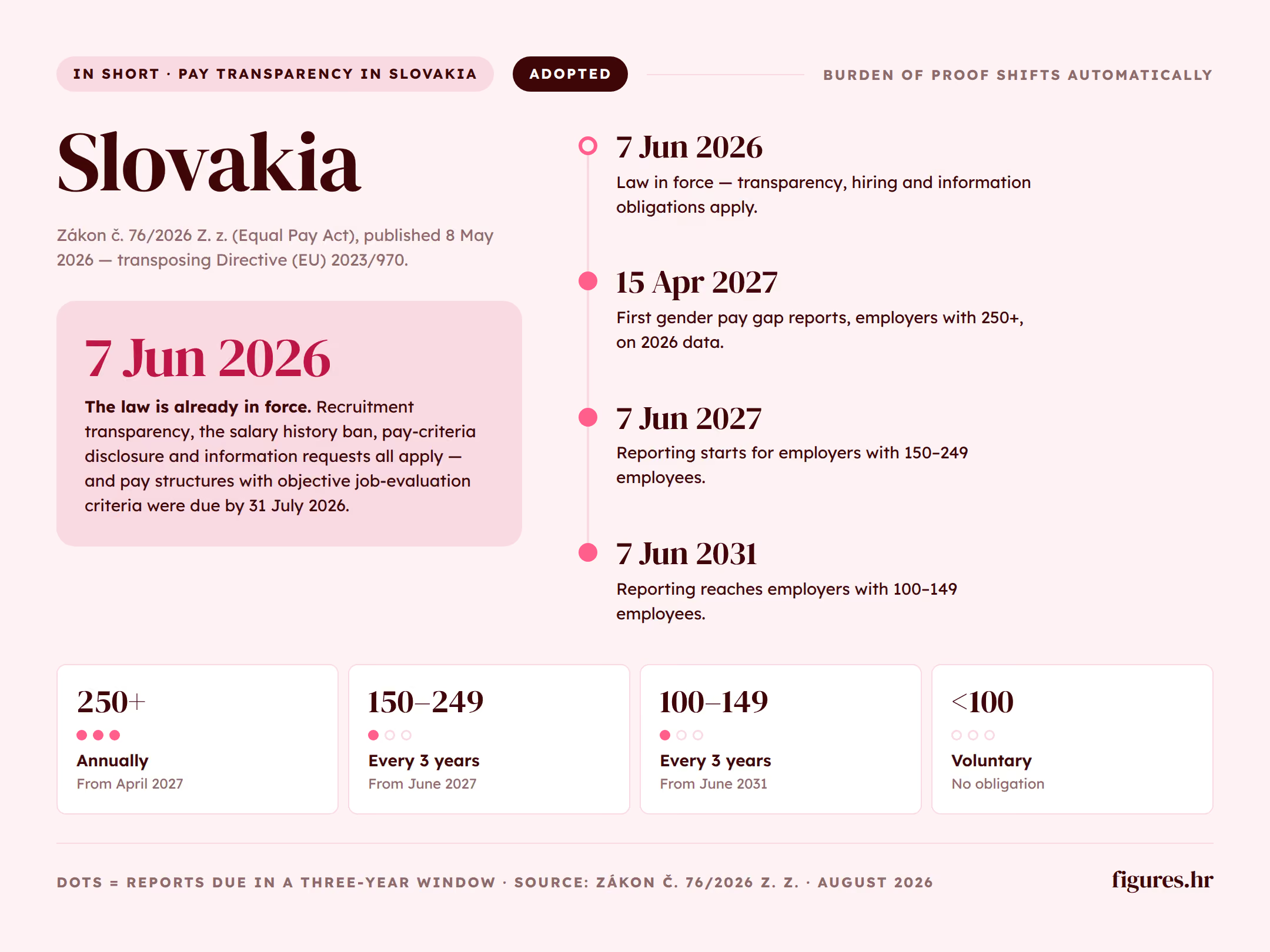
Transposition status in Slovakia at a glance
Slovakia's pay transparency law in detail
Slovakia has transposed the Pay Transparency Directive through the Equal Pay Act, in force since 7 June 2026. The law applies to public and private employers and explicitly pulls judges and prosecutors into scope, while excluding state employees in functions elected by Parliament or appointed by the President or Government.
Administrative fines (€4,000–8,000) apply only to breaches of the reporting duty, after a Ministry-set remediation period of at least 15 days, within a two-year limitation window. Breaches of the transparency, disclosure or information-request obligations carry no equivalent fine: instead, the burden of proof shifts automatically to the employer once a breach is shown, even without the employee pointing to facts suggesting discrimination, unless the employer proves the breach was clearly unintentional and minor. Compensation claims have a three-year limitation period.
Analysis: What Slovakia's law means in practice
Employers in Slovakia now need to adapt their pay practices to meet the new rules: and because Slovakia's law is already in force, they have less runway than employers in most other Member States. Four areas deserve especially close attention: the burden of proof, scope, the information-request process and a few points still pending clarification.
1. Employers face an automatic, stricter burden-of-proof shift than the Directive requires
Under the Directive, an employer's non-compliance with transparency obligations is only an aggravating factor a Member State may take into account once a worker has already shown facts suggesting discrimination.
Slovakia goes further. If an employer breaches its obligations on job-ad transparency, pay-criteria disclosure, the right to information, reporting or joint assessments, the burden of proof shifts to the employer automatically: even if the employee has shown no facts suggesting discrimination: unless the employer can prove the breach was "clearly unintentional and minor."
This raises the stakes on a decision that looks administrative on its face: how employers group employees into "categories" of equal work or equal value. The law leaves that grouping to the employer, using objective criteria, but doesn't prescribe a minimum number of categories or a methodology. In practice, an employer that can't produce a documented, objective rationale for its categories is exposed the moment a pay-information request or report surfaces a gap.
2. Enforcement runs on two tracks: fines for reporting failures, civil liability for everything else
Administrative fines under the Slovak law are narrow: they apply only to failures of the gender pay gap reporting duty, are fixed at €4,000–8,000, and only bite after a Ministry-set remediation period and within a two-year window.
Breaches of the recruitment-transparency, pay-criteria disclosure, right-to-information or joint-assessment provisions carry no equivalent administrative fine. Instead, they expose employers to civil liability: including the automatic burden-of-proof shift described above and compensation claims with a three-year limitation period. For employers, this means the reporting obligation is the one with a clear regulatory price tag, while the day-to-day transparency obligations carry open-ended litigation risk instead.
3. The right-to-information process builds in a privacy safeguard for small comparison groups
As under the Directive, Slovak employees can request their own pay level and the average pay level by gender for their category of equal work. Slovakia adds a specific safeguard: if disclosing that average would reveal one specific colleague's pay, access is restricted to worker representatives, the Labour Inspectorate or the Slovak National Centre for Human Rights, rather than the requesting employee directly.
Employers must respond within two months, and within 30 days if the employee asks for further explanation of an inaccurate or incomplete answer. Employees must be reminded of this right once a year, and any contractual clause requiring pay secrecy is void: though employers can still require confidentiality around the average category figure itself, just not an individual's own pay.
4. Two open questions still need Ministry clarification
Slovakia's law imports the Directive's "single source" concept for comparing employees across different employers, but doesn't define which corporate or organisational structures qualify: group companies, franchise networks and shared public-sector bodies are all left open. The Ministry's analytical tools and methodologies, due by 30 June 2026, may settle this.
Separately, the Directive expects a single designated monitoring body. Slovakia instead splits the function across three bodies: the Ministry of Labour (awareness, data publication, joint-assessment processing), the Slovak National Centre for Human Rights (confidential access, worker advice) and the Labour Inspectorate (enforcement access). It isn't yet clear whether this distributed model satisfies the Directive's expectations.
Key preparation steps for employers in Slovakia
Slovakia's law is already in force, and the first reporting deadlines land in 2027: sooner than in most other Member States. If you have not yet started preparing, focus on these steps first:
- Put your pay structure and objective, gender-neutral job-evaluation criteria in place (due 31 July 2026 for employers already operating before 7 June 2026).
- Document how you group employees into categories of equal work or equal value, and keep the rationale on file: this is your main defense given the automatic burden-of-proof shift.
- Update job adverts and titles to be gender-neutral and to include starting pay or pay-range information.
- Remove any process step that asks candidates about their current or previous pay.
- Make pay-setting and pay-level criteria accessible to all employees, and prepare pay-increase criteria if you have 50 or more employees.
- Build a process to respond to individual and average pay-level requests within two months, and to remind employees annually of this right.
- Review contracts and remove any pay-secrecy clauses.
- Map your headcount against the reporting thresholds (250+, 150–249, 100–149) to confirm which deadline applies to you.
- Watch for the Ministry's methodology guidance, due 30 June 2026, before finalizing any cross-entity or cross-employer pay comparisons.
Learn more about the Pay Transparency Directive
Pay transparency preparation will look different from one country to the next. For employers operating across several markets, Slovakia is one part of a wider country-by-country compliance picture.
To see how other countries are handling pay transparency, head to our full guide.
Ready for the Directive? We help you build a compensation policy you can explain to your teams, your candidates, and regulators.
Ask a demo