As of July 2026, Greece joined the first handful of EU Member States to fully transpose the EU Pay Transparency Directive into national law. The Greek law gives employers a clear set of rules and a relatively short window to prepare, with many core obligations applying from 1 November 2026.
Employers will need to look beyond reporting and ensure the systems supporting it are ready for scrutiny, from pay structures and worker categories to recruitment processes and employee information requests.
Below, we break down what the Greek law requires, the country-specific details employers need to know about and what they should prioritise first.
Transposition status in Greece at a glance
Greece’s pay transparency law in detail
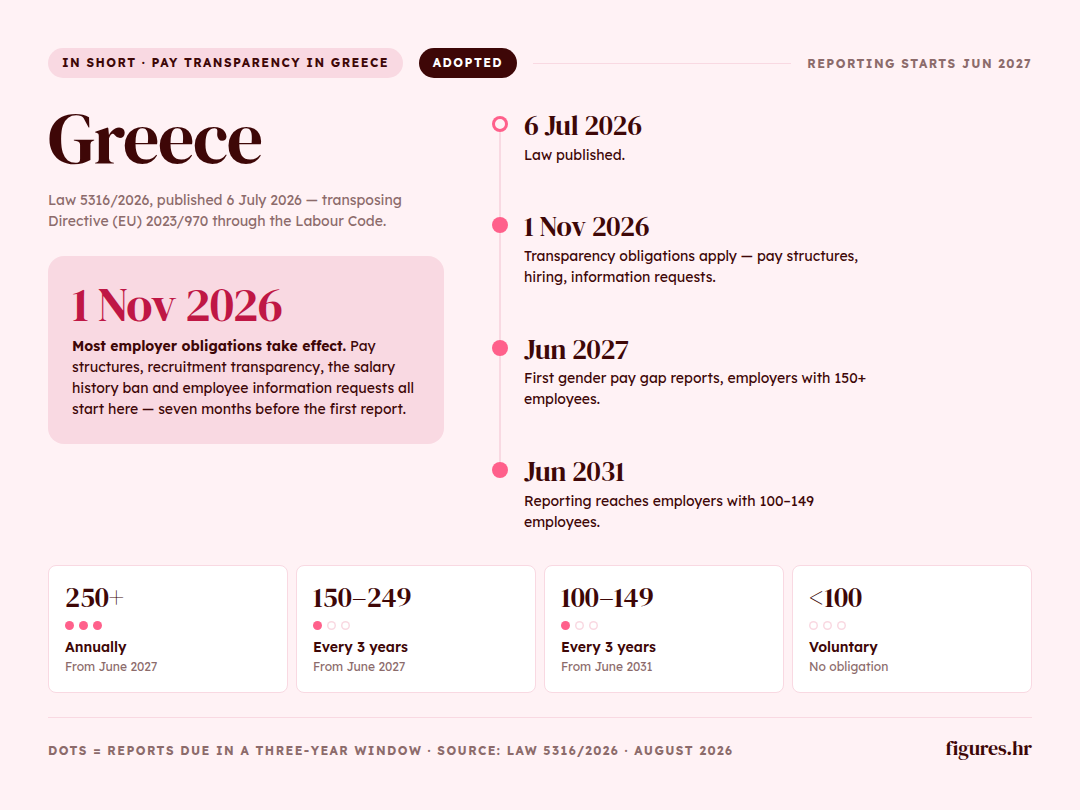
Greece has implemented the EU Pay Transparency Directive through amendments to the Labour Code. Most employer obligations take effect from 1 November 2026, giving organisations a relatively short period to prepare. Here's what employers need to know.
Analysis: What Greece’s law means in practice
Greece’s law largely follows the Directive, with implications across several connected parts of an employer’s compensation process. Here are the main practical priorities for employers.
1. Employers need documented, objective pay structures before reporting starts
The first gender pay gap reports from Greek employers will be due in June 2027. But the main transparency obligations take effect earlier, from 1 November 2026. These include a requirement to maintain written, reviewable pay structures based on objective, gender-neutral criteria such as skills, effort, responsibility and working conditions.
These structures aren’t just important for reporting. They’ll also shape how employers set and explain pay, assess work of equal value, respond to employee information requests and justify progression decisions.
Employers that still rely heavily on manager discretion, inconsistent salary-setting practices or criteria that aren’t properly documented will have a fair amount of work to do before the law takes effect. And since the same structures will underpin future reporting, this isn’t something to leave until the first reporting deadline is around the corner. Greek employers that haven’t started reviewing their pay structures yet should make this a priority now.
2. Worker categories will underpin several different obligations
A lot of the new obligations in the Greek law depend on one thing: how employers group comparable roles. Employers will need to define categories of workers doing the same work or work of equal value, using objective, gender-neutral criteria such as skills, effort, responsibility and working conditions. Where an appropriate collective agreement already defines these categories, employers can use those instead.
These categories will become the backbone of several different obligations, including:
- Employee pay information requests
- Gender pay gap reporting
- Comparisons of equal work or work of equal value
- Joint Pay Assessments
Employers with a strong job architecture may have a head start, but categorising workers based on work of equal value will still take careful assessment. Those with inconsistent job titles, descriptions or levels are likely to have more groundwork to do. Getting this right early should make the wider compliance process easier to manage.
3. Reporting will require total-compensation data, not just base salary
Greek employers will need to look beyond base salary when preparing their gender pay gap reports. The law requires them to report both gross annual and gross hourly pay, taking into account the full range of compensation employees receive.
That includes:
- Base salary
- Bonuses and variable pay
- Allowances
- Benefits in kind
- Other supplementary pay
This data will also need to be handled consistently for part-time workers and temporary agency workers. For some employers, that may mean bringing together data that currently sits across separate payroll, HR and benefits systems.
And reporting is only the start. If the results lead to a Joint Pay Assessment, employers will need to investigate the gaps and correct any unjustified differences. Greece goes further than the Directive here by setting a specific deadline: corrective measures must be completed within one year of the assessment being communicated.
4. Employers need a process for responding to formal pay disputes
The Greek law sets out a formal process for handling equal-pay disputes through the Labour Inspectorate. As part of that process, employers may need to provide the criteria they use to set pay, along with pay data for relevant comparators. The Greek Ombudsman, the country’s independent equality body, can also issue a reasoned opinion and support workers in exercising their right to pay information.
In practice, pay disputes are likely to become much more evidence-based. It won’t be enough for an employer to say that a pay difference is justified: they’ll need to show which criteria were used, how they were applied and why they led to a particular outcome.
That means employers will need clear internal ownership and reliable documentation. HR, managers and legal teams may all need to contribute, so it’s worth deciding in advance who will gather and review the information. Employers sanctioned for equal-pay violations may also be included in a public registry, meaning there’s also a reputational risk at play.
Key preparation steps for employers in Greece
Most of Greece’s new pay transparency obligations take effect from 1 November 2026, giving employers only a short period to prepare. Here’s where to focus first:
- Review pay structures and document objective, gender-neutral criteria.
- Define categories for equal work or work of equal value.
- Align job titles, levels and salary bands with those categories.
- Map total compensation, including bonuses, allowances and benefits in kind.
- Check that annual and hourly pay can be calculated consistently, including for part-time and temporary agency workers.
- Update recruitment processes and remove salary history questions.
- Create a process for annual employee reminders and written pay information requests.
- Decide who will handle cases involving the Labour Inspectorate or Greek Ombudsman.
- Document pay decisions and any exceptions clearly.
- Prepare for Joint Pay Assessments and Greece’s one-year correction deadline.
Learn more about the Pay Transparency Directive
Greece's law closely follows the EU Pay Transparency Directive, but employers have relatively little time to prepare. Organisations that start reviewing their pay structures, worker categories and compensation data now will be in a much stronger position to comply with the new requirements and explain pay decisions with confidence.
For a broader overview of the Directive and how it’s being transposed in different countries, head to our full implementation guide.
Ready for the Directive? We help you build a compensation policy you can explain to your teams, your candidates, and regulators.
Ask a demo