Key points:
- Lack of progression is the top reason employees quit. 63% of workers who left their jobs cited no advancement opportunities as their primary reason for leaving.
- A complete framework has four components. Job levels, competency definitions, evaluation criteria, and career path maps – skip one and the whole structure breaks down.
- Levels without pay ranges are just labels. Every level needs a salary band backed by real market data to make progression feel meaningful.
- The EU Pay Transparency Directive makes this a legal requirement. From June 2026, fair and objective job categorisation is mandatory, not optional.
When employees ask how to get promoted, and there's no documented answer, they leave. We’re not exaggerating when we say this. Pew Research found that 63% of workers who quit cited a lack of advancement opportunities, making it the single most common reason for walking out the door.
If that stat worries you, then this is the guide you need. It’s for HR leaders at UK and EU companies who need to build – or rebuild – a career progression framework that actually incentivises employees to stick with you.
You'll find a clear definition, the four structural components you can't skip, a seven-step build process, and guidance on connecting your framework to compensation so it means something. So, let’s get started.
{{ ai }}
What is a career progression framework?
A career progression framework is a structured system that maps every role in an organisation to defined levels, competency requirements, and clear pathways for moving upward, sideways, or diagonally. It answers three questions for every employee: where am I now, where can I go, and what do I need to do to get there?
Make no mistake; this isn’t a career development plan, which focuses on an individual's personal growth. Instead, a career progression framework is the organisation-wide structure within which a development plan sits.
Without one, things can get messy. Managers often have to make vague assurances that development opportunities exist (with no proof that they do, except from an occasional, inconsistent promotion). With no framework, employees won’t feel motivated. Everyone wants to feel like they’re building toward something.
‼️Before we continue, however, make sure you don’t fall into one of the most common progression traps there is: Manager by Default. That’s where the only chance at progression is to enter management, which isn’t the right move for every employee.
Spotify's "Steps" framework was designed specifically to fix this, giving individual contributors a way to grow their sphere of influence and compensation without ever taking on direct reports.
Oh, and if you’re not connecting your career progression framework to compensation, then you’re leaving more questions than answers. Employees want to feel properly compensated for their efforts. If you haven’t got a concrete number to go by, then your managers won’t either. And you don’t want managers guessing, because it can lead to pay equity issues and pay compression.
The benefits of career progression frameworks for employers
Organisations classified as "career development champions" outperform peers on both retention and profitability, according to LinkedIn's 2025 Workplace Learning Report. A visible growth path gives employees a concrete reason to stay, one that goes beyond their current salary.
Retention is only half of the story, however. Here's what a well-built framework does across the organisation:
- Enables better manager conversations: Gut feelings are no better than a bowel movement, especially when you’re having progression conversations with employees. And without a framework, that’s what most of these conversations come down to. With a framework, though? Managers stop making promises they can't keep, and employees stop hearing "you're doing great, just keep it up."
- Creates consistency across teams: Calibration sessions prevent equivalent roles in different departments from having different promotion timelines. The kind of inconsistency employees notice fast and talk about.
- Supports EU compliance: The EU Pay Transparency Directive (June 2026) requires fair, objective job categorisation. A career progression framework is the structural foundation that makes compliance possible.
🤔 A quick note about retention: it’s a huge cost-saving measure, too. That’s because the cost of replacing employees can cost up to nine months of their annual salary (even more for C-suite employees). That means if you’re trying to reduce HR costs, you’re going to want your employees to stay put.
Components of a complete career progression framework
Every career progression framework, regardless of company size or industry, is built on four structural pillars. And if you skip one of these pillars, your framework will tumble. So, make sure you consider each component carefully!
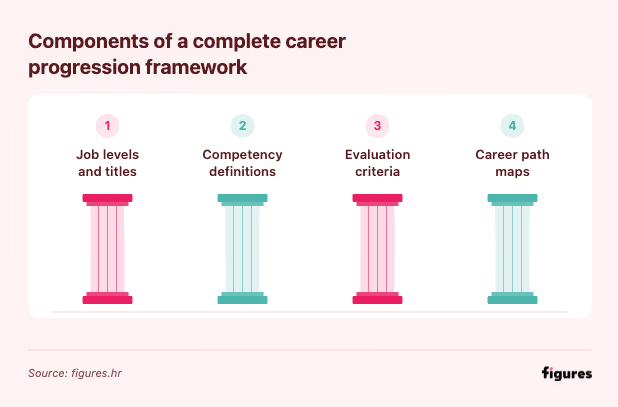
Job levels and titles
A standard hierarchy runs five to eight levels: Entry → Junior → Intermediate → Senior → Staff/Lead → Director → VP → C-Level. The exact number depends on your headcount and complexity.
You can use a simple levelling framework with four IC and four management levels for companies with up to around 250 employees, while the Advanced framework adds more granularity for larger organisations.
Additionally, you’ll want to standardise titles across departments, so the same level code applies to equivalent roles, even when the job titles differ. A Senior Engineer and a Senior Product Designer should sit at the same level if the scope of their work is comparable.
🤔 Many UK and European tech businesses carry what's sometimes called "title debt"; people with inflated titles from early-stage hiring, when "Head of" was handed out to the third employee. A new framework is a natural moment to reset this, handled transparently and with clear communication about what the new levels mean.
Competency definitions
These are the observable behaviours expected at each level, organised by dimensions like scope, impact, autonomy, and expertise. Vague descriptors ("great communicator", "team player") don't belong here, though they can be indicators for competency. Instead, think of factors like specialist training or knowledge, problem-solving skills, and leadership capabilities.
If a manager can't point to a specific example in a calibration meeting, it's not a useful competency.
Evaluation criteria
Sub-level models – where employees progress through 33%, 66%, and 100% competency thresholds before a formal promotion – give visible progress signals between reviews. It gives legitimacy to moving employees onto the next level, and removes the guesswork from managers.
Career path maps
This is where the dual-track model comes in: parallel paths for individual contributors and managers, with genuine parity in compensation potential, number of levels, and organisational status.
Cornell University research found that lateral moves are associated with higher compensation growth over time. A good reminder that career path maps should make sideways movement look as appealing as upward movement.
Building a career progression framework in 7 steps
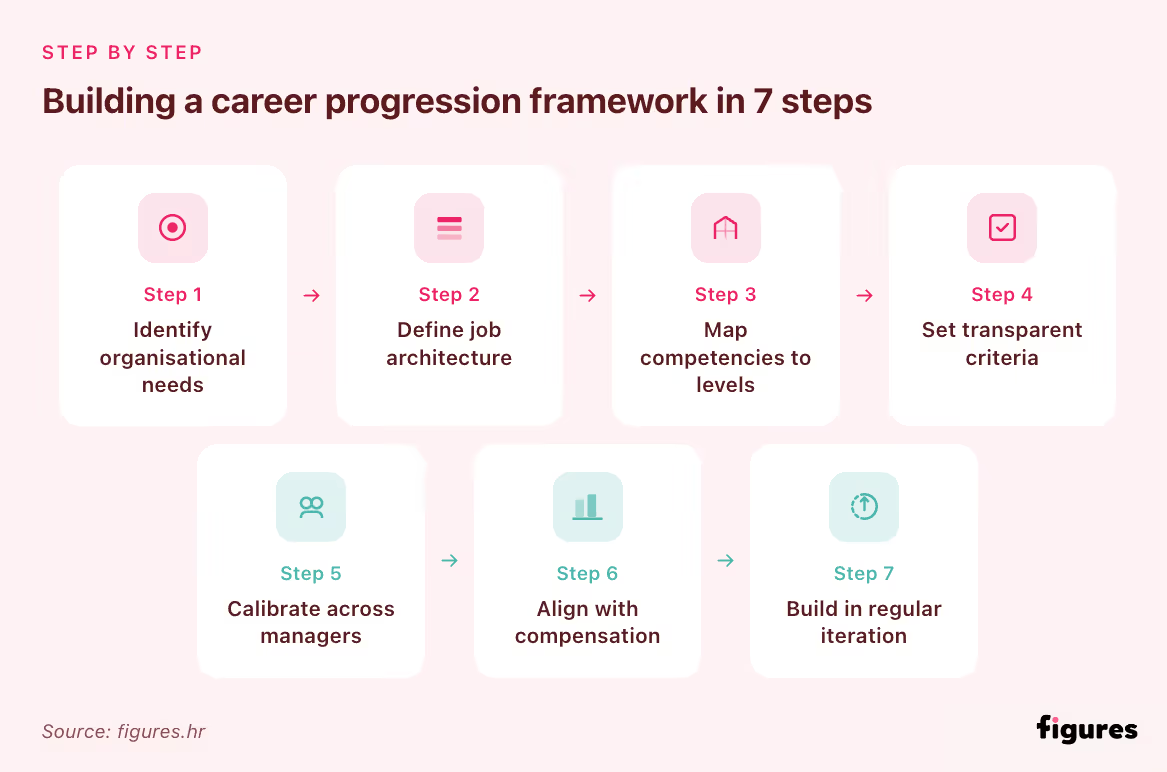
Knowing what a framework should contain is one thing. Actually building it is another. Here's a practical sequence that works whether you're starting from scratch or overhauling something that's quietly stopped working.
Step 1: Identify your organisational needs and goals
Start with the problem you're trying to solve. Is attrition spiking in one team? Are managers struggling to justify promotions? Are you preparing for EU Pay Transparency compliance? Naming the problem tells you which roles to tackle first, and starting with one job family is always better than trying to cover the entire organisation at once.
Step 2: Define your job architecture
Group roles into job families, establish your level hierarchy, name each tier, and decide whether to build parallel IC and management tracks from the start. If you need, there are free levelling templates – Simple and Advanced – which are excellent practical starting points you can duplicate and adapt rather than building the structure from a blank page.
Step 3: Map competencies to each level
Define specific, observable behaviours for each level. Focus on scope of impact, autonomy, and expertise rather than years of experience. Tenure is a proxy, not a measure of actual performance.
Step 4: Set transparent progression criteria
Outline the measurable goals required to move between levels. Employees should be able to see exactly what's required before they're assessed. Not find out after they've been passed over. Transparency (one of our favourite concepts here) is the name of the game. Employees should be able to trust your framework rather than feel it’s rigged against them.
Step 5: Calibrate across managers
Have each manager level their direct reports independently, then cross-check in calibration sessions. This step is what prevents two people doing equivalent work in different teams from landing on different levels. This is definitely something you want to avoid before you start reporting for the Transparency Directive.
Step 6: Align with compensation
Connect each level to a salary band using current market data. A level without a pay range attached is just a label. Don’t worry, we’ll cover this shortly. We won’t leave you high and dry, trying to figure out what makes an acceptable compensation package…
Step 7: Build in regular iteration
Add a review cadence to your HR calendar from day one. The framework will need to be updated as roles change and headcount grows. Aim to review annually at a minimum, and every six months if you're in a rapid growth phase.
Connecting your framework to salary bands and market data
Frameworks without salary band connections are just that – a framework without anything solid holding it together.
A promotion without a clear pay expectation feels hollow. Employees who can see exactly what they need to do to reach the next level, but have no idea what that level pays, are still left guessing about something that matters enormously to them. The framework only becomes real when compensation is attached to it.
Building actually rewarding salary bands can be rough, however. Especially if you’ve got nothing to actually go on. That’s why we recommend basing them on actual market data.
How to anchor each level to market data:
- Set a market midpoint for each level: Use external benchmarking data to establish what the market pays for that level of role. This becomes the centre of your salary band.
- Define your range spread: Most bands run roughly 80–120% of the midpoint, giving room for differences in performance and tenure within a level without requiring a promotion every time someone grows.
- Map your existing employees to their bands: Some will sit below the band minimum (underpaid), some above the maximum. Raise underpaid employees promptly, as leaving someone below band after you've made it visible is a fast way to lose them. For those above band, commit to a transparent plan for smaller future adjustments rather than silence.
‼️ From June 2026, the EU Pay Transparency Directive requires employers to provide pay range information and use fair, objective job categorisation methods. With this, your compensation-linked career framework has now turned into a compliance requirement.
This is exactly where Figures' Salary Bands module earns its place. It benchmarks each level against Mercer data, which covers over 3.5 million data points, and automatically generates salary ranges by job, location, and seniority.
What would otherwise require a third-party consultancy and a months-long project becomes something your HR team can manage directly, with live market data rather than annual survey snapshots.
Rolling out to existing employees and keeping the framework alive
Building the framework is the easier half. Rolling it out to people who already have titles, expectations, and salary histories… Well, that's where things get genuinely tricky.
A two-stage approach works best. First, managers calibrate independently, levelling their direct reports, then cross-checking with peers in structured calibration sessions. Once that's done, managers have individual conversations with each employee, walking them through where they've landed and why.
Those conversations will likely surface some uncomfortable realities. But transparency goes a long way to maintaining relationships between employees and the business, alongside solutions on how you’re going to fix these issues.
Once it's live, keep it alive. A framework that isn't embedded into existing processes will quietly die within a year. Tie it to:
- Performance review cycles.
- Regular 1:1s between managers and direct reports.
- Salary calibration and compensation review seasons.
Make sure to measure its performance too! Track retention rates before and after implementation, internal promotion frequency versus external hiring, the percentage of employees sitting within their salary band, and engagement survey scores over time. If you’re not seeing marked improvements, head back to the drawing board.
One more thing worth measuring: your adjusted gender pay gap, before and after implementation. Moving from discretionary raises to band-based progression naturally reduces the pay discrepancies that build up when negotiation behaviour varies between individuals. A well-run framework is one of the most effective structural tools for closing that gap.
Your next steps for building a framework that lasts
You don't have to get everything right at once. Start with one team, one job family, and a clear level structure and then expand. The hardest part isn't the build itself; it's making compensation feel as structured and defensible as the levels it sits beneath.
When employees can see not just what's expected at each level but what it pays, the framework stops being an HR document and starts being something they actually use. And if you want to see what that can look like for actual companies, take a look at some examples below.
Swan achieved 100% of employees within their salary bands. Welcome to the Jungle built theirs from scratch and gave managers a shared language for compensation conversations they'd never had before – both using Figures' Salary Bands module to benchmark each level against live Mercer data.
Ready to see how it works? Book a free demo.
FAQs about career progression frameworks
Do small companies need a career progression framework?
Even at 50 employees, inconsistent promotion decisions create retention risk. The framework's complexity should scale with your headcount. A 100-person company doesn't need eight levels, but it does need documented expectations and compensation clarity. Starting simple is fine, because it will always be better than never starting at all.
How often should a career progression framework be reviewed?
At a minimum, annually, ideally timed alongside your compensation review cycle so level definitions and salary bands get updated together. Companies in rapid-growth phases should reassess every six months, checking whether new roles have emerged that don't fit existing levels or whether market data has shifted enough to warrant adjusting band ranges.