Key points:
- Companies with 100+ employees must report gender pay gaps starting in 2027, covering 2026 data, with reporting frequency based on company size (annual for 250+, every 3 years for smaller companies).
- Reports must include detailed breakdowns: mean and median gaps, variable pay differences, quartile distributions, and gaps by categories of workers doing equal value work.
- The 5% trigger is serious: unexplained gaps exceeding 5% require joint pay assessments with employee representatives, with employers bearing the burden of proof to demonstrate no discrimination occurred.
- New hiring transparency rules: employers must disclose pay ranges before interviews and cannot ask candidates about salary history. Employees gain the right to request pay information for themselves and comparable colleagues.
- Your real deadline is now: first reports cover 2026 financial year data, meaning compensation data must be clean, categorized, and audit-ready before year-end 2026. Companies discovering gaps late won't have time to remediate.
The EU Pay Transparency Directive enforces "equal pay for equal work" by requiring employers with 100+ employees to report gender pay gaps. And it's not going to be a passive reporting – you need to implement active gap remediation, with joint assessments triggered when unexplained gaps exceed 5%.
But what does that actually mean for your business?
Should you report per country or as one entity? What counts as "pay"? How do you categorize workers doing "equal value" work when there's no official guidance yet?
You're not alone in this confusion. The first reports will start in 2027, but many HR teams are discovering that "compliance" is far messier than it sounds.
We think it's about time to clear up that mess. We'll walk you through who must report, which specific data points you need, how to calculate the numbers correctly, and what happens if your gap exceeds the 5% threshold. Most importantly, we'll show you how to start preparing now, before the deadline catches you off guard. Let's go.
{{ ai }}
Gender pay gap reporting in Europe: who must report
Let's start off clear. As of June 2026, gender pay gap reporting will be mandatory for all EU member states. But is your company required to report? And if so, how often? Check out the numbers:
- 250+ employees: Annual reporting from June 2027 (covering 2026 data).
- 150-249 employees: Every three years, starting June 2027.
- 100-149 employees: First report June 2031, then every three years.
Looks pretty simple, right? Well, yes, as long as you haven't got offices in multiple EU territories. 50 employees in an office in Marseilles, 100 in Berlin, and 30 in Dublin could be a headache when it comes to reporting, especially as there are no solid answers as to how you should calculate.
To complicate that further, the Directive is only really a baseline. Individual territories can make their own rules, which supersede wider EU rules. For instance, France already requires reporting for 50+ employees. Sweden keeps its 10+ threshold and adds parental leave analysis. Belgium's Wallonia-Brussels became the first to fully transpose the directive in September 2024.
The EU works through a concept called "subsidiarity" – each member state implements the Directive's baseline while tailoring it to their specific labour market realities. Yes, this creates some complexity for multi-country employers, but it also allows countries like France and Sweden to maintain their stronger existing protections rather than weakening them to match a common denominator.
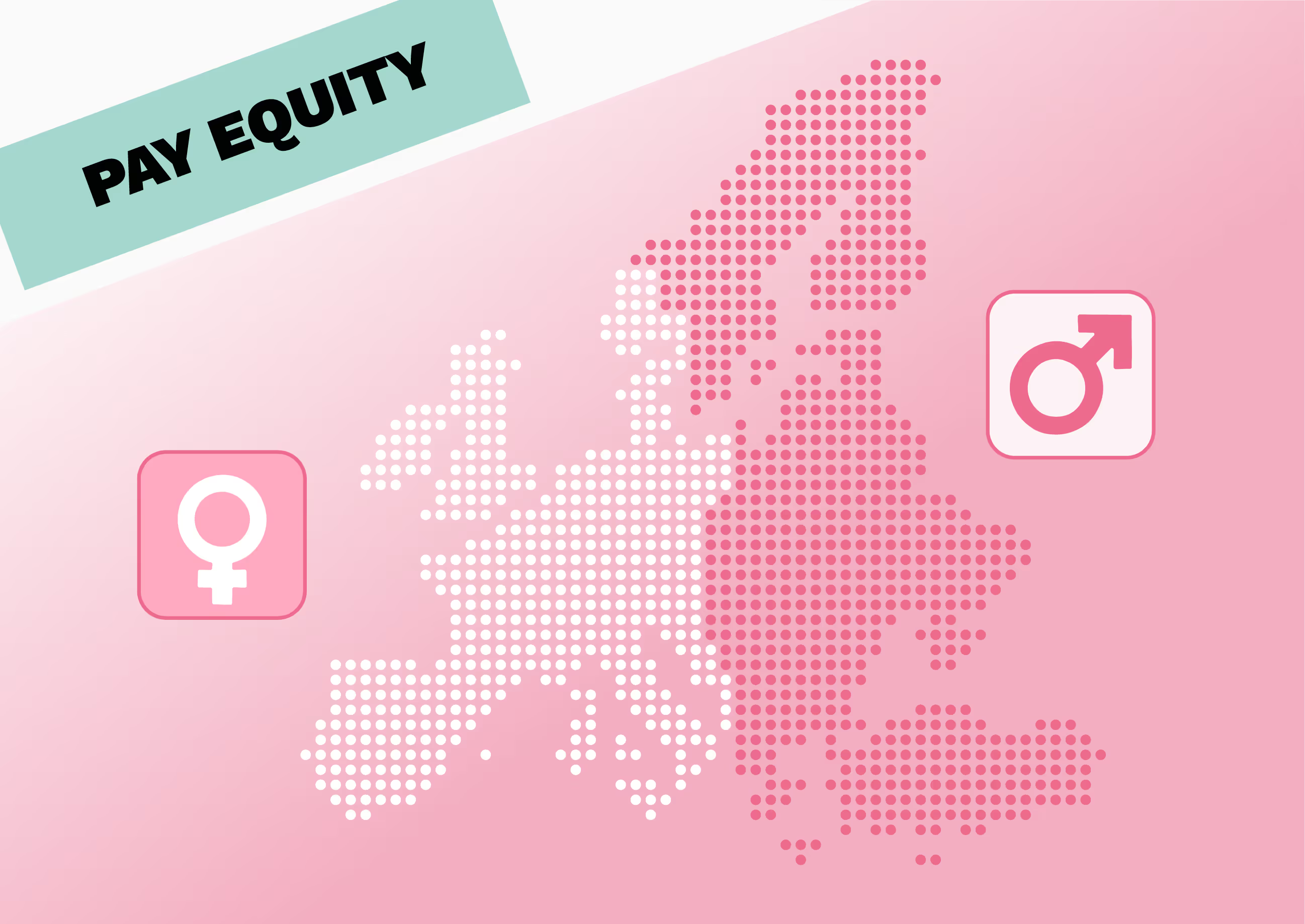
But given the EU gender pay gap stood at 12% as of 2023, ensuring that every country is legally obligated to address pay gaps is a noble pursuit, regardless of early confusion.
When is EU gender pay gap reporting due?
The legal deadline is June 7, 2026, but you won't have to publish a report on that date.
Your first reports are actually due in 2027, covering your 2026 financial year. This means your compensation data needs to be clean and categorized now. For those of you reading this in early 2026, you've roughly one compensation cycle to get everything right.
Now, if you're living in a country that's imposing its own version of the Directive (with stricter company limits or different reporting regulations), don't wait for it finalize the law. Start collecting data now and use the Directive's standards as a baseline. After all, gaps found late in 2026 are unlikely to be fixed by the time you actually need to deliver your report.
What needs to be included in your report
This is where it gets technical. The Directive doesn't want a broad average of your company's gender pay gap; it wants nuance.
Required metrics:
It gets a little more difficult when you need to consider who to include in your reports and who counts as a worker.
The definition is broader than you think:
- Full-time employees ✅
- Part-time employees ✅
- Trainees and apprentices ✅
- Genuine freelancers ❌
The hardest part? Defining "categories of workers" doing work of equal value. You'll need solid job architecture to group roles by skills, effort, responsibility, and working conditions – not just job titles.
🤔 Without proper job architecture, you're essentially guessing at categories. Figures' Pay Equity module automates these calculations using pre-filled EU templates, saving weeks of spreadsheet work and ensuring you group workers correctly from the start.
{{ cta }}
The 5% trigger and joint pay assessments
Discovering a gap higher than 5% isn't always a huge problem… as long as it's actually justified.
If it's not, then you must conduct a joint pay assessment with employee representatives. It might be extra work, but don't view this as a negative. Instead, consider it the first step in fixing pay gaps and making your company a better place to work.
What "joint" actually means
No, it's not a form of compensation for workers at specialist cafes in Amsterdam.
Instead, you're working alongside union reps or elected worker representatives (which is why it's a joint assessment) to dig into the root causes of your pay gap and create a remediation plan in order to close it.
Unfortunately, most member states haven't published frameworks for how to actually do this, which means companies are flying blind. This is especially frustrating, given you only have six months to deliver results.
🤔 Keep in mind, your remediation plan has to include an action plan to close the gap (which needs to be put into action), but also ensure that there are safeguards in place to prevent those gaps from opening again.
Not sure how to do that? Check out our detailed guide on building remediation strategies that close disparities for good!
Burden of proof and other risks
This is the real teeth of the directive. You must prove discrimination didn't occur; not wait for employees to prove it did. The burden of proof is entirely on the employer, so if you do have a gap exceeding 5%, you'd best have a good reason.
Especially as reports must be published and available to the public. Large gaps and poor excuses could completely ruin you in the public sphere. News spreads quickly; prospective employees will be looking elsewhere, and you should expect similar behaviour from existing employees too.
Scuffed reputations aren't your only problem, either. You'll likely receive a penalty, which can vary by country but is designed to be "effective, proportionate, and dissuasive." Translation: expensive enough to hurt.
Beyond reporting: what else changes for employers
The directive doesn't stop at annual reports. It fundamentally reshapes how you hire and communicate about pay. So, let's start with new hiring rules:
- Mandatory disclosure of pay range: You can either include pay ranges in job ads or in interview invitation emails. As long as it's disclosed before the initial interview.
- Pay history is private: You're forbidden from asking candidates to disclose what they were paid in prior roles.
‼️ Member states are implementing these differently. Ireland proposes mandatory salary ranges in all job postings. The Netherlands only requires disclosure before the first interview. Both comply with the directive but impose different practical requirements on multi-country employers.
Employee information rights
Workers can now request:
- Their individual pay level.
- Average pay levels for colleagues doing the same work.
- The breakdown by gender for their category.
"Most companies aren't prepared for the cultural shift this creates because it goes way beyond just having the data. Instead, it forces managers to have honest conversations when employees ask why their colleague earns more or why they're offering below-average compensation to potential candidates."
– Virgile Raingeard, CEO at Figures
Additionally, you'll need to provide concrete pathways for progression. Criteria for raises and promotions must be objective and gender-neutral. This means documenting your decision-making process, not just the outcomes.
💡 Did you know that with Figures, your employees get an automated email when they request pay information? It includes the current position, determination criteria, company-wide context, and other useful information – all without HR or manager involvement.
{{ cta }}
The impact on UK employers
The directive applies to EU entities only. However, if your UK-based company has 100+ employees in the EU, you must comply.
And if you're going to offer transparency to those outside of the UK, it'd be pretty dubious not to offer the same to your UK teams. Even if you're not legally required to, given how lax UK requirements are in comparison.
How UK requirements compare
The UK's current gender pay gap reporting focuses on company-wide averages with a "name and shame" approach: companies are legally required to publish their reports… but not much else. No joint pay assessments or obligations to close the gap. The British Bulldog bares its teeth, but it's just gums.
Compare that to the EU Directive, which:
- Requires action (joint assessments) when gaps exceed 5%.
- Covers specific worker categories, not just overall averages.
- Shifts the burden of proof to employers.
- Mandates salary range disclosure in recruitment.
And you'll wonder why the UK even has requirements in the first place.
🤔 The UK government recently abandoned its pay transparency pilot, possibly to observe the EU rollout before implementing similar requirements.
The conclusion? If you operate on both sides of the Channel, you'll likely adopt the stricter EU standards everywhere. Building two separate compensation systems rarely makes financial sense.
How best to prepare? Start now!
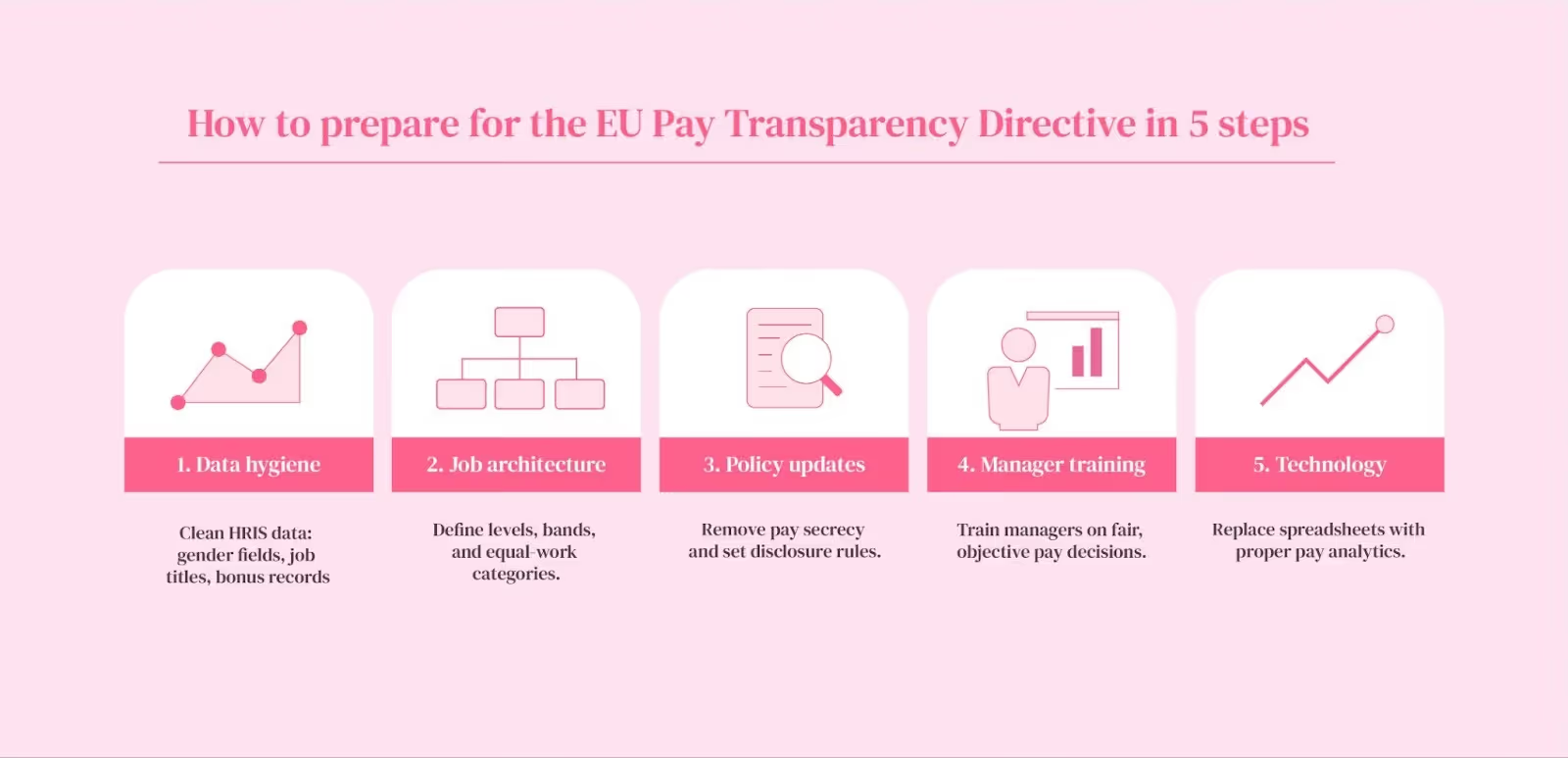
Don't wait for June 2026. The companies that struggle most are those treating this as a reporting exercise rather than a data quality project.
Your preparation roadmap:
Streamline compliance with Figures
Figures is built specifically for European companies facing the EU Pay Transparency Directive, combining real-time benchmarking with compliance-ready pay equity reporting:
- Automated directive compliance: Pre-filled EU templates calculate mean, median, and category-based gaps with built-in validation checks.
- 30+ HRIS integrations: Seamless connection to your existing systems eliminates manual data entry and reduces implementation time.
- 3.5 million Mercer data points: Enterprise-grade compensation intelligence without enterprise complexity.
- Three weeks saved per compensation review: Automated workflows replace Excel chaos with structured, audit-ready processes.
- Triple certification: The only platform with SOC 2 Type 2, ISO 27001, and GDPR compliance – critical for directive readiness.
You can get all of that in a relatively short turnaround time, too. Software implementation includes 1-4 dedicated onboarding calls, along with customer success support, ensuring that you can get Figures up and running in no time.
Built for mid-market European companies (250-5,000 employees) navigating multi-country compliance. You'll get access to industry-specific data with a focus on the tech industry (including SaaS, finance and banking, and consulting).
Book a free demo to see your current pay gap status and start preparing for June 2027 reporting.
Your path to June 2027
June 7, 2026, marks the transposition deadline, but your real deadline is now.
The first reports cover 2026 data. Companies discovering 5%+ gaps in late 2026 won't have time to remediate before their first submission.
When you prepare instead of doing panicked, last-minute work, you get clean HRIS data with consistent job categories, a clear job architecture for grouping workers doing equal value work, and capable managers trained on defensible pay decisions. And, as a nice bonus, they've stopped using spreadsheets for compliance work that requires audit trails.
Start with data, not deadlines. Understand where your gaps exist today, before regulators require you to publish them.
Book a free demo with Figures to see your current pay equity status and build your compliance roadmap.

Summarize this article with AI
No time to read it all? Get a clear, structured, and actionable summary in one click.