The EU Pay Transparency Directive sets new standards for pay transparency across Europe, but the practical rules depend on how each Member State transposes it into national law.
Italy has now transposed the Directive, turning those broad requirements into concrete rules employers need to follow. The law affects several parts of the pay process, from job adverts and salary history questions to employee information requests and gender pay gap reporting.
Below, we break down what Italy’s law says, where it adds country-specific detail, and what employers should pay close attention to when preparing.
{{ ai }}
Transposition status in Italy at a glance
Italy’s pay transparency law in detail
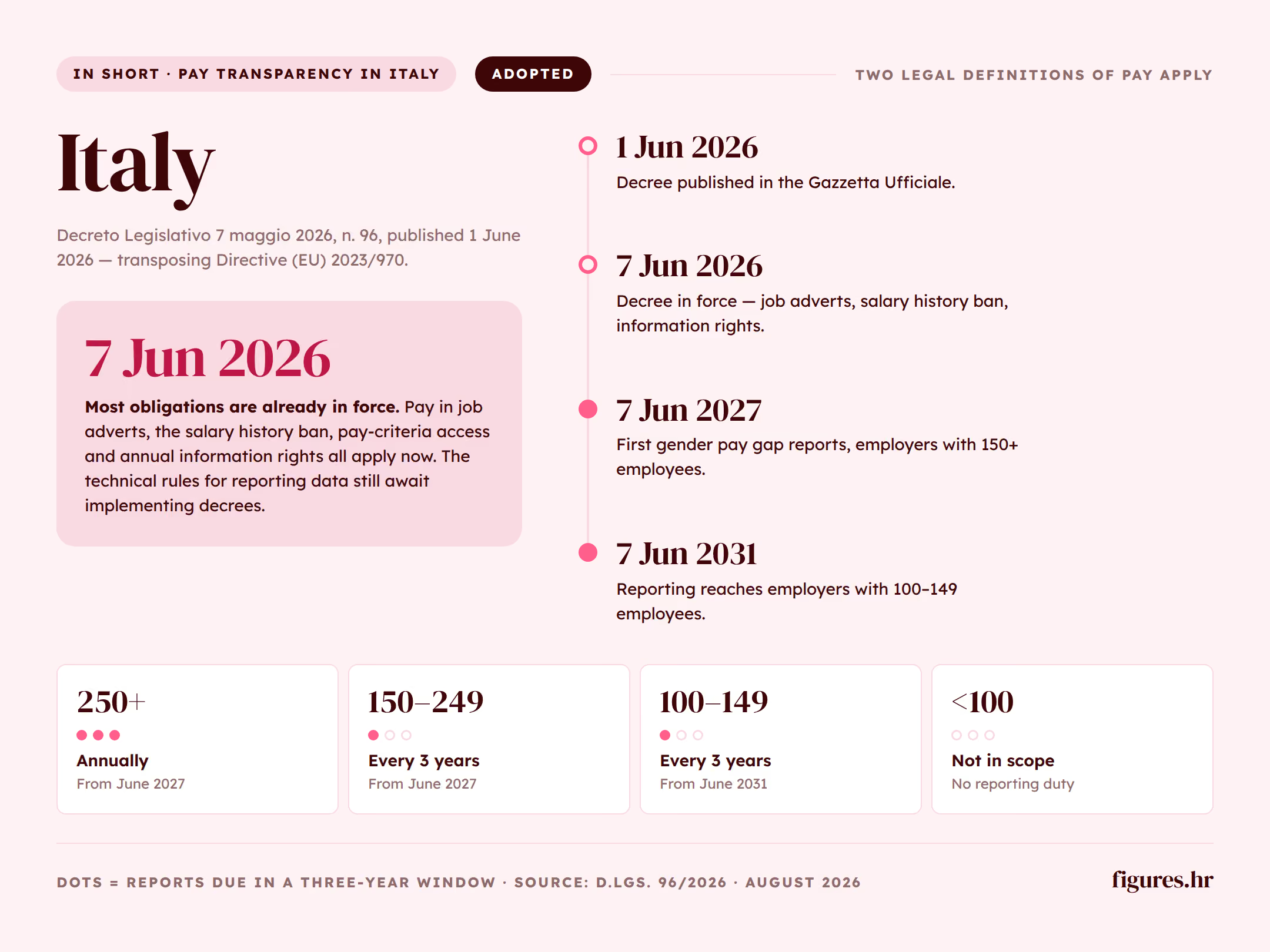
Italy has transposed the Pay Transparency Directive through Decreto Legislativo 7 maggio 2026, n. 96, published on 1 June 2026 and in force from 7 June 2026. The decree applies to public and private employers and covers subordinate employment contracts, including fixed-term, permanent and part-time contracts. Domestic work and intermittent work are excluded but agency workers do appear to be in scope for some obligations.
Analysis: What Italy’s law means in practice
Employers in Italy now need to adapt their pay practices to meet the new rules. Three areas deserve especially close attention: pay definitions, work comparisons and reporting data.
1. Employers will need to work with different pay definitions
Italy’s pay transparency law includes two separate definitions of pay: retribuzione (pay) and livello retributivo (pay level).
Retribuzione is the broader concept. It includes base pay plus variable, complementary and in-kind elements (e.g. bonuses, benefits and allowances). Livello retributivo is narrower and refers only to an employee’s fixed and continuous gross annual or hourly pay.
This is important because different obligations rely on different pay concepts:
For employers, the practical challenge is that “pay” cannot be treated as one single data point. To comply with the law, they will need to understand which pay definition applies to which obligation and create clear internal rules for classifying different pay elements.
2. Employers will need a clear process for employee pay information requests
The Pay Transparency Directive gives workers the right to request average pay levels, broken down by sex, for workers doing the same work or work of equal value. Employers must remind them of this right at least once a year. In Italy, employers must respond in writing within two months, and employees are limited to one request per year.
The Italian decree also includes a privacy safeguard for small comparison groups. If sharing average pay data would make another worker’s pay identifiable, the employer can disclose that information only to workers’ representatives, not directly to the requesting employee. In these cases, the workers’ representatives can advise employees based on the information they’ve received, but can’t share the data itself.
3. Collective agreements will be central to “work of equal value” comparisons
The EU Pay Transparency Directive requires employers to define work of equal value using objective, gender-neutral criteria, including skills, effort, responsibility and working conditions.
In Italy, employers will also need to look closely at CCNL classifications. CCNLs are sector-level collective agreements widely used by employers in Italy. They set job categories, levels and minimum pay rules for covered workers. Under the decree, applying a qualifying CCNL, including its professional classification and pay system, can create a “presumption of compliance” with equal pay and pay transparency principles.
This puts employers in a stronger compliance position, but it’s not a complete shield. They still need to check how actual roles, internal job structures and pay practices map onto the relevant collective agreement classifications.
For multinational employers, this may mean reconciling Italian CCNL categories with global job levels or salary bands. Where no CCNL applies directly, the decree uses the CCNL signed by the comparatively most representative trade unions in the relevant sector as the reference.
4. Employers need to prepare for reporting rules that are still being finalised
The Italian law confirms the deadlines and headcount thresholds for gender pay gap reporting, which are in line with the Directive. But the technical rules for collecting and processing that data are still pending.
The details will be confirmed by future decrees, but the rules may allow data to be drawn from public bodies such as INPS (social security), INAIL (workplace accident insurance) and INL (labour inspection). While this could reduce some manual data collection for employers, they will still need to confirm the accuracy of the information after consulting workers’ representatives.
For now, employers should prepare their HR and payroll data (using the two separate pay definitions outlined above) so they can later reconcile it with any public-body data that may be included in the reporting process.
Key preparation steps for employers in Italy
The first gender pay gap reports are not due until 2027, but other parts of Italy’s law apply from 7 June 2026. If you have not yet started preparing, focus on these steps first:
- Identify which pay elements count as retribuzione and which count as livello retributivo.
- Check your internal roles, job levels and salary bands against any applicable collective agreement (CCNL).
- Make pay-setting and pay-level criteria accessible to workers (and prepare pay progression criteria if you have 50 or more employees).
- Update job adverts to include initial pay or pay ranges.
- Remove any process steps that ask candidates about current or previous pay.
- Create a process for informing workers annually of their pay information rights and responding to requests within two months.
- Review contracts to remove any pay confidentiality clauses.
- Begin preparing for the first pay gap reports by reviewing HR and payroll data and organising pay elements under the correct Italian pay definitions.
Learn more about the Pay Transparency Directive
Pay transparency preparation will look different from one country to the next. For employers operating across several markets, Italy is one part of a wider country-by-country compliance picture.
To see how other countries are handling pay transparency, head to our full guide.