Key points:
- No version control nightmares: Compensation software replaces spreadsheet chaos with centralised workflows, real-time benchmarking data, and audit trails that prove decisions are fair and market-aligned.
- Three main types exist: traditional survey providers (credible but slow), HRIS add-ons (convenient but basic), and purpose-built platforms (comprehensive but require commitment).
- Best for EU and UK businesses: Figures leads for European mid-market companies with monthly-refreshed Mercer data, manager-friendly workflows, and built-in EU Pay Transparency Directive compliance.
- Choose to fit your business: Choose based on geography, company size, and whether compensation is a competitive advantage – under 250 employees can use HRIS tools, while 250-5,000 need purpose-built platforms.
Hark back to every merit cycle season you’ve had. Juggling fifteen versions of the same spreadsheet, chasing managers who haven't submitted their recommendations, and catching formula errors that somehow multiplied someone's salary by 1000% (one happy bunny).
Running compensation reviews in spreadsheets creates version-control nightmares, silent formula errors, and no audit trail when someone inevitably questions a decision. So what’s the solution? Well, compensation platforms are your best bet. They’re built from the ground up to help you make informed decisions in situations just like this.
But with so many options out there, what platforms are going to have the features you’ll need? That’s what we’re here for. We'll compare leading compensation platforms on what actually matters – data freshness, workflow depth, and cost – so you can choose the right fit for your organisation.
{{ ai }}
What is compensation management software?
Compensation management software replaces spreadsheet-driven pay reviews with centralised, auditable workflows that tie decisions to performance and market data.
Instead of scattered Excel files creating a game of Telephone across departments, these platforms centralise every compensation decision in one place. You get a complete record of who decided what, when, and why.
The core capabilities break down into four areas:
- Real-time benchmarking data: shows what the market actually pays for specific roles.
- Salary band management: create and maintain structured pay ranges.
- Streamlined review workflows: with budgets, approvals, and manager guidance built in.
- Pay equity analysis and compliance: identify gaps before they become regulatory problems.
One important clarification: compensation software operates upstream of payroll. It helps you plan and justify decisions, but it doesn't process paycheques. That's your payroll system's job.
Key benefits
We wouldn’t expect you to shell out cash for compensation software if it didn’t bring significant benefits to both your business and operations. So, let’s delve into some:
- Time savings: Calibration meetings drop to 3 minutes per employee versus hours of spreadsheet reconciliation. No more hunting down the "final_final_v3" file or manually copying data between tabs.
- Accuracy: Data-backed recommendations eliminate gut-feel bias and create defensible decisions. When a manager questions why someone received 4% instead of 6%, you have concrete market data and performance metrics to point to.
- Strategic advantage: Software turns compensation strategy into a competitive advantage for attracting and retaining top talent. The alternative? Losing candidates to better offers and watching turnover climb because your pay doesn't reflect reality.
- Fairness: Pay equity analytics identify and remediate gaps before they become regulatory problems. You can spot patterns across gender, ethnicity, or department that would stay hidden in spreadsheets.
- Compliance: Audit trails document every decision's rationale for the EU Pay Transparency Directive and other regulations. When regulators or employees ask questions, you have answers.
Plus, it’s just a nicer way to manage compensation, rather than having to trawl through the cells and rows of the prisons known as Excel and Google Sheets. Intuitive dashboards and informative graphics truly are the way to go.
3 main types of compensation management solutions
Even though compensation tools can be similar in the way that they work, most are still built differently, and understanding the different categories is important. Let’s take a look:
Software designed specifically for comprehensive compensation management. The real difference is in how they source data. Some use HRIS integrations for live updates, others rely on "give-to-get" models.
Compensation is a competitive advantage for retention, and you need dedicated tools with proper depth.
You're happy with basic HRIS functionality or have fewer than 100 employees.
If you’re using compensation as a competitive advantage, both in talent retention and acquisition, you can’t go wrong with purpose-built compensation platforms. That’s because comp platforms help you create a compensation framework, and consistently provide you with the information needed to keep it competitive.
Why companies move beyond spreadsheets
Let's start with the obvious pain: splitting files, chasing managers, and version control nightmares that waste weeks during merit cycles. You send out the master file on Monday. By Friday, you're reconciling seven different versions with conflicting numbers, trying to figure out which manager's inputs are the "real" ones. Not the ideal way to perform compensation reviews.
But the deeper issue is what happens after the cycle ends.
- Retention suffers when pay decisions feel arbitrary. Objective, market-backed pay reduces turnover by proving compensation reflects reality instead of politics. Employees who can see their salary aligns with market rates and performance are far less likely to jump ship when a recruiter calls.
- Compliance anxiety compounds. Without recorded decision trails, you're vulnerable when regulators or employees ask why someone received a specific increase. Spreadsheets don't capture the "why" behind decisions; they only capture the final numbers.
- Strategy gets stuck in admin mode. When HR teams spend weeks on spreadsheet logistics, they can't focus on data-driven decisions that make compensation a competitive advantage. The admin work crowds out the strategic thinking.
What to look for in compensation management software
Ask yourself four questions that'll narrow your options fast:
- Where do you hire? Geographic coverage (France/UK/Germany vs US vs global) determines which platform's data is actually relevant.
- How strategic is compensation? Answers whether you need specialist depth or HRIS convenience.
- What's your compliance exposure? EU vs US regulations require different platform capabilities.
- What's your implementation capacity? Data hygiene, manager training, and timeline constraints vary.
Important features to evaluate
- Real-time benchmarking: Data source (HRIS-integrated vs survey-based) and refresh cadence (daily/monthly vs annual) determine whether you can price offers accurately.
- Salary band management: Tools to create, visualise, and maintain structured pay ranges with version control.
- Review workflows: Campaign setup, multi-budget tracking, suggestion matrices, manager worksheets, approval hierarchies, and off-cycle handling.
- Pay equity compliance: Gap detection, remediation modelling, audit trails, compliance-ready reports.
- Integrations: HRIS connections, performance system sync, security certifications (SOC 2, ISO 27001, GDPR).
Right, with all that in mind, let’s actually examine the best comp management software on offer.
The 5 best compensation management software solutions
Figures – The UK and EU all-rounder
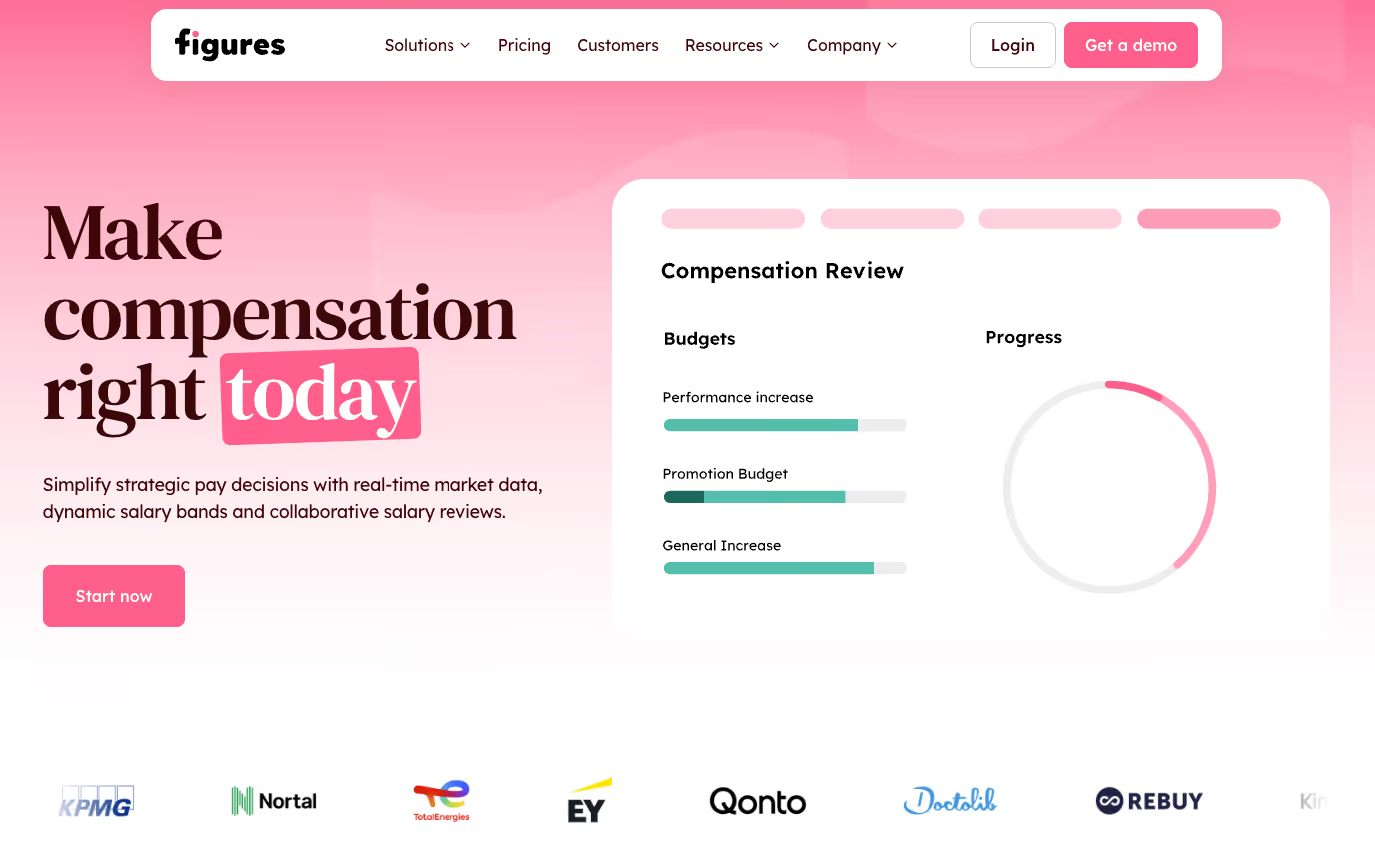
Figures is the European mid-market specialist (250–5,000 employees) with strong EU regulatory expertise and Mercer data partnership. The platform manages the entire compensation lifecycle from benchmarking through review cycles to pay equity analysis.
Key features:
- Data approach: Monthly refresh combining European HRIS data with Mercer partnership, covering 3.5 million data points across EU and UK markets (France, Germany, Spain, and beyond).
- Workflows: Pay equity built specifically for EU Pay Transparency Directive compliance, with gap analysis, remediation modelling, compensation reviews, and audit trails ready for 2026 requirements.
- Security: SOC 2 Type 2, ISO 27001, GDPR compliant with European data residency—the first European compensation platform to achieve ISO 27001 certification.
- Cost: Starting at €2,500/year, scaling based on company size and modules.
Best for: European mid-market (250-5,000 employees) needing manager-friendly workflows, current UK/European data, and EU compliance readiness.
Limitations: Limited Eastern Europe/Scandinavia depth. Not designed for complex sales commissions or US-heavy operations.
Ravio – The tech specialist
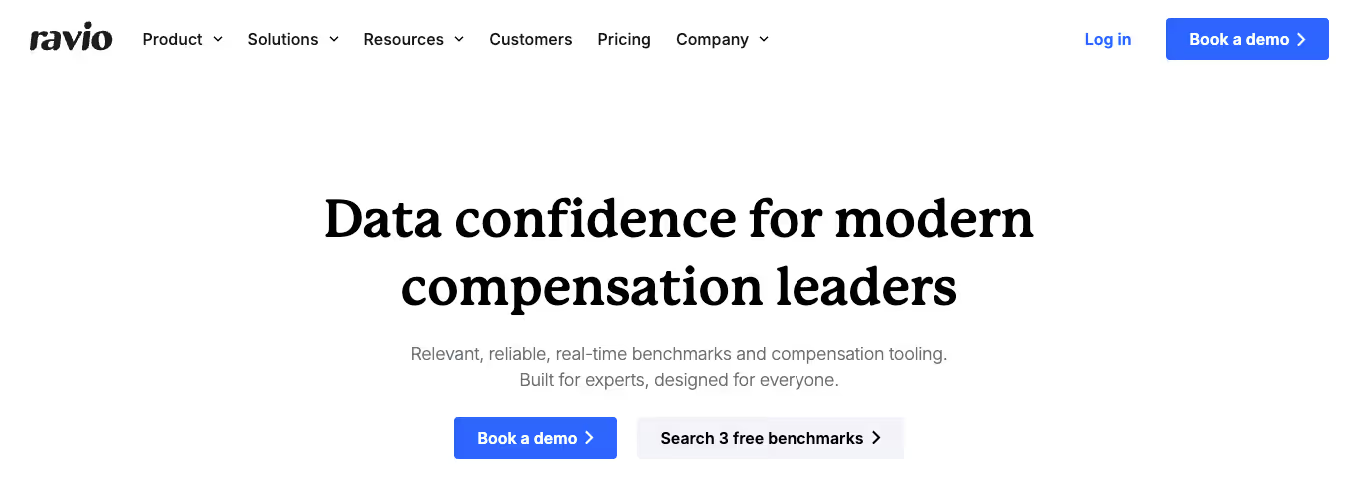
Ravio is the tech-focused platform with a 30-day free trial and a "give-to-get" data model that appeals to startups and scale-ups comfortable sharing anonymized compensation data.
Key features:
- Data approach: Companies share anonymized data to access peer benchmarks. HRIS is integrated and updated regularly to keep data current.
- Workflows: Focus on benchmarking with lighter review workflow tools suitable for simpler merit cycles.
- Security: UK and EU GDPR compliant, and the “Explore the Market benchmark” is fully anonymised.
- Cost: Approximately £5,000/year for 500 employees.
Best for: Tech companies and startups comfortable sharing data, prioritising peer-group benchmarks over broader market coverage.
Limitations: Workflow tools have the strongest coverage in the tech sector, with limited coverage outside that industry.
Pave – The platform for North America
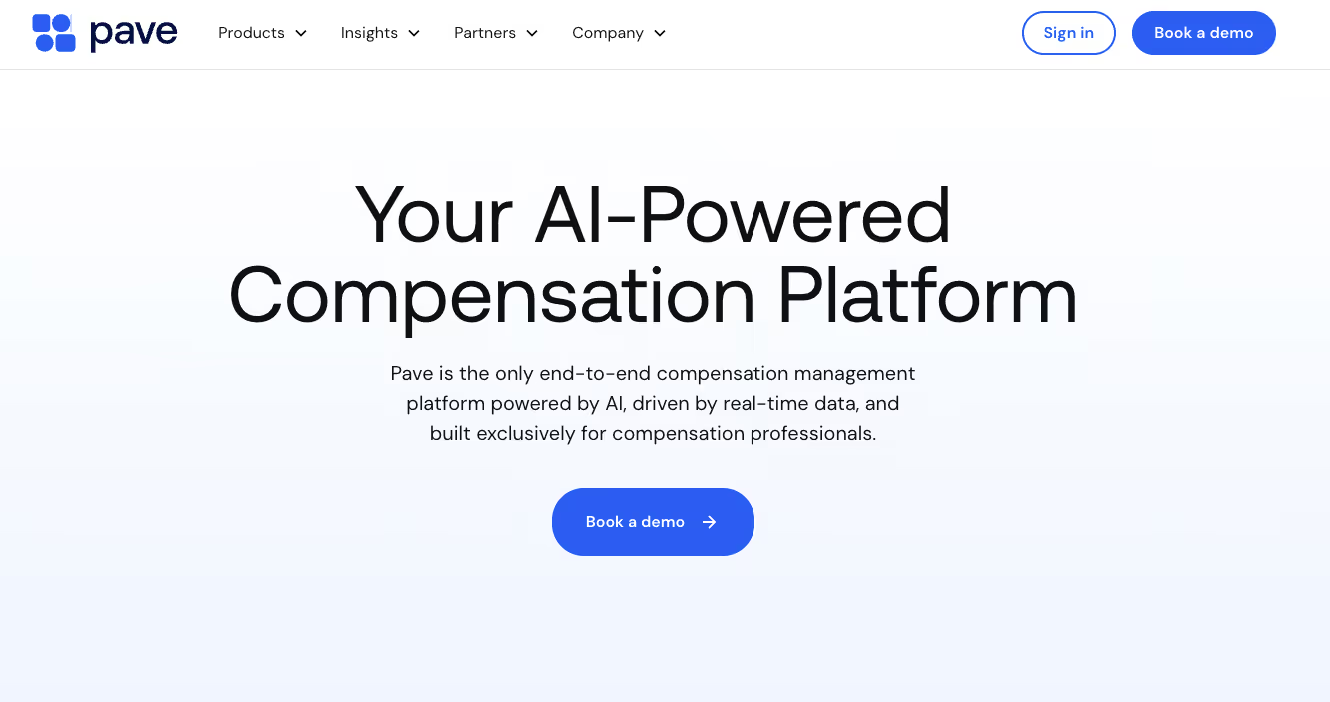
Pave dominates the US compensation software market with deep North American data coverage and equity management capabilities that European platforms typically lack.
Key features:
- Data approach: Real-time HRIS integrations focused on US market with strong equity compensation data for startups managing stock options and RSUs.
- Workflows: Comprehensive compensation planning tools with equity modelling, scenario planning, and approval workflows
- Security: ISO27001 Certified, SOC 2 Type 1 and Type 2 Compliance.
- Cost: Pricing not publicly disclosed; typically positioned as a premium offering.
Best for: US-based companies (especially startups with complex equity structures) needing North American market data and equity management.
Limitations: Limited European market data and no EU Pay Transparency Directive compliance tools. Less relevant for UK/EU-focused hiring strategies.
Personio – The small-team suite
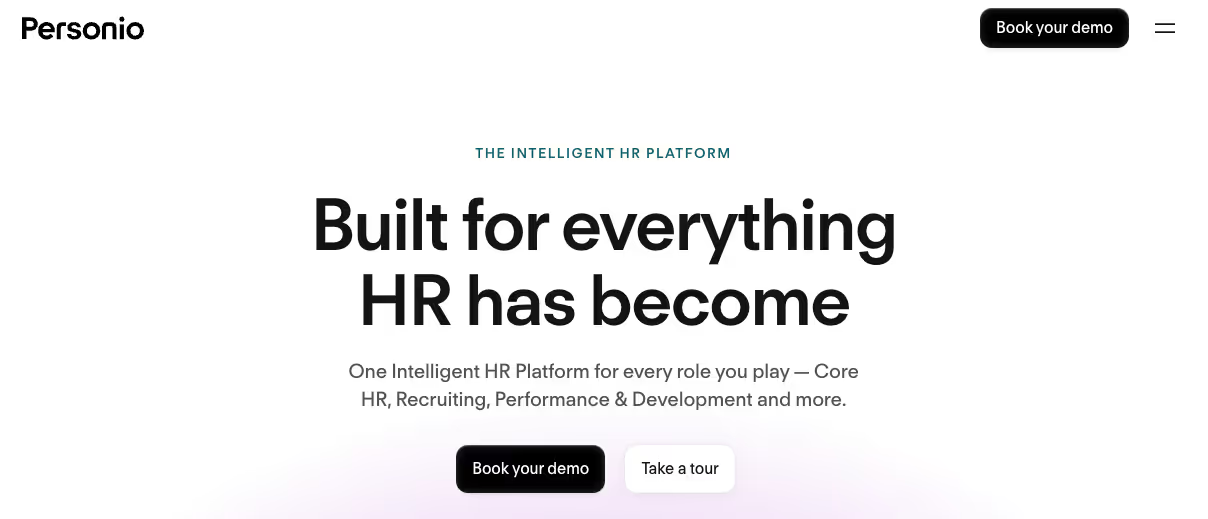
Personio is the European all-in-one HRIS platform that added compensation management functionality in 2024. Best suited for companies already using Personio who want basic review tools without adding another vendor.
Key features:
- Data approach: No external benchmarking data. It instead relies on your internal historical salary information and manual market research.
- Workflows: Basic salary review cycles with supervisor worksheets, budget tracking, approval hierarchies, and automatic sync to employee profiles.
- Security: ISO 27001 certification, a Secure Software Development Lifecycle (SSDLC), and various controls and policies.
- Cost: Add-on pricing for existing Personio customers; not publicly disclosed.
Best for: Existing Personio customers (under 500 employees) who prioritise HRIS consolidation and have straightforward compensation needs without complex benchmarking requirements.
Limitations: No market benchmarking data, limited pay equity analytics, and basic workflow functionality compared to purpose-built platforms.
Beqom – The enterprise solution
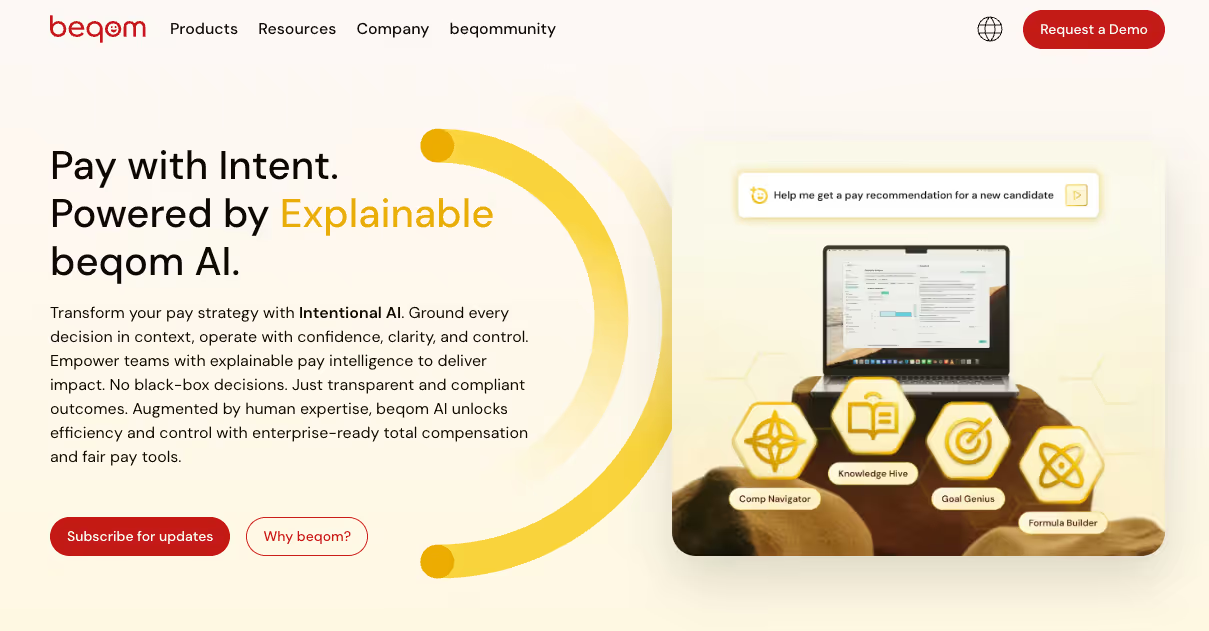
Beqom is the enterprise-grade platform designed for large, multinational organisations (5,000+ employees) with complex compensation structures including variable pay, sales commissions, and long-term incentives.
Key features:
- Data approach: Integrates with multiple external data providers and supports complex compensation modelling across regions.
- Workflows: Comprehensive total rewards management, including base pay, bonuses, equity, benefits, and sales compensation plans.
- Security: beqom is certified ISO 27001, ISO 27017, and ISO 27018, and meets compliance standards, such as ISAE 3402 and SOC2 Type II.
- Cost: Not publicly available, but most estimates put it between five and six figures.
Best for: Large enterprises (5,000+ employees) with complex global compensation structures, variable pay schemes, and dedicated compensation teams.
Limitations: Implementation timelines are measured in months, not weeks. Requires significant internal resources and technical expertise to maintain.
How to choose the right platform for your company
So these are the best options the market has to offer, but how do you make your choice? The answer lies within, so it’s time for some introspective thinking:
- Match platform to company stage:
- Under 250 employees, your HRIS module likely suffices unless retention is suffering.
- At 250-5,000 employees, purpose-built platforms make compensation a competitive advantage.
- Above 5,000 employees, enterprise solutions handle complex global structures.
- Prioritise based on hiring geography: Geographic coverage matters more than feature lists.
- European companies need European data (Figures).
- US-focused companies need US data (Pave).
- Evaluate compliance requirements: EU and UK businesses hiring European workers must prepare for the 2026 EU Pay Transparency Directive. Built-in gap analysis is a must here, alongside your regulatory obligations.
- Consider implementation realistically: Be honest about your team's capacity for data cleanup and manager training. The fanciest platform is useless if you can't get it running before your next merit cycle.
Make compensation decisions you can defend
Spreadsheet compensation reviews waste weeks of your team's time and leave you vulnerable when someone questions a decision. No audit trail. No market data. Just gut feelings and version control nightmares.
Figures combines monthly-refreshed European benchmarking data with manager-friendly workflows and compliance-ready pay equity analytics. You get Mercer-quality data, streamlined review cycles that actually work, and audit trails that stand up to regulatory scrutiny.
Lucca, a leading French HR software company serving 450+ employees, uses Figures for benchmarking to support its hypergrowth. As Charles de Fréminville, HR Manager at Lucca, puts it: "Figures [were] very valuable in establishing a sound basis for salary policy."
Book a free demo to see how Figures turns compensation from an administrative headache into a competitive advantage for attracting and retaining the talent you need.

Summarize this article with AI
No time to read it all? Get a clear, structured, and actionable summary in one click.