Can you remember how much you earned in your first job? Imagine if you’d kept that same job, but five, 10, even 20 years down the road, you’re stuck on the same pay level. Your responsibilities would have increased plenty since you started; you’ve probably trained new team members, and maybe taken a few professional development courses yourself in that time. Few people would be happy, or even able, to remain with their employer without their pay increasing.
Pay progression is an essential part of the employee journey — that’s a given — after all, earning a wage is the primary reason most of us work. But for employers, it’s an ongoing challenge to manage pay progression in a way that’s both fair and doesn’t bust the budget. This guide supports you by sharing how to create a progression framework for your organisation.
{{ ai }}
What is pay progression?
Pay progression describes the structured path employees take through their assigned salary range. Compensation isn’t static forever — your workers wouldn’t stay for very long if it was. Put simply, progression answers one question:
“How does someone earn more without changing jobs?”
Using a clearly defined pay progression framework, your employees can keep earning more, as they grow in capability or contribution within the same role. But it’s important to note that progression sits inside a broader framework that defines:
- Levels or steps within a role
- What it takes to move to the next step
- The salary range attached to each step
- How you make and review decisions
Why companies offer pay progression
If there was a single overarching reason that companies progress employees’ pay, it would be this: pay needs to keep pace with the value someone brings. It’s not the only factor that shapes satisfaction — meaningful work, belonging, and flexibility all matter — but a structured progression model unlocks several employer-side benefits.
Increased motivation
Employees who can see a clear pay progression path tend to push further in their roles. Uncertainty undermines effort; clarity encourages it. In one recent industry survey, workers rated their satisfaction with pay progression at just 5 out of 10, demonstrating how much ground most organisations still need to cover. Another study found that 77.9% of employees believe they’d be more productive if recognised more often. Progression is one of the most meaningful forms of recognition an employer can offer.
Positive reinforcement
Progression acts as reinforcement for the behaviours and contributions an organisation wants more of. When people see that stronger performance or deeper capability leads to real movement in their pay, the link between effort and reward becomes clear. This approach removes guesswork and gives employees a reason to keep developing inside their role.
Greater employee retention
Progression also keeps employees on side, protecting the bottom line. Some 88% of organisations are concerned about employee retention, and with good reason. Replacing a leaver costs time, money, and continuity. It’s often cheaper, and far more effective, to reward growth in your existing team. The case gets stronger when you consider 39.4% of workers rank fair pay as the top reason they stay with an employer.
Types of pay progression
Progression isn’t a single mechanism. Organisations use several routes … (sometimes deliberately, sometimes by accident) … each linking pay movement to a different trigger. This table breaks down the main types and what they look like in practice.
How to build a fair pay progression framework in 7 steps
If you’re in any doubt about why you might need a formal pay progression framework, imagine life without it. For your employees, it can feel like a blend of luck and knowing the right people. One person might earn a more generous salary because their manager champions them, while someone else waits years for the same. Your teams will almost certainly notice these gaps before HR does.
A clear framework gives everyone a reference point and a shared, steady way to grow. Here’s how to build one that works in practice.
Step 1. Start with a clear pay philosophy
An effective progression framework requires everyone to understand the principles behind it. Your pay philosophy is a short statement that explains what you reward, how you make pay decisions, and what employees can expect as they grow. It doesn’t need to be long or technical, but it should spell out the rules you stand by.
Begin by answering a few questions.
- What does “fair pay” mean in your organisation?
- Do you link pay movement to performance, capability, market position, or a mix of these?
- How quickly should someone move through their range if they’re developing well?
- What does or doesn’t trigger a pay change?
Writing this down gives managers something solid to work with and provides employees with a shared understanding of how pay is shaped. It also stops one-off decisions from defining your culture by accident.
A clear philosophy won’t solve every challenge, but it sets the tone for everything that follows — your salary bands, your levelling, your reviews, and the conversations managers have every day.
Real-world example: Developer company PostHog publishes its full compensation handbook openly, including levels, steps, location factors and a salary calculator that shows exact pay for each role and location. Its philosophy is simple: clear criteria, transparent ranges and predictable progression. Employees can see where they stand today and what it takes to move forward.
Step 2. Create a job architecture that supports progression
Progression only works when roles and expectations are clear. A simple job architecture gives you the structure to anchor growth. To build yours, ask:
- What roles exist in each function?
- How many levels does each role need? (Often 3-5 is enough.)
- What changes as someone moves from one level to the next?
- Which behaviours, skills or responsibilities define each level?
Write short, practical descriptions for each level that become the reference point for every progression decision.
Step 3. Use reliable market data
Progression only works if your salary ranges reflect the real market. When bands fall out of date, you end up firefighting: counteroffers, mid-cycle adjustments, and employees who feel underpaid compared with new hires.
To keep your ranges grounded, consider:
- Are you using verified, role-matched market data using platforms like Figures, or are yours based on broad industry averages?
- Does the data reflect your hiring locations rather than generic global numbers?
- How often will you refresh it? (Annual updates are the minimum; some roles move faster.)
Most organisations struggle to maintain this manually. Benchmarking across countries, levels and job families takes time, and it’s easy to miss shifts that materially affect your people.
Step 4. Define how you’ll make progression decisions
Progression falls apart when no one knows what comes first: the higher pay or the higher level of contribution. According to a LinkedIn poll, 71% of employees believe they should demonstrate more before expecting a pay increase. But more than 1 in 4 feel the pay should come first so they can step into the bigger expectations.
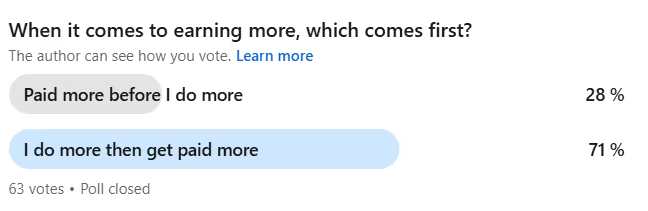
Your organisation needs a consistent stance against this tension. Employees should know exactly what they need to demonstrate before moving through their range. Managers should know what evidence to look for and how to judge it.
Useful questions to settle internally:
- What level of impact or capability counts as “ready for the next step”?
- What examples help managers recognise that readiness?
- Who signs off progression, and what do they review?
- How do you talk to employees who feel ready but haven’t demonstrated it yet?
Step 5. Separate progression from ad-hoc adjustments
Other pay movements happen for different reasons, and mixing them blurs the picture for employees. When everything gets labelled as “progression,” people lose trust in the pay process.
Keep these pay movements clearly distinct and tell employees what type of increase they’re receiving:
- Progression: earned through development, capability, contribution
- Market adjustments: applied when external pay rates rise
- Cost-of-living increases: applied to protect purchasing power
- Counteroffers: used when someone is at risk of leaving
Step 6. Introduce checks for fairness
Even the best-designed framework needs regular oversight. Small inconsistencies can creep in, often driven by differences in manager judgement or team structure. A quick fairness review each cycle helps you spot issues before they take root.
When you review progression outcomes, look for:
- Teams or managers with noticeably faster or slower progression
- Employees who stay at the same step for long periods without feedback
- Differences across gender, ethnicity, working pattern or location
- Levels where no one is progressing, which may point to unclear criteria
If something looks off, speak to managers early. A light-touch correction now protects trust in the whole system.
Step 7. Prepare managers to explain the framework
Managers bring your progression framework to life. If they can explain how progression works, employees feel informed and confident. If they can’t, even the clearest system starts to feel inconsistent.
Give managers what they need to communicate well:
- A simple explanation of your pay philosophy
- Clear examples of what progression looks like in their team
- Guidance on timing expectations
- Straightforward answers to common employee questions about pay
When managers feel equipped, conversations about growth become easier and more honest.
Bolster your pay progression framework with Figures
Progression only works when the structure behind it is solid. Clear levels, accurate ranges and consistent decision-making form the backbone of any fair framework, and that’s exactly where many organisations struggle.
Figures brings these pieces together in one place. When your salary bands reflect the real market and your managers follow a steady, well-governed process, progression feels predictable and fair rather than opaque or ad-hoc.
Our compensation platform helps HR and Reward teams build and maintain progression frameworks that stand up to scrutiny:
- Reliable market benchmarking: Understand current pay levels across roles, countries and seniority.
- Structured salary bands: Create clear ranges that support step progression without spreadsheets.
- Progression-ready review workflows: Give managers the tools to make consistent, well-documented decisions.
- Fairness and equity checks: Spot drift, gaps and outliers before they become problems.
If you want to bring clarity and consistency to pay progression, and retire the guesswork for good, book a free Figures demo to see how it works in practice.

Summarize this article with AI
No time to read it all? Get a clear, structured, and actionable summary in one click.