Key points:
- Salary adjustments respond to systemic factors: market shifts, cost-of-living changes, internal equity corrections, and legal compliance trigger adjustments independently of how well you performed.
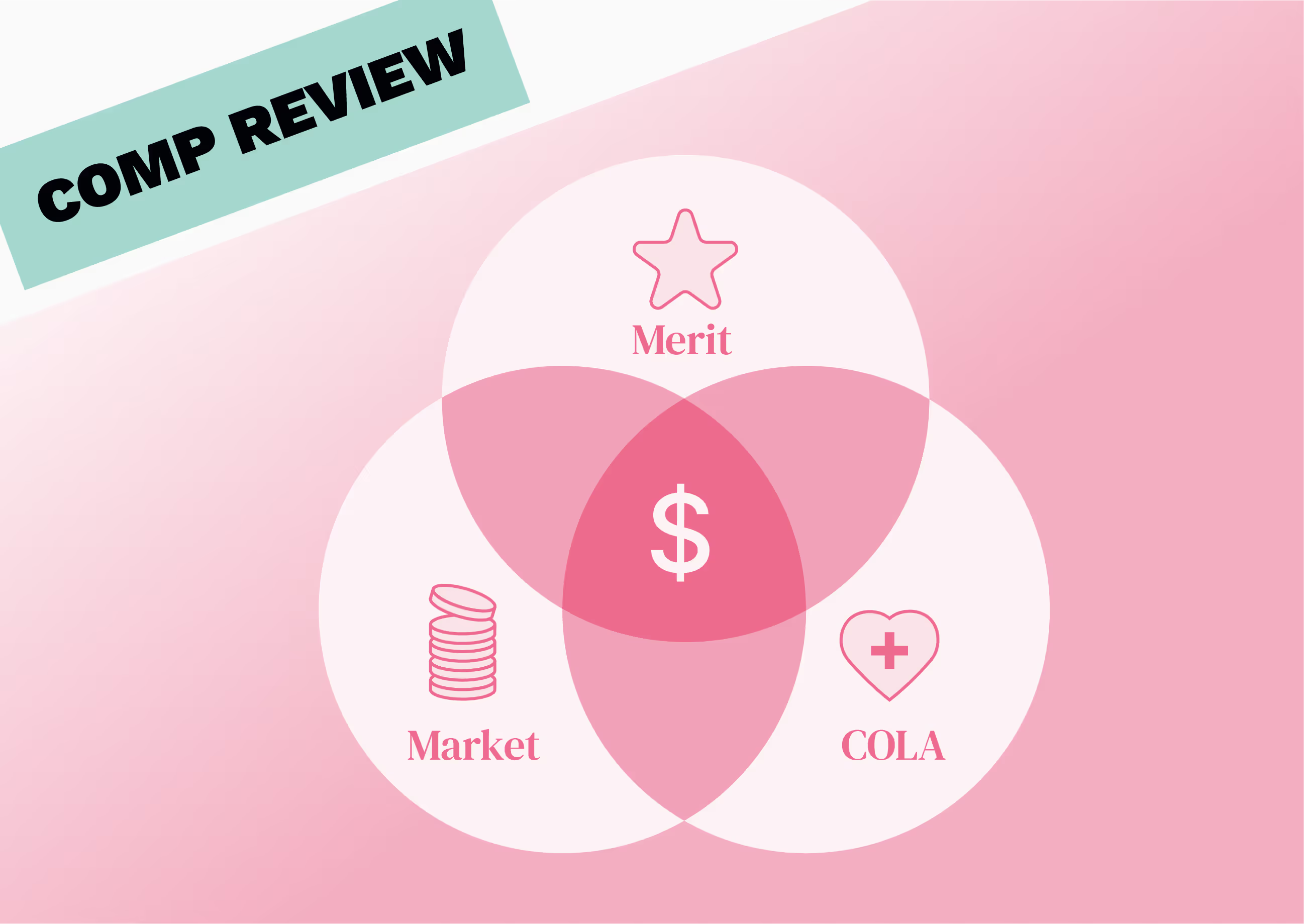
- Typical percentages vary by adjustment type: COLA (Cost-Of-Living Adjustment) increases are usually lower than merit-based increases. Promotions are where you’re going to see the biggest change in salary.
- The 2026 EU Pay Transparency Directive requires documentation: companies with 100+ employees must justify pay gaps exceeding 5%, making data-driven adjustment processes a compliance requirement rather than a nice-to-have.
A salary adjustment is a change to an employee's base pay driven by systemic factors such as market rates, internal equity, or role changes, rather than individual performance alone.
Unlike performance-based raises that reward individual achievements, salary adjustments respond to broader organisational or economic shifts. They fall into three main categories:
- Permanent adjustments: include annual market revisions, promotions, or corrections to align with industry standards.
- Temporary adjustments: cover acting allowances or additional pay for short-term assignments.
- Negative adjustments: though rare, can occur during demotions or significant role changes, often raising the question: "Can my pay actually go down?"
Salary adjustments are likely to become much more common, especially with the upcoming EU Pay Transparency Directive coming into effect. But there are also plenty of benefits beyond just complying with the law. Think higher morale (as long as you’re not passing out negative adjustments), higher employee retention, plus a huge reputation boost for your business.
Want to see some of those benefits for yourself? You’re in the right place. We’ll be providing practical advice to help you implement your own salary adjustment structures. But before we get into the nitty-gritty of the topic, let’s make an important distinction first. Namely, how on Earth is this any different from a pay rise? Good question…
{{ ai }}
Salary adjustment vs. pay raise: what's the difference?
Aside from the rare cases where a salary adjustment can negatively affect pay (which would really suck if you were expecting a pay raise), there are a number of differences between the two. Take a look:
So, think of it this way:
- If your colleague is doing similar work and suddenly gets paid more because the market rate jumped, that's a salary adjustment.
- If you get paid more because you exceeded your targets, that's a merit raise.
🤔 Important: to remain competitive in the European and UK markets, you’ll need to make adjustments to your salaries based on the trends and regulations of your market. Where will you find that information, though? In the Annual Salary Increase e-book, of course! It’s the perfect resource for HR leaders and stakeholders who want to make fair, data-backed salary adjustments.
Why do companies adjust salaries? (beyond performance)
Now, let’s actually examine the reasons behind a salary adjustment. After all, it can be awfully confusing if your pay increase occurs outside your review period (though it’s always welcome!), especially if your company doesn’t explain why they’re doing it. So let’s figure it out.
Market rate alignment
Market-rate adjustments keep your pay competitive with what other companies offer for similar roles.
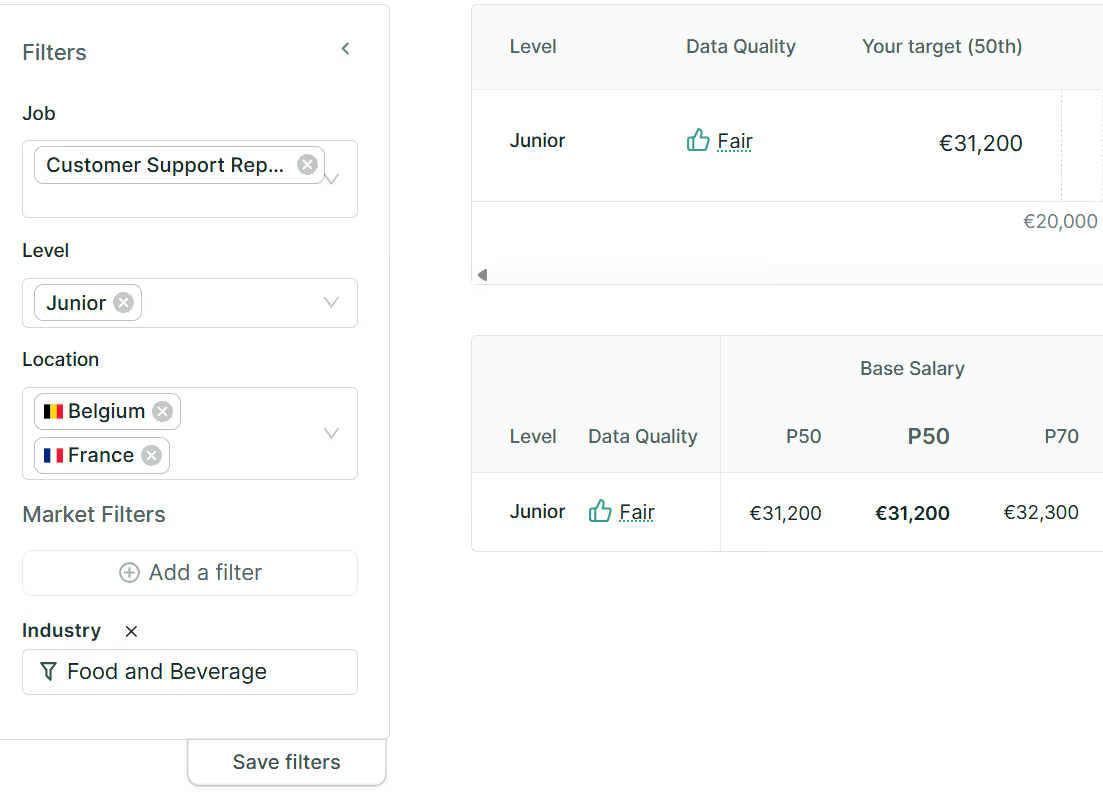
The market moves fast. A role worth £50,000 two years ago might now require £58,000 to attract talent. Without adjustments, you risk losing employees to better offers or creating pay inversions where new hires earn more than experienced staff.
The only problem is that it can be a pain in the backside to track market changes. Calculating competitive pay requires you to draw on multiple data sources to build a full picture. That’s easier said than done, however, especially if you’re relying on surveys or online aggregators.
Allow us to shamelessly promote Figures here and our recent team-up with Mercer. Utilising 3.5 million+ datapoints, you can compare salaries for different job roles and offer competitive compensation packages across the market.
Cost of living (COLA) and inflation
Inflation and cost of living have become hot-button issues in recent years, and for good reason. They affect your purchasing power, especially if you haven’t had a salary adjustment in years. What was good three years back might not be now.
Let’s show you what we mean. If your £45,000 salary stays flat while inflation runs at 3%, you've effectively taken a 3% pay cut. Your rent, weekly shop, and transport all cost more, but your paycheck hasn't budged. And it’s not like you’re doing 3% less work.
That’s where COLA comes in. Companies adjust your salary to meet inflation and the cost of living, ensuring that your wage has the same purchasing power as it did the previous year.
🤔Smart companies separate COLA from merit increases. Don’t pee in your employees’ collective Cornflakes and tell them it’s milk; COLA is supposed to maintain a standard of living, while merit-based increases are supposed to improve it. Employees will be able to tell the difference!
Legal compliance (UK focus)
Adjustments aren’t always optional. Especially when the law is involved. We’ll focus on the UK here, as it recently made changes to its wage laws.
The National Living Wage increased to £12.21 per hour in April 2025 for workers aged 21 and over. The Real Living Wage (voluntary but widely adopted) stands at £13.45 across the UK and £14.80 in London.
Internal equity and fairness
Internal equity adjustments correct pay disparities between employees doing similar work with similar performance. It's when your company discovers two people with the same job and performance are paid differently for historical reasons - different negotiation skills at hire, gender pay gaps, or timing differences - and fixes it.
This is a pressing issue, especially when territories are introducing legislation to ensure equity is taken seriously.
Thankfully, the Figures' pay equity dashboard identifies these disparities early, showing glass ceilings, pay quartiles, and specific employees with potential gaps.
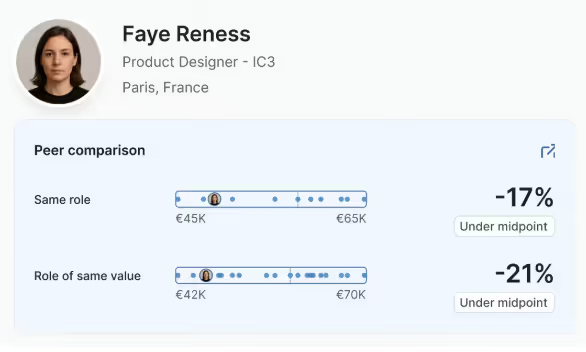
🤓What about the EU? Well, the EU Pay Transparency Directive requires companies with 100+ employees to address pay gaps exceeding 5% by 2026. This can be difficult to identify, especially if you’re tracking salaries via spreadsheets in Ex-hell (sorry, not sorry).
Role changes and employment terms
Promotions warrant substantial increases (often 10-20%) when you move into higher-level roles. Significant duty changes without title changes also justify adjustments.
Hour changes create technical adjustments, too. Moving from full-time to part-time shows as a "salary adjustment" on your payslip, even if your hourly rate stays the same – you're simply being paid for different hours.
Typical salary adjustment percentages: how much is normal?
We’ve talked about reasons; now let’s talk numbers. Adjustments are necessary, but they still need to make sense. If you’re adjusting pay by 10%, even though inflation has increased by 3%, employees will be throwing you a party. The board, on the other hand, will be throwing you on the street to look for another job. That’s why you need a good framework to work from.
We’ve got you covered. Let’s start with salary increase budgets.
General budget trends
Salary increase budgets currently hover around 3-4% of total payroll across UK and European companies – down from 6%+ in 2022-23.
That 3-4% covers all increases combined – general raises, merit, market corrections, and promotions. Here’s a more detailed breakdown:
- Market corrections: typically 10-20% when benchmarking reveals significant gaps between your pay and your competitors.
- In-range adjustments: these dive an employee deeper into their salary band without promotion. You could see an increase from £42,000 to £50,000 within a €40,000-€60,000 band. This is dependent on your job architecture and the predetermined role levels (junior, senior, executive, etc.).
- Merit vs. band position: Two employees with identical performance shouldn't get identical raises if one sits at the bottom of their band and the other at the top. Strong performers low in bands might receive 8-10%. Those near the ceiling might get 2-3%, or be considered for promotion instead.
If you’re still unsure what kind of adjustment an employee should get, the Office for National Statistics calculator shows whether a proposed increase keeps pace with inflation.
Now, let’s give you the practical advice needed for managing salary adjustments.
Best practices for managing salary adjustments
Effective management of salary adjustments sets companies that retain talent apart from those that constantly recruit replacements.
Audit first, adjust second
Never apply salary changes without understanding your current pay landscape. That’s basically like trying to build IKEA furniture without the instructions. You might have an idea of what you’re building towards, but without context, you’re clueless on whether you’re doing the right thing.
So, run equity audits before making decisions. Use data to pinpoint:
- Employees paid below market positioning.
- Pay gaps between people doing similar work.
- Gender or demographic disparities that need addressing.
- Compression issues where new hires earn more than experienced staff.
Starting with data prevents the embarrassing discovery of problems after adjustments go live. Oh, and pay compression issues, which is always nice.
Prepare for 2026 now
The EU Pay Transparency Directive isn't a distant concern. Companies with 250+ European employees face reporting obligations starting in 2026. That means organisations must report pay gaps and justify differences exceeding 5%. And provide concrete strategies to reduce pay caps that do exceed that limit.
Unfortunately, that means that a manager making changes based on gut feeling could be getting you into hot water. Every salary decision needs a defensible rationale backed by data – performance ratings, market benchmarks, role scope, or equity corrections.
"Market data is the cornerstone of fair executive compensation. Without real-time benchmarking data, you're essentially guessing what competitive pay looks like, which is exactly the opposite of what you should be doing."
– Virgile Raingeard, CEO at Figures
Communication makes or breaks the process
If there’s one thing we know, it’s not what you do, it’s how you communicate it. You might have the best intentions ever, but if you’ve got a tongue of stone rather than silver, your intentions won’t matter as much. So, in your communications about salary adjustments, aim for:
- Transparency – Explain what drove the decision (market data, equity correction, new responsibilities).
- Empathy – Acknowledge the employee's perspective and concerns.
- Clarity – Specify the new amount, effective date, and any conditions.
With that in mind, you’ll also need to adapt your communications based on what type of adjustment is being made:
To help you out, here’s a simple template for adjustment notifications:
"Following our compensation review, your salary will increase from €X to €Y, effective [date]. This adjustment reflects [market positioning changes / internal equity corrections / expanded role scope]. Your contributions continue to be valued, and we're committed to ensuring your compensation remains fair and competitive."
Keep it brief. Personalise it. Follow up in writing. And DON’T do these things:
- Burying the number in corporate jargon.
- Making it sound like a favour rather than a fair practice.
- Forgetting to specify when the change takes effect.
Secure your data properly
Pay data is sensitive – you need to handle it accordingly.
Compensation management requires GDPR compliance for European operations and SOC 2 Type II certification for secure data processing. These aren’t optional, obviously. They’re there to protect your employees.
With that in mind, spreadsheets shared via email don't meet security standards (though you likely already know that). Granted, if you’re using spreadsheets to track employee compensation, you’ve likely noticed more shortcomings than just poor security compliance… there’s a better way, however.
When Excel breaks: managing compensation at scale
Small teams can survive on spreadsheets. But once you hit 200+ employees, the cracks become chasms. Version control chaos, continuous manual updates, poor security considerations; it doesn’t have to be that way.
That’s why you need a platform that links with your existing HRIS and provides you with all the data you need to make payroll adjustments comfortably. That platform is Figures.
Figures' compensation review platform integrates with 30+ HRIS systems to centralise salary adjustments in one secure workspace. The suggestion matrix automatically combines performance ratings with real-time market data from 3.5 million benchmarks, recommending larger adjustments for underpaid employees to correct historical inequities.
Live budget tracking prevents overruns as managers propose changes, while role-based permissions ensure each stakeholder sees data relevant to them. Everything happens in a SOC 2 Type II certified environment that automatically documents every decision for 2026 EU Pay Transparency Directive compliance.
So, what are your next steps? Come with us to explore the full HR process of making a payroll adjustment or if you’re ready to dive into Figures, check out our demo today!
Frequently Asked Questions
Is a one-time bonus considered a type of salary adjustment?
No. Bonuses are variable pay that don't change your base salary. A salary adjustment modifies your ongoing base pay – what you earn every month, regardless of performance. To put it concisely: bonuses are subject to more regular changes, but salary adjustments aren’t… at least until your next salary adjustment.
What is a paid adjustment?
A paid adjustment usually refers to a retroactive correction for payroll errors or backdated raises. If your salary increase should have started in January but payroll only processed it in March, you'll receive a paid adjustment covering those two months of difference. Not bad, right?
Can a salary adjustment ever mean my pay goes down?
Yes, though it's rare and legally complex in the UK. Pay reductions typically happen only during demotions, voluntary role changes to part-time status, or significant duty reductions. Employers can't unilaterally reduce your salary without following proper procedures, including consultation and potentially obtaining your agreement.
Involuntary pay cuts without valid reasons can constitute constructive dismissal.

Summarize this article with AI
No time to read it all? Get a clear, structured, and actionable summary in one click.