Key points:
- Negotiation-driven pay is a structural problem, not a people problem: compensation frameworks are how you fix these issues for good.
- A compensation framework has five interdependent components: philosophy, job architecture, market benchmarking, location modifiers, and salary bands. Skip one, and the whole structure wobbles.
- Formalising your framework will likely surface pay gaps: 82% of companies that join Figures have gaps exceeding 5%. That's not a reason to delay; it's exactly why you start.
- The EU Pay Transparency Directive deadline is June 2026: Companies with a documented framework will be ahead of every competitor still wrestling with spreadsheets.
For many businesses, it’s not uncommon to see three people in a department doing the same jobs, but all getting paid completely different salaries. One’s a silver-tongued devil, who can come out of any meeting smelling of roses. One joined during a hiring freeze, where budgets were much tighter. The last just accepted the first offer given to them.
This is negotiation-driven pay, and it's more common than anyone likes to admit. But just because it’s a common practice doesn’t mean that it’s right. In fact, it can cause retention and pay compression issues, which can be difficult to resolve.
Especially if you’re looking to Google for a fix. Every HR resource defines compensation terms differently, leaving you knee-deep in spreadsheet gymnastics and not much closer to a decision. Granted, Google isn’t the worst place to search – it did lead you to us after all.
We'll walk through what a compensation framework actually is, how it differs from a compensation philosophy, the five components it needs to include, and how to build one. We’ll also include why getting this right before the June 2026 EU Pay Transparency Directive deadline is a genuine strategic advantage. Let’s go.
What is a compensation framework?
A compensation framework – often called a compensation policy – is the structured system that defines how your organisation determines, manages, and communicates employee pay. It brings together a guiding philosophy, job levels, market benchmarking data, and salary bands into one coherent structure.
The point of a framework is to have a single source of truth for both the strategy (the why) and the structure (the how) of pay.
Without one, pay decisions default to whoever negotiates loudest or whoever happens to join at the right moment. With one, every salary decision is backed by documented, defensible criteria, and not just a manager’s gut feeling (which could’ve just been a bowel movement anyway).
What a compensation framework does for companies
A well-built framework does three things that matter enormously right now:
Compensation framework vs. compensation philosophy
These two terms are thrown about all the time because many professionals believe them to be the same thing. They’re not, and understanding the difference will save you a lot of confusion when building your own system.
Here's the simplest way to think about it:
Your compensation philosophy is the "why."
It's a set of written principles that defines what your organisation values in pay. Do you want to reward those who stay with you the longest? Or maybe want to use competitive pay to attract top talent? That’s your compensation philosophy (though don’t consider these factors an exhaustive list; there’s plenty more that goes into a comp philosophy).
Your compensation framework is the "how."
It's the operational system that takes your philosophy and turns it into something real – job levels, market data, salary bands, location tiers. The full machinery.
🤔 One without the other creates problems. A philosophy with no framework stays stuck as a nice-sounding document that nobody uses. A framework with no philosophy is just a collection of numbers with no story behind them.
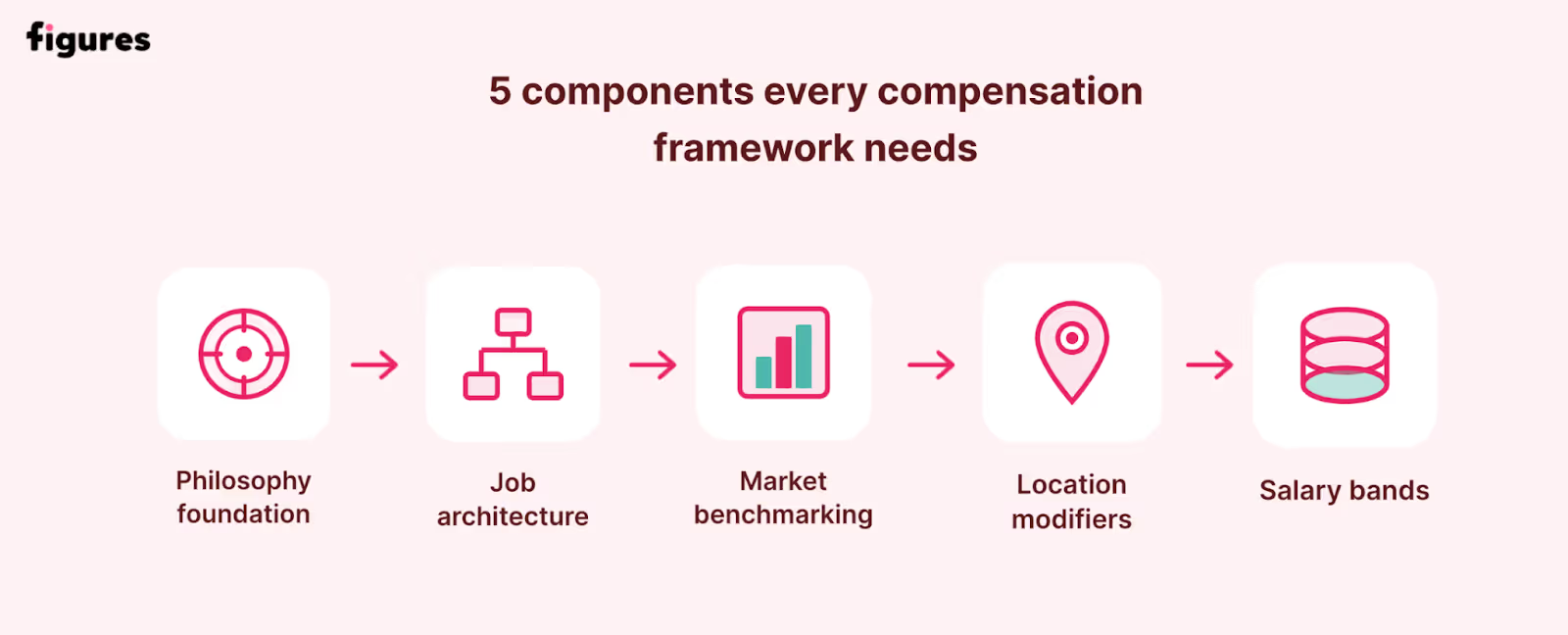
5 components every compensation framework needs
Now that you know what a compensation framework is and how it differs from a philosophy, here's what actually goes inside one.
These five components build on each other, with each one depending on the one before it. Skip a step, and your framework crumbles like a house of cards.
- The philosophy foundation: Defines your market stance (are you paying at the 50th percentile, or leading at the 75th?) and your approach to transparency. Everything downstream flows from this.
- Job architecture, levels, and grades: The structural map that classifies roles into families – Engineering, Sales, Operations – and defines seniority levels based on scope and impact, from Junior through to Lead.
- Market benchmarking: High-quality salary data (like the 3.5M+ Mercer data points used by Figures) tells you what the market is actually paying for each role at each level.
- Location modifiers: Your geographic pay strategy. Will you pay a single national rate, or use tiers based on the cost of labour? London vs. Manchester, for example?
- Salary bands and total rewards: The final output: defined pay ranges (minimum, midpoint, maximum) for every grade, plus benefits and bonuses.
🤔 Most pay equity problems don't start with bad intentions, but with missing architecture. When job levels aren't clearly defined, pay decisions fill the gaps inconsistently.
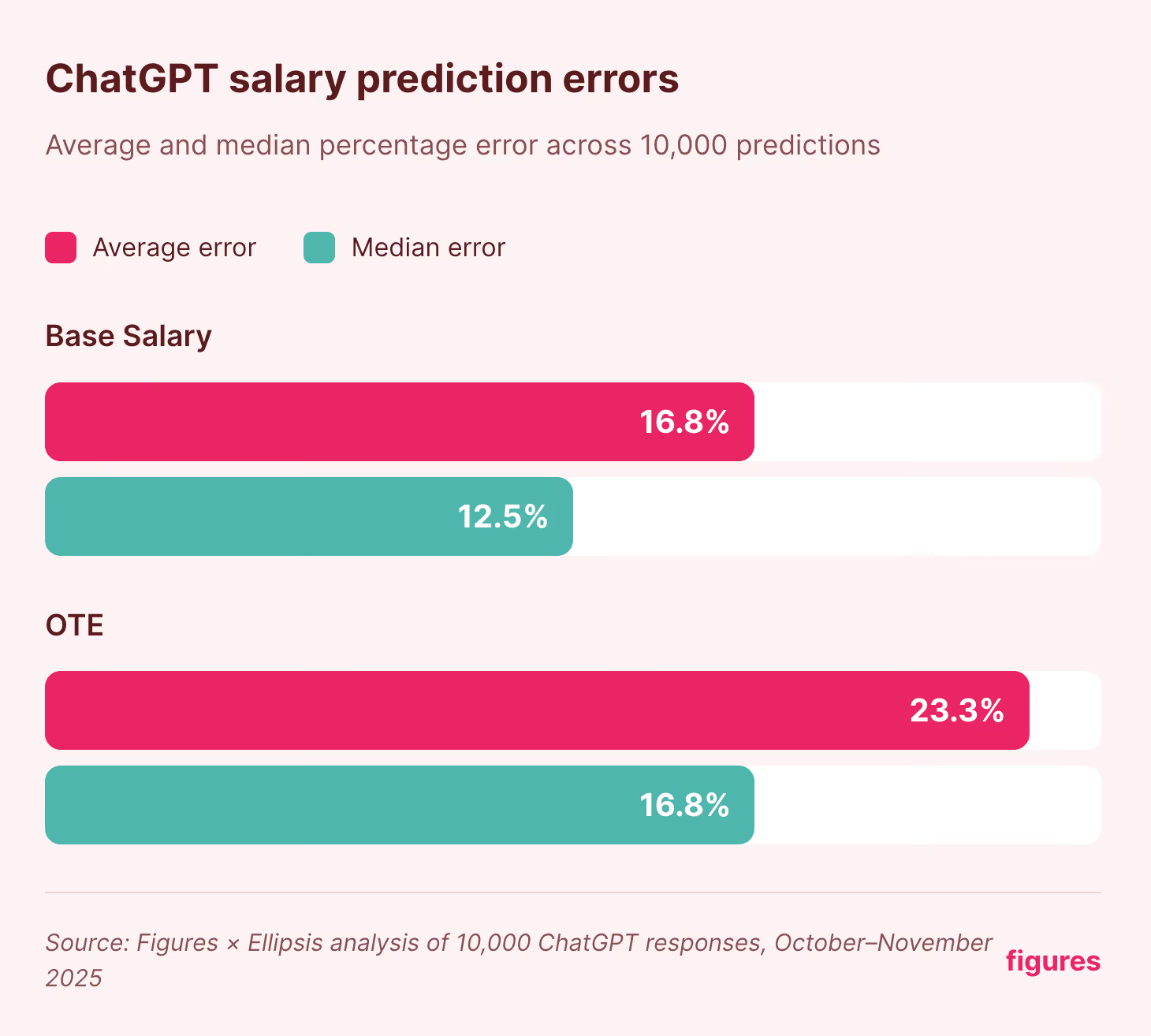
Tempted to use ChatGPT for your salary benchmarking? We tested 10K prompts and realised it’s not the best strategy, especially for senior positions.
How to build a compensation framework
Before we begin, a friendly warning: building your compensation framework will almost certainly bring existing pay gaps to the forefront. This can be a huge worry, but it’s no reason to delay your framework.
Discovering inconsistencies is a normal – and healthy – part of the process. It means the framework is working. The goal isn't to pretend those gaps don't exist; it's to find them, understand them, and fix them with a clear, budget-aligned plan.
"82% of companies that join Figures have pay gaps exceeding the 5% threshold. The framework doesn't create those gaps; it just makes them visible for the first time. And visible problems are solvable problems."
— Virgile Raingeard, CEO at Figures
With that said, here's how to build one from scratch.
1. Define your compensation philosophy
Before you touch a single number, get clear on your principles. What does your organisation value? How do you think about fairness, transparency, and market competitiveness?
This is the foundation on which everything else is built; your stance on pay before the data enters the room. If you’re a bit lost and don’t know where to begin, Figures' compensation philosophy guide includes a free template to help you get started.
2. Choose your market positioning
Once your philosophy is written down, get tactical. Based on your budget and talent needs, decide which percentile you're targeting against the market.
- 50th percentile: matching the market.
- 75th percentile: leading the market.
- Below 50th: lagging, typically offset by equity, flexibility, or mission.
There's no universally "right" answer here. The right answer is the one that's honest, documented, and applied consistently.
‼️ If you’re offering below the 50th percentile, you'd best have more to offer than compensation in order to attract top talent. Remote opportunities, frameworks for career development and growth, and comprehensive benefits packages can help offset lower salary packets.
3. Build your job architecture and levels
Map every role in your organisation into functional families and define clear levels based on impact and complexity – not just years of experience.
This step is harder than it sounds, especially at fast-growing companies where titles have been handed out generously. Thankfully, we love to offer a helping hand! Figures' job levelling guide covers both simple and advanced frameworks, depending on your company's size.
4. Gather market data
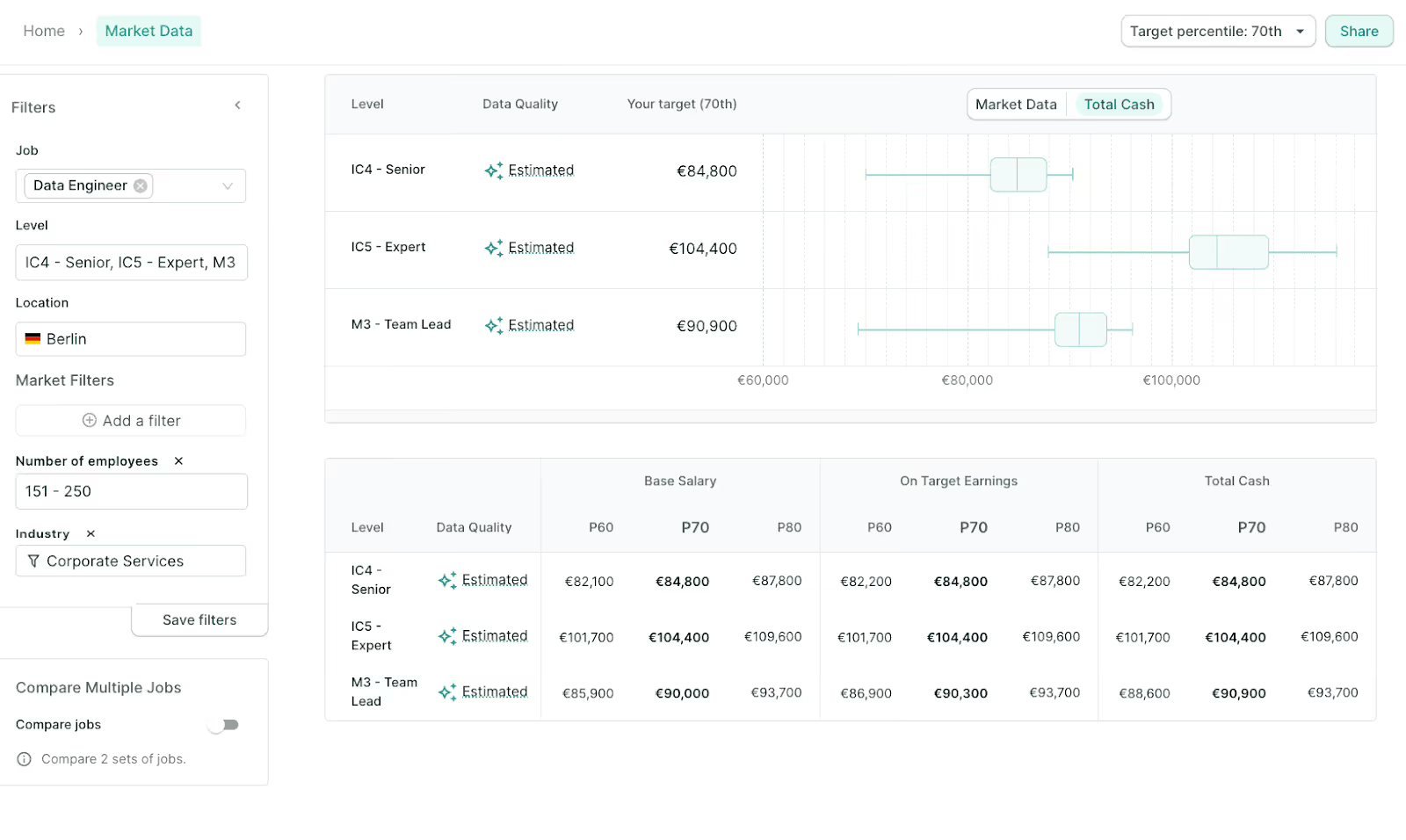
Use high-quality salary surveys or benchmarking platforms to find the going rate for your role-and-level combinations in your primary market.
Data source matters enormously here. Crowd-sourced or self-reported platforms can contain significant inconsistencies. Figures uses the Figures x Mercer dataset – 3.5M+ data points, updated monthly – so your benchmarks reflect what the market is actually doing right now, not what it was doing 18 months ago.
5. Set your location framework
Decide on your geographic pay strategy. Will you run a single national rate, or apply location tiers – London, regional, remote?
💡 Did you know? A significant proportion of European companies localise pay by geography, a number that’s growing as remote and hybrid work becomes the norm. The right approach depends on your talent markets, not just where your offices happen to be.
This step is easy to skip. It's also where a lot of remote-first companies quietly accumulate pay equity problems without realising it.
6. Design your salary bands
Create pay ranges – minimum, midpoint, maximum – for each grade. Bands should be wide enough to allow for growth within a role, but narrow enough to keep pay equity intact.
Figures' salary bands tool generates ranges by job, location, and seniority using live market data. There’s also a salary bands checklist, which breaks the creation process into 12 concrete steps across three phases.
7. Conduct a gap analysis
Overlay your new bands onto current employee salaries. You're looking for two things:
- Green circles – employees paid below the minimum of their band (underpaid).
- Red circles – employees paid above the maximum of their band (overpaid).
Neither situation is a crisis, but they do need to be resolved. Build a remediation roadmap that's realistic given your budget and timeline.
8. Document, communicate, and train
A framework nobody understands is a framework nobody uses.
Finalise your policy for merit increases and promotions. Train managers first, because they're the ones having pay conversations day-to-day. Then communicate to employees.
This step is also where the EU Pay Transparency Directive becomes directly relevant.
Under the directive, employees have a legal right to request information on average pay levels, broken down by sex, for categories of workers performing the same work or work of equal value. A documented framework gives you the infrastructure to respond to those requests confidently.
9. Schedule regular reviews
Commit to an annual review of your market data, and a quarterly check on internal pay gaps.
A compensation framework isn't a document you write once and file away. It's a living system, that grows and changes with your company. The businesses that treat it that way are the ones that stay both competitive and compliant.
Put your compensation framework into practice
You now have everything you need: a clear definition, the five components, a nine-step build sequence, and the business case for getting it done before June 2026.
But a framework is only as good as its implementation.
Moving away from spreadsheet chaos to a structured system like Figures saves HR teams approximately three weeks of work during compensation review cycles alone. More importantly, it transforms pay from a source of frustration into a strategic tool for retention and talent acquisition.
The companies that build this infrastructure now won't just be compliant when the EU Pay Transparency Directive lands. They'll be ahead of their competitors in every conversation that matters: hiring, retention, and pay equity.
Ready to build yours? Get started with Figures and see how the platform brings your compensation framework to life, from philosophy through salary bands and pay equity analysis.
Book a free demo today, and let's get your comp sorted.
Frequently asked questions
What is the difference between a compensation strategy and a compensation plan?
A compensation strategy is the high-level approach your organisation takes to using pay as a business tool – how competitive you want to be, what behaviours you want to reward, and how pay connects to your broader people goals.
A compensation plan is the document that operationalises that strategy with specific salary ranges, bonus targets, and benefit details. Strategy sets the direction; the plan maps the route.
How often should a company review its compensation framework?
Annually at minimum, with quarterly checks on internal pay gaps recommended. Beyond the regular cadence, there are specific triggers that should prompt an immediate review: significant market shifts, rapid headcount growth, notable attrition in certain teams, funding rounds, or regulatory changes – like the incoming EU Pay Transparency Directive. Markets don't wait for your annual review cycle, and neither should you.
How does a compensation framework support pay equity?
Without a documented framework, pay decisions are made inconsistently, which can expand pay gaps. A framework replaces subjective, negotiation-driven decisions with structured criteria: defined job levels, market benchmarking, and salary bands that apply equally across your workforce. Research shows that 85% of companies acknowledge they need to improve pay equity.
Do smaller companies need a compensation framework?
Yes – and the earlier the better. The longer a company operates without one, the more legacy pay inconsistencies accumulate, and the more expensive remediation becomes.
Fast-growing companies in particular tend to hand out titles and salaries reactively during hiring surges, which creates structural pay problems that are much harder to untangle later. Building a framework for 150 employees is significantly easier than rebuilding one for 500.
What comes first – job levelling or salary bands?
Job levelling always comes first. Salary bands are built on top of a defined job architecture, because you can't set meaningful pay ranges until you know what levels exist, what each level means, and how roles map onto that structure. Trying to build bands without levels is like designing floors for a building that hasn't been architected yet.

Summarize this article with AI
No time to read it all? Get a clear, structured, and actionable summary in one click.