Key points:
- A merit increase is a permanent, performance-based pay rise, so it compounds into every future raise, bonus and pension contribution.
- It's not the same as a bonus, cost-of-living rise, market adjustment or promotion – keeping them as separate budget lines keeps a review honest.
- The final percentage comes from three factors – the merit pool (the budget), the performance rating, and compa-ratio (current salary ÷ band midpoint) – which combine in a merit matrix.
- Flat percentages applied to unequal salaries widen pay gaps every year – a compliance risk under the EU Pay Transparency Directive.
- A defensible cycle rests on market-anchored salary bands, a signed-off matrix, manager calibration, layered approvals, an equity check, and an audit trail for every number.
A merit increase is a permanent rise to an employee's base salary or variable compensation, given for individual performance rather than tenure, inflation, or a change of role.
The word doing the work there is permanent. Unlike a bonus, a merit increase becomes part of someone's compensation for good, so every future raise, pension contribution and percentage-based bonus builds on the higher number. A decision that feels minor in the moment, 3% here, 5% there, quietly compounds for years.
That's what makes the exact percentage so hard to land. Give two people on the same performance rating the same increase, and it looks fair, until you remember one of them was already paid well above the other.
To get this right, you need to think about four things: performance, where someone sits in their salary band, what the market is doing, and how much it would hurt to lose them.
But first, let’s talk about some important distinctions.
How a merit increase differs from a bonus, COLA, market adjustment, and promotion
"Pay rise" is a word that can cover several things: merit, cost-of-living, market adjustment, bonus, promotion. Yes, they all show up in someone's pay, but they're funded differently, decided on different grounds, and only some of them stick around. A lot of awkward pay conversations start exactly here, when a manager promises a "raise" and HR delivers something with a very different shape.
Here's how the five compare:
❗ A quick caveat: typical ranges vary a lot between companies, sectors and years, so treat the above percentages as rough orientation rather than benchmarks.
A few of these get mixed up more than the rest:
- Merit vs bonus: in year one, they can be worth the same cash. By year five, they're miles apart, because merit has been compounding on base pay while the bonus was paid once and spent.
- Merit vs COLA: a cost-of-living rise protects everyone's purchasing power equally. Merit is meant to do the opposite and single out individual contributions.
- Merit vs market adjustment: a market adjustment corrects external underpayment regardless of performance, while merit rewards performance – though merit still operates inside the salary band, so it's never fully decoupled from the market either. The two often run in the same cycle, from separate budgets.
- Merit vs promotion: a promotion pays someone for taking on a bigger job. Merit pays them for how well they're doing the one they already have.
If you don’t understand the differences, your budget planning will suffer. It's why Figures' Compensation Review keeps merit, promotion and off-cycle adjustments as separate budget lines in the same campaign, so you can see what each one actually costs instead of burying them all in a single "raises" total.
How the merit increase decision gets made
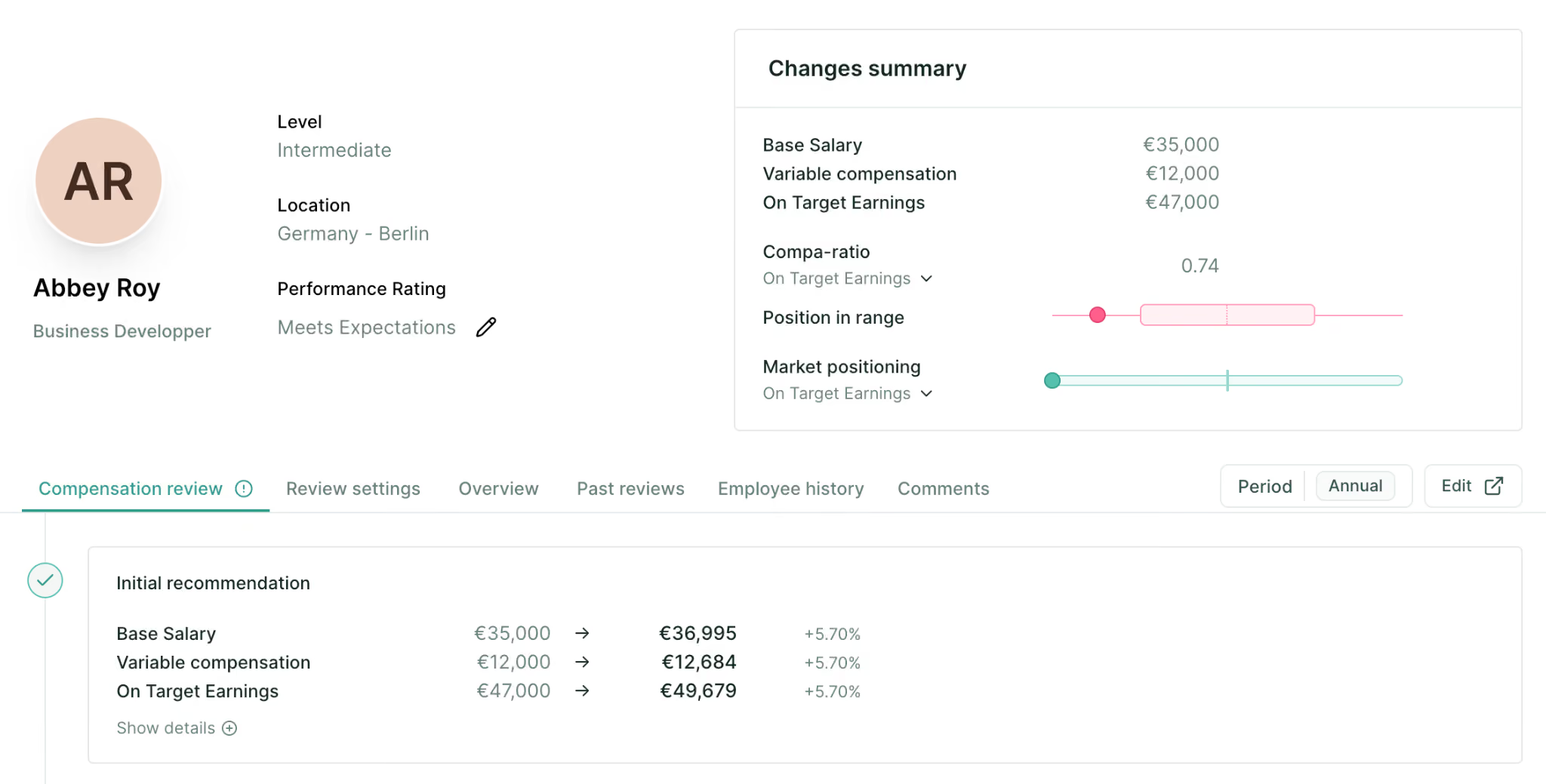
Three factors decide the final percentage:
- The merit pool.
- Performance rating.
- Compa-ratio.
The pool sets how much money there is; the performance rating and compa-ratio then combine in a merit matrix that turns those inputs into a number for each person – which is what the three steps below walk through.
Setting the merit pool
The merit pool is the total share of payroll set aside for merit increases, typically expressed as a percentage. If your pool is 3%, the whole cycle has to average out to 3% of the relevant salary bill, however you carve it up. It's normally the CFO's call, weighed against revenue, what the market is paying, and how worried the business is about losing people.
So what's a normal number? The 2025 European compensation trends report put the median in-role salary increase across European tech at 5.0% for both 2024 and 2025. For wider context, Mercer's October 2025 QuickPulse survey of more than 1,000 organisations projected merit budgets of around 3.2% for 2026, roughly in line with the year before, though that figure is US-based and sits lower than the European number.
Whatever the pool comes to, it's a fixed envelope. A bigger increase for one person means a smaller one for someone else, which is exactly why the next step matters.
Building the merit matrix
A merit matrix is a grid. One axis is the performance rating, usually 1 to 5; the other is where someone sits in their salary band. Every cell holds a target increase, so once you know a person's rating and their band position, the matrix hands you the number.
Here's a worked example:
As you can see, the biggest percentages sit top-left: strong performers who are currently underpaid. The smallest sit bottom-right: weaker performers who are already above the midpoint of their band. Everyone else lands somewhere between.
A matrix like this is good for a lot of things:
- It reins in manager discretion, so raises follow a rule rather than someone’s mood of the day.
- It keeps the whole cycle inside the pool.
- It gives you a decision you can explain to every employee, which counts for a lot once pay transparency rules enter the picture (more on those later).
The matrix only works if you have real salary bands built on current market data. Compa-ratio measures where someone sits against the midpoint of their band, so with no bands, there's nothing to measure against. If you want to go deeper into building one, we've got a full guide to the merit matrix.
Why compa-ratio changes the percentage
Compa-ratio is calculated by dividing the current salary by the band’s midpoint. Someone earning £46,750 against a £55,000 midpoint has a compa-ratio of 0.85, sitting 15% below the middle of their band.
So, for example, if you have two people next to each other, both rated "exceeds" on the matrix above, the one at 0.85 lands around 7%, while the one at 1.15 gets closer to 3%. Even though the rating is the same, the raise is quite different because the cycle rewards performance and corrects underpayment in the same move, with the larger percentage nudging the underpaid person back toward the middle of their band.
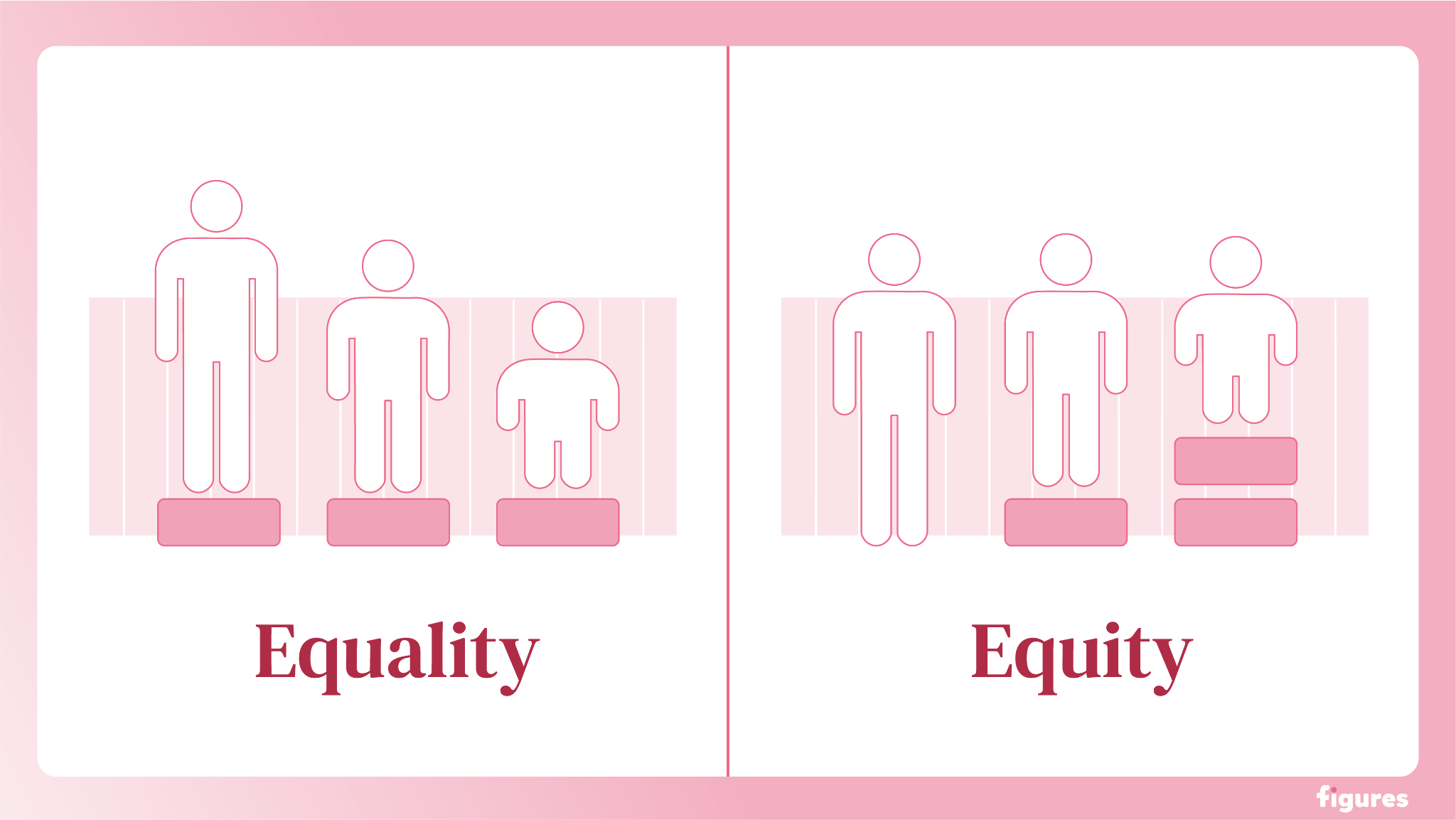
This is why equal-looking decisions can sometimes make the issues worse. You always need to take into account the starting point; otherwise, nothing is actually fixed.
Figures' suggestion matrix runs this calculation for every employee automatically, pulling performance, market data and band position together, so the correction is built in rather than something you have to spot by hand.
Lump sum vs permanent base pay
Merit increases are generally a permanent addition to base salary, not a one-off payment. But some companies hand out the same value as a lump sum that leaves base pay untouched, which will bring an entirely different outcome.
Let’s do an example with a 3% merit increase on a £60,000 salary.
- If you run it as a permanent raise for five identical cycles, the salary climbs to roughly £69,500, because each year's rise compounds on the last.
- If you pay it as five separate £1,800 lump sums instead, and the person banks the cash each time, their base is still £60,000 at the end.
For the employer, that's the whole trade-off. Lump sums keep costs tight, add nothing permanent to payroll, and come in handy when next year's revenue is uncertain. A permanent raise sends a much stronger retention signal, but it also compounds into pensions, percentage-based bonus targets, severance and parental leave pay for years afterwards.
Both have their place. Lump sums are genuinely useful for spot recognition, but when you lean on them as the default, you can’t really use merit pay as a retention tactic.
The pros and cons of running a merit programme
Merit pay isn't inherently the right call or the wrong one. It comes with genuine advantages and some equally genuine ways to get it wrong, no matter how good your intentions are. To make sure that doesn’t happen, you need a reliable programme you can defend.
Advantages of a merit programme
- It signals commitment. A permanent lift to base pay tells someone the company is backing them for the long term, not just clapping for a good quarter.
- It rewards the individual. People can see a direct line between doing the work well and what they take home.
- It ties pay to performance. Money flows toward the people creating the most value, which is rather the point.
- It imposes discipline. A fixed merit pool means every increase has to earn its place against every other one, so nothing gets waved through on autopilot.
Disadvantages of a merit programme
- Thin budgets don't move anyone. With a 3% pool, the difference between a "meets" rating at 2% and an "exceeds" rating at 4% is roughly £1,400 a year before tax on a £70,000 salary. That's not much to pin someone's sense of recognition on.
- Bias becomes permanent. Because the increase sticks, any unfairness in a single review compounds over time. Emilio Castilla's 2008 research found that employees with identical performance ratings still received different merit increases along gender and ethnic lines, and the language of "meritocracy" made those gaps less likely to be challenged.
- Differentiation rarely happens. 83% of employers still plan to spread increases fairly evenly rather than concentrate them on top performers or the skills they can't afford to lose.
As you can see in some of the examples, none of the downsides is fatal by design and it mostly depends on the intention and goodwill behind them.
- A budget too thin to differentiate can be topped up with one-off bonuses.
- Bias can be caught with calibration sessions and compa-ratio inputs.
- Salaries drifting off-market can be corrected with a separate off-cycle adjustment instead of being quietly baked into merit.
The trick is settling all of that before the cycle opens, not after the letters have gone out.
Pay equity, compounding inequity, and the EU Pay Transparency Directive
Thankfully, times are changing and so are the rules around pay. Still, not all businesses are up to date with the latest regulations. Among companies joining Figures, 82% sit above the 5% unadjusted gender pay gap threshold the EU Pay Transparency Directive treats as the line to stay under. Most aren't compliant the first time they measure it properly.
Merit cycles are part of how those gaps get built. As we mentioned earlier, when you give everyone the same percentage, you're applying it to salaries that were never level to start with. A 3% rise on a smaller salary is fewer pounds than 3% on a larger one, so the gap in real money widens a little every year, even while the percentage gap holds steady. And because the increase is permanent, nothing pulls it back.
So, to start closing gaps rather than widening them, you need to allocate the larger percentage to whoever sits furthest below their band midpoint.
The directive raises the stakes by expecting employers to justify pay decisions, not just make them. Every percentage in your matrix now needs a rationale you could show someone: performance, compa-ratio and market data, on the record.
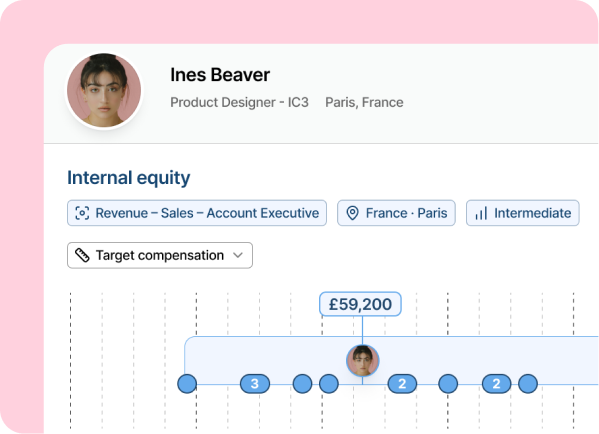
Figures' Pay Equity module runs alongside the compensation review, flags any gap over the 5% threshold within a peer group as decisions are made, and keeps that rationale on file. Our guide to the directive covers what it asks of employers in full.
What a defensible merit cycle looks like in practice
Now, enough of theory and statistics – let’s take a look at how you can perform a justifiable and fair merit cycle. You need:
- Salary bands built on current market data, so compa-ratio is measured against a real midpoint, not a number someone guessed at in 2022.
- A merit matrix signed off before the cycle opens, so the logic is agreed up front and not quietly bent once managers see who it affects.
- Calibration sessions across managers, so an "exceeds" in one team means the same as an "exceeds" in the next.
- Layered approvals with real teeth: hard rules that block an out-of-band raise outright, soft rules that let one through only with a written reason.
- An equity check before anything is signed, catching any decision that widens a gap inside a peer group while there's still time to change it.
- A recorded rationale for every number, so six months on you can say exactly why Priya got 6% and Tom got 3%.
And yes, you could do all of this in a spreadsheet. But it's slow, breakable, and unforgiving of the one pasted formula that overwrites a column. Figures' Compensation Review is built to hold the whole cycle: multi-budget campaigns, a sandbox for testing scenarios before they're real, live budget tracking, configurable hard and soft rules, salary letters generated in several languages, and the pay equity view sitting inside the same campaign rather than in a separate audit afterwards.
Swan, a European fintech, made exactly that move, from discretionary salary calls to objective ones, and finished the cycle with every employee positioned inside their internal bands. Their HRBP, Mathilde Sou, put it plainly: "Implementing a tool to manage our salary reviews forced us to structure our campaign much more precisely."
The timing sharpens it. The directive's transposition deadline has passed, and the first reports for employers with 250+ staff are due in June 2027 on this year's data, so the decisions you make this cycle are the ones you'll be defending then.
Ready for the Directive? We help you build a compensation policy you can explain to your teams, your candidates, and regulators.
Ask a demoFrequently asked questions
Is a merit increase permanent?
Yes. It's added to salary and stays there, so it also lifts everything calculated off base pay: future percentage raises, pension contributions and any percentage-based bonus.
How is a merit increase calculated?
Usually through a merit matrix, which crosses the employee's performance rating with their compa-ratio (current salary ÷ band midpoint) to produce a target percentage, then applies that to their current salary.
Is a merit increase the same as a bonus?
No. A merit increase permanently changes base pay and compounds year after year. A bonus is paid once and leaves base salary exactly where it was.
Is a 3.5% merit raise good?
On its own, 3.5% doesn't tell you much; it depends on the pool it came from. Out of a 3% pool it marks someone as a strong performer; out of a 5% pool the same figure signals the opposite.