Key points:
- PRP links pay to assessed performance, not discretion: objectives are set in advance, performance is formally rated against them, and the outcome directly affects pay – unlike a discretionary bonus, which has no structured criteria.
- 60% of UK employers use PRP, but coverage is uneven: management and professional staff are far more likely to be included than employees in other roles.
- Individual schemes drive the biggest productivity gains: group schemes weaken as team size grows, and financial participation schemes have smaller direct effects but help with retention.
- PRP can widen pay gaps if left unchecked: research found a 46.8% gender gap in average annual PRP amounts in the UK, making demographic audits before pay letters go out a requirement, not a nice-to-have.
- The EU Pay Transparency Directive raises the stakes: from June 2026, companies with 100+ employees must report pay gaps, and unexplained disparities over 5% trigger a mandatory joint pay assessment.
Most HR teams have sat through at least one meeting where someone said, "We should tie pay to performance." It sounds simple enough – until you're the person who has to figure out what that actually looks like for 300 employees across different teams, roles, and salary bands.
You start asking yourself: Which type of scheme fits your company? How do you stop manager bias from creeping into ratings? And how do you make sure you're not accidentally widening pay gaps?
This guide breaks it all down – from the mechanics of different PRP models to what it takes to run one fairly at scale.
{{ ai }}
What is performance-related pay?
Performance-related pay (PRP) is a compensation system where some or all of an employee's pay depends on a formal assessment of how well they've performed against pre-agreed objectives.
You'll see it called different things – merit pay, appraisal-related pay, pay for performance, but they’re all variations of the same idea.
Now, because this is related to performance, some people confuse it with a standard annual bonus (also known as a discretionary bonus or a “corporate Christmas miracle”). However, they aren’t the same.
A discretionary bonus is a one-off payment your employer decides to give, often to reward a specific achievement or as a morale booster. It doesn’t have formal criteria or a rating framework, compared to PRP, which follows a more structured process (more on that in a bit).
According to the CIPD's 2024 Pay, Performance and Transparency survey, around 60% of UK employers link pay to performance in some form – but that number tells a lopsided story. Coverage is heavily concentrated among management, professional, and technical staff, while employees in other roles are far less likely to be included.
Advantages and disadvantages of PRP
So, does linking pay to performance actually work?
The short answer: yes – but with caveats big enough to fill a compliance manual.
What PRP gets right
On paper, the logic is appealing. When people can see a direct connection between what they do and what they earn, they tend to put in more effort. The CIPD's factsheet on PRP groups the rationale under three headings:
- Motivating higher output.
- Rewarding individual contribution rather than just time served.
- Building a culture where performance genuinely matters.
Research from IZA World of Labor backs this up. They found that individual PRP schemes produce the largest productivity effects of any incentive structure.
For HR teams specifically, PRP replaces the dreaded "why did Sarah get more than me?" conversation with a transparent framework everyone can point to. For your strongest performers, it creates a much clearer connection between effort and reward than a flat, across-the-board increase ever could.
Where it falls apart
PRP only works when two conditions are met – fair measurement and transparent objectives. Remove either one, and your motivational tool becomes a demotivational one. Both the CIPD and IZA reach this conclusion independently.
Subjective ratings open the door to bias (conscious or otherwise), while poorly calibrated targets encourage people to game the system rather than genuinely improve. And when variable pay makes up too large a share of someone's total compensation – or when targets feel more aspirational than achievable – the result isn't motivation. It's stress, burnout, and a spike in your attrition rate.
Types of performance-related pay and when to use each one
The simplest way to think about PRP schemes is in two categories: short-term (rewarding output within a defined cycle) and long-term (tying compensation to the company's broader financial performance over time). There are also two models that sit across both categories. Here's how they break down.
Short-term schemes
- Piecework – employees are paid per unit of output. Common in manufacturing, logistics, and warehouse roles. Straightforward to measure, but it can push people toward speed at the expense of quality (e.g., 10 really good spoons vs. 100 weird-looking ones), and it simply doesn't translate to knowledge work.
- Commission – a percentage of sales revenue goes to the person who closed the deal. It's the default in sales teams across sectors, but it can breed a "lone wolf" culture where individual competition wins out over team collaboration.
- Payment by results – a bonus earned against independently appraised output. Works well for roles with clearly measurable deliverables, but you need objective, auditable metrics, or disputes will follow.
- Appraisal-related pay – salary progression tied to a formal review against pre-agreed objectives. This is the most common model for professional, managerial, and technical roles. The problem here is that it heavily depends on manager consistency and rating quality. Annual review cycles also delay recognition, which can push top performers to start browsing LinkedIn before their increase comes through.
Long-term schemes
- Profit-related pay – bonuses linked to company profitability, designed to create a sense of collective ownership. The limitation is that one person's effort has minimal visible impact on a company-wide profit number.
- Share options – equity that vests over time, primarily used to retain senior or specialist staff. The value is tied to market conditions that employees can't control, which can feel frustrating when performance is strong but the share price isn't cooperating.
Cross-cutting models
- Merit pay – increases based on a general assessment of someone's contribution. Less structured than appraisal-related pay, which makes it flexible but more vulnerable to subjectivity.
- Competence-based pay – linked to demonstrated skills and capability development rather than output. Useful where growing someone's abilities matters more than hitting a quarterly target, though defining "competence" can get vague quickly.
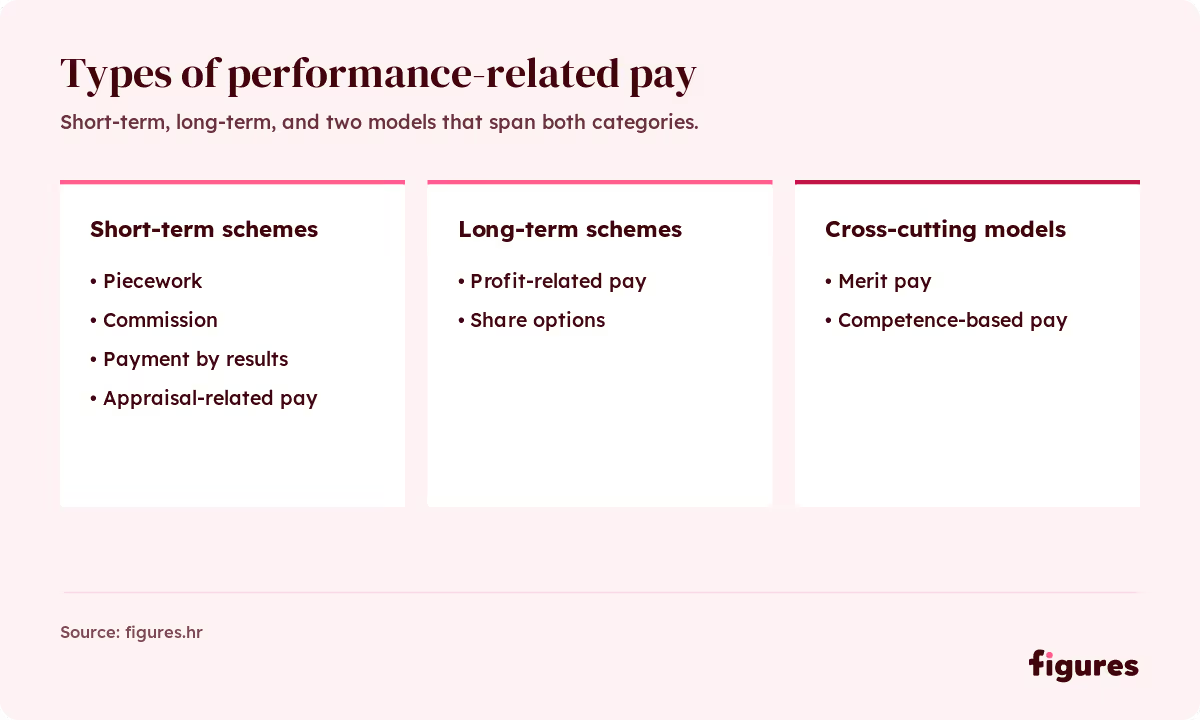
Here's how they compare side by side:
⚠️ Important: Merit and appraisal-related increases are typically permanent – they get built into base salary once awarded. Bonuses, commission, and piecework, on the other hand, reset each cycle. A 3% merit rise compounds year on year; a 3% bonus does not.
And when it comes to productivity, IZA World of Labor found that individual schemes produce the largest gains. Group schemes suffer from what economists call the "1/N problem" – the bigger the team, the weaker each person's incentive to pull their weight. Financial participation schemes (profit-sharing, share ownership) show the smallest direct productivity effects, but they do reduce turnover, which has its own value.
For a deeper look at how commission, bonuses, and profit-sharing fit into the bigger picture of total compensation, Figures' fixed vs. variable pay guide covers the mechanics in more detail.
Make pay decisions you can defend to your CFO, your team, and EU regulators. Get a custom demo
Examples of PRP in practice: sector and industry variations
PRP doesn't look the same everywhere. What counts as "standard practice" in a sales team would raise eyebrows in a council office – and vice versa. Let’s take a peek:
- Sales is where commission-based PRP is the default, and the incentive is about as direct as it gets: close deals = profit. No ambiguity about what "good performance" means.
- Professional services and management lean toward merit pay tied to annual appraisal. It's the classic model – your manager reviews your year, rates your contribution, and that feeds into your pay increase.
- Financial services use PRP extensively, but with guardrails. Post-2008 regulations put constraints on bonus structures that could incentivise excessive risk-taking, so scheme design here is more tightly controlled than in most other industries.
- The public-private gap is significant. According to the CIPD's 2024 survey, 69% of private-sector organisations use PRP in some form, compared with just 34% in the public sector. And even within the public sector, the trend is moving away from PRP in some areas. Maintained schools in England dropped mandatory teacher PRP from September 2024 after the Workload Reduction Taskforce concluded it works poorly in practice.
- In local government, the picture is even starker. Only around 15% of councils use performance or contribution-related pay progression, with the majority (77%) relying on time-served increments instead.
One emerging trend worth watching: research published in the British Journal of Industrial Relations found that working from home shifts PRP away from individual schemes and toward collective ones – think profit-sharing and team bonuses rather than solo performance targets.
If you're benchmarking your PRP approach against what's typical in your industry, Figures' benchmarking tool draws on 3.5M+ Mercer data points filterable by sector and geography.
How performance ratings translate into pay increases
Getting the ratings right is hard enough, but it doesn’t end there. The next step is to translate them into actual pay numbers, which adds another layer of complexity. Let’s see how that’s done.
Pay bands and the compa ratio
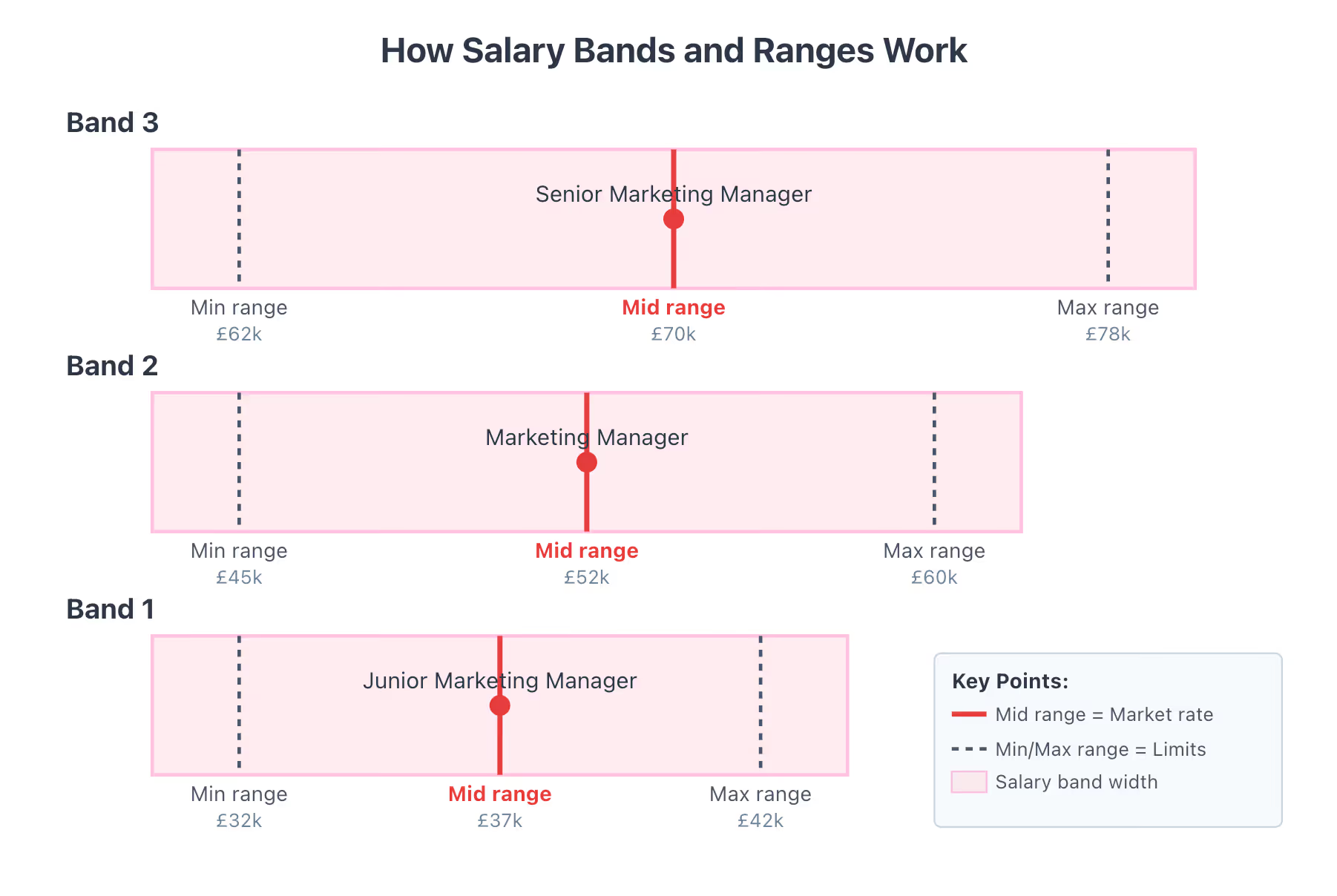
Most PRP schemes operate within a salary band structure. Each role has a minimum, midpoint, and maximum salary, and an employee's position within that band is tracked using something called a compa ratio: their actual salary divided by the band midpoint, expressed as a percentage.
With bands, two employees can receive the exact same performance rating and still get different percentage increases – and that's by design.
Say you have an employee earning £42,000 in a band with a £50,000 midpoint. Their compa ratio is 84%, which means they're sitting well below the market rate for their role. They'd typically receive a larger percentage increase than a colleague earning £55,000 (a compa ratio of 110%) who got the same rating. The logic is simple – the first employee has more room to grow within the band, and bringing them closer to the midpoint keeps pay competitive.
All-merit vs. basic-plus-merit
Companies generally distribute their pay review budget in one of two ways.
- All-merit schemes put the entire budget in the hands of performance ratings. No guaranteed increase for anyone – everything depends on your assessment. This model creates sharp differentiation between performance levels, which suits organisations that want to reward top contributors aggressively.
- Basic-plus-merit schemes give everyone a standard cost-of-living or inflation-linked increase first, then layer a performance-based increment on top. This approach offers a safety net – nobody's pay goes backwards in real terms just because they had an average year. It tends to work better in organisations where stability and trust matter as much as differentiation.
Performance is one input, not the only one
Fair pay decisions require at least three inputs: the performance rating itself, market benchmarking data, and the employee's position within their salary band. Lean too heavily on any single factor and something breaks – either your competitiveness, your internal equity, or your employees' trust.
We'd always recommend treating performance as one ingredient in the mix, not the whole recipe. And whatever your variable pay outcomes look like, base salaries need to hold up on their own – no one should be relying on hitting every target just to cover their rent.
What a company needs to implement PRP successfully
Step 1: Build your salary bands first
This might sound obvious, but you can't position someone within a pay band if bands don't exist yet. The compa ratio mechanics we covered in the previous section only work when every role has a defined minimum, midpoint, and maximum.
Here’s an example of how these might look for a marketing role:
Step 2: Get your measurement approach right
Vague objectives lead to vague ratings, which lead to arguments. The goals you're assessing people against need to be specific, measurable, and agreed upon before the review period begins. Even better, co-create them with employees rather than handing them down from above. When people help shape their own targets, they're more invested in hitting them and far less likely to dispute the outcome.
Retrospective impressions are not a rating framework. If a manager can't point to pre-agreed criteria when explaining a score, the system isn't working.
Step 3: Train your managers
Two managers using the same rating scale can produce wildly different results if they haven't been calibrated. The CIPD acknowledges that subjective measures are vulnerable to bias, and IZA's research confirms that prejudice and favouritism routinely affect subjective ratings.
Manager training needs to cover both consistent rating practices and awareness of unconscious bias, and it should become a regular part of your review process.
Step 4: Communicate before you launch
Employees need to understand the criteria and how ratings connect to pay before their first review cycle – not during it. If the first time someone hears about the rules is when they're being assessed, you've already lost their trust.
Step 5: Create an appeals process
Any scheme without a way for employees to challenge their rating will erode confidence over time. Even if appeals are rare, the fact that the mechanism exists signals that the organisation takes fairness seriously.
And speaking of fairness – this isn't optional. Jones & Kaya (2024) found a 46.8% gender gap in average annual PRP amounts in the UK: £7,198 for men compared to £3,832 for women. The Equality and Human Rights Commission has warned that PRP can increase the risk of unequal pay between men and women (cited in the UNISON PRP Negotiators' Guide).
Companies shouldn’t wait for a complaint to land on someone's desk to audit PRP outcomes by demographic group.
⚠️ The June 2026 reality check: Under the EU Pay Transparency Directive (effective June 2026), companies with 100+ employees must report pay gaps. Any disparity over 5% that can't be objectively justified triggers a mandatory joint pay assessment. If your PRP scheme is producing uneven outcomes you can't explain, this is the deadline that makes it your problem.
Step 6: Pair PRP with development support
A scheme that rewards performance without investing in the skills to improve it will plateau fast. When someone falls short of their targets, the response shouldn't just be a smaller pay rise – it should be a development conversation that gives them a clear path forward.
Link your PRP outcomes to learning and growth, and the scheme starts lifting the whole organisation rather than just sorting people into winners and losers.
All six steps above are straightforward individually, but running them simultaneously across hundreds of employees, within budget, on a deadline, is a different challenge entirely.
How you can run PRP fairly at scale
Everything we've covered so far adds up to a level of complexity that spreadsheets simply weren't built to handle. And the fairness stakes are too high for manual workarounds. As we saw in the implementation section, PRP schemes can widen pay gaps if outcomes aren't audited by demographic group before decisions go out.
Compensation platforms solve this by pulling performance ratings, compa ratios, and market benchmarking into a single workflow. They auto-generate recommended increases, apply configurable rules to catch out-of-policy raises, and flag equity issues in real time – not three months after letters have been sent.
Figures' compensation review module does exactly this. The suggestion matrix combines your performance data with band positioning and live market benchmarks (powered by 3.5M+ Mercer data points) to produce a recommended increase for every employee. You can run multiple budget campaigns – merit, promotions, off-cycle adjustments – in one place, and test parameters in sandbox mode before anything goes live.
Make compensation decisions you can defend to your CFO, your team, and EU regulators. Book a custom demo.
FAQs about performance-related pay
How do managers objectively measure employee performance for pay decisions?
The most reliable approach combines quantitative targets (revenue generated, projects delivered, measurable KPIs) with qualitative assessment (leadership, collaboration, problem-solving). Neither type works well on its own – pure numbers miss context, and pure judgement invites bias.
The other piece that makes a real difference is calibration: sessions where managers compare and align their ratings across teams before pay decisions are finalised. This catches inconsistencies between "tough graders" and "soft graders" before they affect someone's pay. Figures' calibration guide covers the full process if you're setting this up for the first time.
Whatever approach you use, the objectives being assessed should be pre-agreed and reviewed against evidence – not based on a manager's general impression of how the year went.
Is PRP the same thing as a PIP?
No. PRP (performance-related pay) is a compensation framework that links pay to assessed performance. A PIP (performance improvement plan) is a structured process for addressing underperformance. One rewards contribution; the other addresses a problem. The abbreviations are confusingly similar, but they serve completely different purposes.
Does PRP actually motivate employees?
The evidence says yes – but with conditions. Research from IZA World of Labor found that individual PRP schemes produce the largest productivity gains of any incentive structure, and the CIPD's 2024 survey found that 79% of employers using PRP reported a net positive impact on performance. But those gains depend on two things being true: employees need to feel the amount on offer is fair (distributive justice), and they need to believe the rating process itself is fair (procedural justice). Remove either condition and the motivational effect collapses – or reverses.
Can PRP increase stress or negatively affect employee wellbeing?
It can, particularly when variable pay makes up too large a proportion of total compensation or when targets feel unrealistic. IZA's research flags that PRP can lead to work intensification, excessive strain, and psychological stress – and that short-term productivity gains may come at the cost of long-term employee health.
The practical takeaway for HR teams: make sure base salaries remain livable without the variable component, keep targets stretching but achievable, and monitor workload alongside performance metrics.