Key points:
- An HRIS and a compensation platform are a generalist and a specialist – most growing companies need both.
- The big suites build real compensation modules; a specialist platform adds depth they aren't built for.
- The EU Pay Transparency Directive changes the urgency. From June 2026, employers must document how salary ranges were set and justify pay gaps exceeding 5%.
- Under 250 employees, you may not need a specialist platform yet; the inflection point usually lands between 250 and 500.
Your HRIS is good at a lot of things. It holds your people data, feeds payroll, tracks time off, and handles compensation, at least the basics. For a good while, that's plenty.
Then your business grows, and the comp questions get harder. Maybe your last merit cycle ended up back in a spreadsheet because the module couldn't handle split budgets. Maybe someone asked how your salaries compare to the market, and the most honest answer was a shrug. And that's before anyone brings up pay equity or the gender pay gap.
This is the point at which many HR teams start wondering whether they need a dedicated compensation tool on top of their HRIS. It's a fair question, and the honest answer is that it depends on what you're trying to do. So let's work through what each tool is actually for, and when adding a specialist layer earns its place.
What HRIS and compensation platforms are built for
The simplest way to think about it: an HRIS is a generalist, and a compensation platform is a specialist. Neither is necessarily better than the other. They're built to do different jobs.
An HRIS is your system of record, and it's built to be broad. It holds job titles, levels, locations, and salary history, and its compensation module uses that data to run merit cycles, track salary changes, and route approvals. The big HRIS suites are genuinely good at this – Workday, SAP SuccessFactors, HiBob, and Personio, to name a few.
A compensation platform is the specialist. It specialises in compensation and covers the whole of it: benchmarking against external market data, building and maintaining salary bands, modelling scenarios, analysing pay equity, and running the multi-step workflows that compensation planning actually involves. It's the layer where pay decisions get planned and justified before they ever reach payroll.
The difference is depth, not capability. A generalist module covers compensation as one feature among hundreds. A specialist platform treats it as the entire product – which shows up in the detail once you put the two side by side.
Beyond spreadsheets and traditional salary surveys, that leaves two real options: an HRIS with a compensation add-on, or a platform built solely for compensation. Most companies start with the first. The question is when you add the second.
Three signs you've outgrown a generalist comp module
There's usually a moment when a generalist module stops keeping pace with what your comp team needs to do. The work isn't getting worse – it's getting more specialised. The signs are easy to spot.
Sign 1: your benchmark data is a snapshot, not a feed
Most generalist modules surface market data as a periodic download – a salary survey that refreshes quarterly at best, or a static export you map to your roles by hand. Plenty of those surveys are thorough. The catch is timing: by the time the data lands in your system, it can be six months or more behind the market.
That's fine for an annual look at where you sit. It's harder when you're pricing offers continuously, because a salary you set in Q1 might be built on data from the back half of last year – the difference between landing a candidate and losing them.
If your team has been filling the gap with free sources like Glassdoor or LinkedIn salary data, the problem compounds. Self-reported figures, no job-level granularity, no way to verify what's real. They're fine for a rough gut-check on the market. For structured pay decisions, they won't hold up.
A specialist platform treats benchmarking as a live feed rather than a document you read once a quarter. Figures, for instance, pairs monthly Mercer data across 3.5M+ data points with the audit trail you'll want when someone asks how a salary was set. Often it's the same underlying data the big suites use – Figures runs on Mercer, and so does HiBob. The difference isn't the source. It's whether that data lives in a platform you can act on, or sits in a PDF that's already ageing.
Sign 2: your approval workflows can't flex
A generalist module tends to follow one approval path. One budget category, one cycle, one route through the system. That works when you're running a single annual merit cycle, in one country, with a straightforward pay structure.
It gets harder when you need to:
- Manage separate budget pools for merit, retention, and market adjustments
- Run off-cycle adjustments (Mercer's March 2025 Compensation Planning Survey found over 60% of organisations plan to provide these)
- Route approvals conditionally across departments and countries
- Model the cost and equity impact of a proposed change before committing to it
A specialist platform is built for exactly this. Figures' compensation review module includes a sandbox for testing scenarios, auto-generated recommendations based on performance and band positioning, and configurable guardrails that ask for a justification on out-of-policy raises. Having that reasoning documented matters more than it used to under the EU Pay Transparency Directive, which we'll come to.
Sign 3: you've fallen back to spreadsheets
We've nothing against spreadsheets in principle. They're brilliant for plenty of things. Managing compensation strategy isn't one of them – not once you're juggling fifteen versions of the same file, chasing managers who haven't submitted their numbers, and catching the formula error that quietly multiplied someone's salary by a thousand.
The deeper issue is that spreadsheets don't keep a record. There's no documented reasoning behind a decision, no real-time view of the budget, and no approval routing beyond an email chain. That's an operational headache today. Under the new pay transparency rules, it's also a gap you'll want closed.
Why the EU Pay Transparency Directive changes the timeline
Pay transparency isn't only a compliance deadline. It's a fundamental shift in what employees, candidates, and regulators expect you to be able to explain – and it's where the difference between a generalist module and a specialist platform starts to matter most.
The EU Pay Transparency Directive took effect on 7 June 2026. Among other things, it requires employers to:
- Share salary ranges with candidates during recruitment
- Respond to employee requests for pay information, broken down by sex
- Stop asking applicants about their salary history
Gender pay gap reporting follows for larger employers: companies with 250+ employees report first by June 2027 and annually thereafter, with the obligation extending down to companies of 100+ employees by 2031. Where a pay gap above 5% can't be explained by objective, gender-neutral factors, a joint assessment with employee representatives is triggered.
In practice, that means being able to show how a salary range was set, which market data informed it, and why an individual sits where they do within the band. A record of the final number isn't the same as a record of how you got there – and it's the second one the directive asks for.
‼️ Worth knowing: 82% of companies joining Figures have pay gaps above the 5% threshold. If you haven't looked at your own numbers yet, the directive is a good reason to start.
There's a second-order point here too. This is fast-moving regulation, and national transposition will keep shifting the detail (for updates, see our European Pay Transparency Directive Tracker). A platform built specifically around the directive can adapt to those changes more quickly than a broad HR suite reprioritising a roadmap that spans every corner of HR.
When a generalist HRIS is enough (and when it isn't)
Compensation software is the bees’ knees. But we’re honest folks at Figures, and we’d be lying if we said that comp software is a good fit for every company. Frankly, its utility depends heavily on the size of your business.
Under 250 employees, in a single country, with one annual merit cycle and a straightforward pay structure? Your HRIS module is probably doing the job. It's lighter on depth and flexibility, but at that scale those limits may not be costing you anything real – unless retention is already under pressure.
Between 250 and 500 employees, the gap tends to turn operational. A specialist platform earns its place if:
- Employees or regulators are asking you to defend your pay ranges
- Pay equity questions are getting harder to answer with the data you have
- You're hiring across multiple countries with different market rates
- You've added variable pay alongside base salary
- You're running more than one compensation cycle a year
Building the internal business case
If you're making the case internally, the framing that tends to land with finance is the cost of inaction. That comes down to three things: time lost to manual processes (Figures saves roughly three weeks per compensation review cycle), readiness for the EU Pay Transparency Directive, and talent lost to offers priced on stale data.
Lucca is a French HR software company with 450+ employees. They build HR tools for a living – and they still use Figures for salary benchmarking. When an HRIS vendor adds a specialist compensation platform for its own pay decisions, it's a useful signal. The two aren't rivals. They're layers.
For European companies with between 250 and 5,000 employees seeing the signs above, Figures is built for exactly this. It covers the full compensation lifecycle – compensation reviews, pay equity analysis, salary bands, and EU Pay Transparency Directive compliance – with monthly Mercer data across 3.5M+ data points, 30+ HRIS integrations.
Want to see how it fits your setup? Book a demo today.
How a compensation platform and your HRIS work together
This was never an either/or situation. A compensation platform is built to complement your HRIS, not replace it.
It connects to your existing HRIS through an API or a pre-built connector, and pulls employee data automatically – job titles, levels, locations, and salary history. Your HRIS stays exactly where it is, as the system of record for your people data. The compensation platform sits on top, handling the planning, benchmarking, and analysis. The data flows from one to the other, which is precisely why these tools work better together than apart.
Setup is quicker than you might expect. Pre-built connectors typically go live in two to four weeks. Custom API integrations take longer – roughly eight to twelve – but those are the exception, not the rule.
Yes, a specialist tool means another vendor to manage. That's a fair concern. For companies past the thresholds above, the depth in benchmarking, scenario modelling and compliance tooling tends to outweigh the cost of one more login.
🤔 If security comes up in procurement: Figures holds triple certification – SOC 2 Type 2, ISO 27001, and GDPR – with European data residency, and it integrates with 30+ HRIS platforms, including Workday, HiBob, and Personio.
Finding the right compensation platform for your team
If you've read this far and recognised your own company in the signs above, a specialist platform is probably worth a look. We've got one in mind.
Figures is built specifically for European companies with between 250 and 5,000 employees. It covers the full compensation lifecycle in one place – from compensation reviews and pay equity analysis to salary bands and EU Pay Transparency Directive compliance – backed by monthly Mercer data across 3.5M+ data points.
What you're really adding isn't only software. It's a team that lives and breathes European compensation and provides personalised support, plus a product that moves as fast as the regulation does.
The results back it up. Swan, a European fintech, reached 100% of employees positioned within their internal salary bands after implementing Figures' compensation review module. As Mathilde Sou, HRBP at Swan, put it: “Implementing a tool to manage our salary reviews forced us to structure our campaign much more precisely.”
Pricing is fully custom to your needs, and it is built for the mid-market from the ground up, rather than an enterprise platform scaled down to fit.
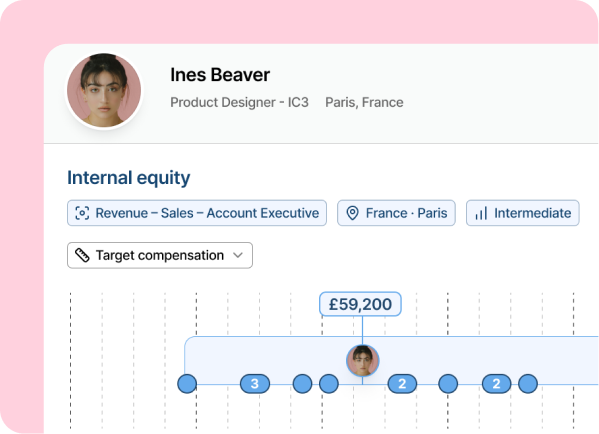
Book a free demo and see how it fits your setup.
Ask a demoFrequently asked questions
How do dedicated compensation tools handle scenario modelling and off-cycle pay adjustments compared to a standard HRIS?
A specialist platform lets you model the cost and equity impact of a change before you commit to it – a sandbox, what-if scenarios across departments and geographies, and side-by-side comparisons of different budget allocations. For off-cycle adjustments like retention grants or counter-offers, it supports conditional approval routing that adapts to the type of change, the amount, and who needs to sign off, with budget visibility staying live across every concurrent process.
A generalist module is built around the standard annual cycle. Running anything outside that usually means manual exports, IT workarounds, or – you guessed it – spreadsheets.
What are the best compensation software options for different company types?
It depends on where you operate and how many people you employ.
- EU mid-market (250–5,000 employees): Figures covers the full compensation lifecycle – compensation reviews, pay equity, salary bands, and EU Pay Transparency Directive compliance – with Mercer benchmarking data and 30+ HRIS integrations.
- US-centric companies: Pave offers strong equity communication tools and US market data. Payscale provides AI-driven job matching at enterprise tiers.
- Large enterprises (5,000+ employees): Beqom handles total rewards, including commissions and long-term incentives. PeopleFluent supports multi-HRIS environments with concurrent processes.
- All-in-one HRIS with a compensation add-on: Workday (enterprise, strong on US equity), HiBob (mid-market, Mercer Comptryx data), Personio (European, partner data for benchmarking).
For a closer side-by-side, Figures' compensation platforms guide breaks down pricing, features, and sizing across all three categories.
Is compensation part of HRM?
Yes – it's just one of the areas where a generalist tool and a specialist tool do different depths of the same job. Compensation sits within HRM as a function, which is why most HRIS platforms include a compensation module. Those modules handle the administration well – recording pay changes, routing approvals. The strategic side (benchmarking, scenario modelling, pay equity analysis) is where a specialist platform goes deeper, which is why many HR teams add one on top of their HRIS rather than instead of it.
What's the difference between payroll and compensation?
Payroll is execution. It processes payments, calculates deductions, and makes sure everyone is paid correctly and on time. Compensation is the strategy behind what people are paid and why – base salary, bonus structures, salary bands, market benchmarking, and pay equity. Compensation planning happens upstream; payroll happens downstream. Dedicated compensation software like Figures operates in that upstream space – it plans and justifies pay decisions before they ever reach the payroll system.