Key points:
- Layoffs rarely deliver lasting savings: Poorly planned cuts often trigger contractor hiring and aggressive rehiring that erodes the savings within months.
- Compensation is the largest and most controllable HR cost line: Auditing salary bands against live market data surfaces overpayment and retention risk without touching headcount.
- Most companies are already exposed on pay equity: 82% of companies joining Figures exceed the 5% gender pay gap threshold–putting them in scope for mandatory assessments under the EU Pay Transparency Directive (June 2026).
- Sustainable savings require measurement discipline: Only 11% of organisations sustain cost reductions for three years – because tracking breaks down after the initial effort.
The economy is tough, and you need to spend smarter and spend less. And somehow, you're expected to thread that needle without losing your best people or landing in legal trouble.
You're not alone. Gartner reports that 65% of HR leaders anticipated flat or decreased budgets in 2025. So, you’ll need an HR cost-reduction strategy to address the shortfall while maintaining compliance obligations.
HR cost reduction is the discipline of reducing spend across compensation, recruitment, technology, and administration. All while ensuring you’re not creating downstream costs that wipe out the savings before you've had a chance to celebrate them.
It’s a delicate dance, but we’re here to help you master the HR habanera. We’ll cover a structured methodology for reducing costs, within two firm constraints: no layoffs (which often fail to reduce operating expenditure anyway), and no compliance risk. Let’s go.
{{ ai }}
Where HR costs come from and how to prioritise
Before you start cutting anything, it helps to know what you're actually spending. Most organisations haven't properly baselined their HR costs by category, which means they end up snipping at the wrong things.
So let’s break down a typical HR cost structure:
Eurostat data shows non-wage costs account for around 25% of total labour costs across the EU, meaning wages and salaries dominate the bill. It’s for that reason that many who want to cut costs quickly will cut the workforce first. But you need to think of the risks first, before you start making changes that could cripple your business in the long run.
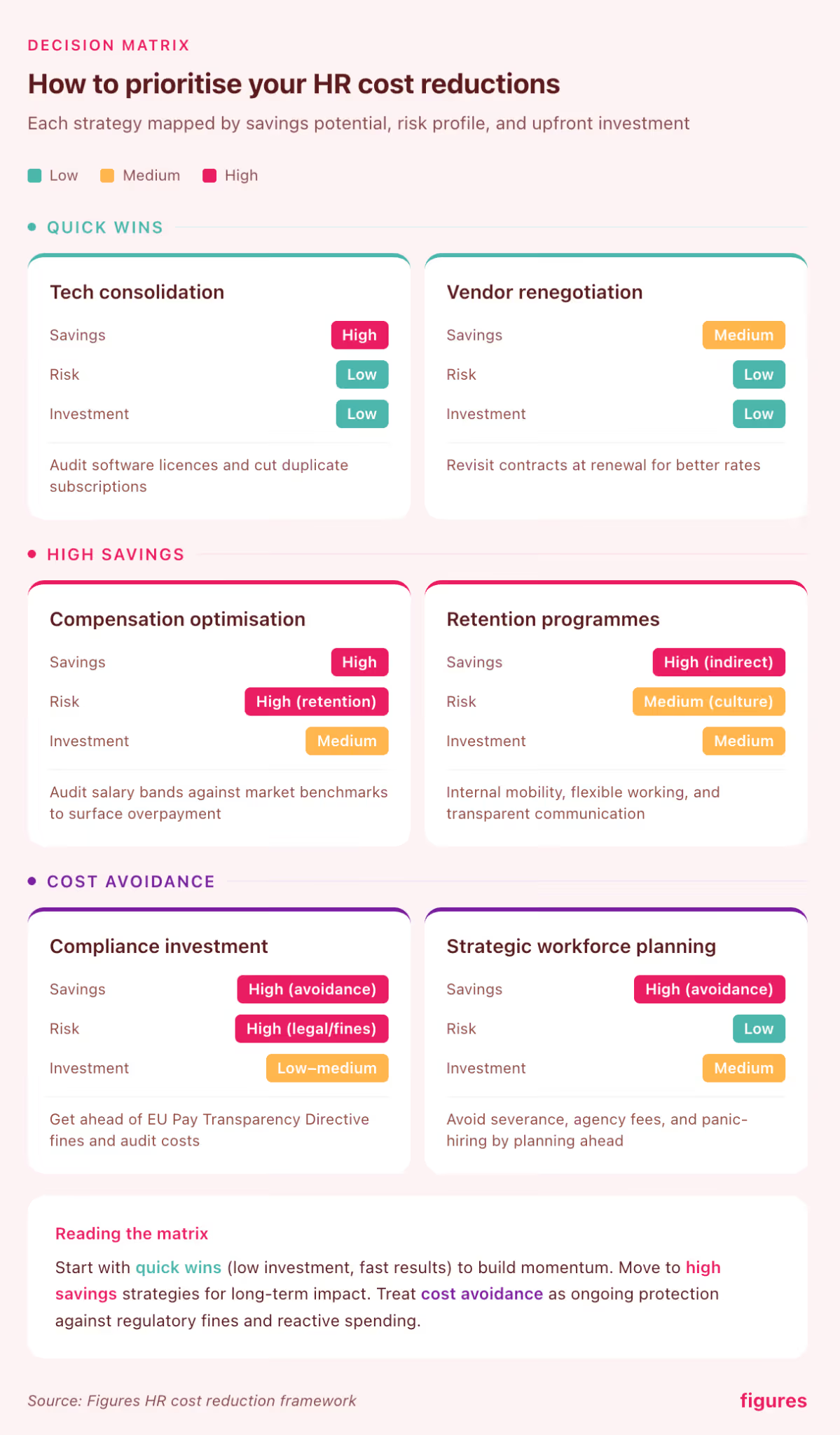
Not all cuts carry the same risk. Some save money quickly with minimal fallout. Others require investment upfront but protect you from far higher costs down the line. The matrix below maps the main levers across three dimensions – savings potential, risk profile, and upfront investment required – so you can see at a glance where to start.
Keep this in mind, because the rest of this article follows this matrix. We'll work through quick wins first, then the higher-effort, higher-reward strategies. Then, we'll finish with how to avoid the expensive reactive cuts that tend to undo the progress.
Quick wins: HR cost reduction strategies
Let’s take a look at the strategies that you can actually start this quarter.
Audit your software licences first
Most HR teams accumulate tools gradually. A new ATS here, a pulse survey platform there… eventually, nobody's quite sure what's live, what's redundant, and what three people use once a year.
A full inventory of what you're paying for versus what's actively used will almost always surface overlap. Duplicate subscriptions and seats nobody touches are quiet drains that rarely get flagged in budget reviews.
Renegotiate vendor contracts
If you haven't revisited your contracts recently, there's a reasonable chance you're paying above current market rates. Vendors expect renegotiation, especially at renewal. You don't need to threaten to leave; you just need to ask.
🤔 Always prepare yourself for the negotiation. A solid strategy can help you get a better deal; know what your bottom line is and where you’re willing to compromise. Plus, don’t be afraid to leverage competition and understand what other offers are available on the market.
Automate repetitive admin
Payroll processing, onboarding workflows, and compliance reporting all eat into HR hours without adding strategic value. So, you can get more bang for your buck by automating those processes.
Automation takes longer to show ROI than a simple licence cut, but the savings compound month over month. The time you recover is reinvested in something useful.
💡 What does that look like in practice? Let’s look at Swan, the European Banking-as-a-Service company, which replaced Excel-based compensation reviews with a dedicated platform and saved approximately three weeks per review cycle – time their HR team reinvested into deeper, more considered salary decisions.
High savings: Compensation optimisation and retention strategies
This may seem like a strange point to make, but making employees stay in the long run and getting your salary bands in working order will save you a pretty penny. But to see those benefits, you’ll need to look at the bigger picture. So let’s paint it for you.
Why retention is cheaper than recruitment
Replacing an employee typically costs between six and nine months of their salary. That's recruitment fees, onboarding time, lost productivity while the new hire gets up to speed, and the institutional knowledge that walked out the door with them.
The thing is, most departures are preventable. Research found that 35% of workers planning to quit cite better pay and benefits as their primary reason for leaving, making compensation the single most common driver of avoidable turnover.
So before you look for costs to cut, check what poor retention is already costing you.
A few retention levers that also reduce spend:
- Internal mobility over external hiring: Filling roles from within eliminates agency fees entirely and dramatically reduces onboarding time. It also sends a clear signal to your team that progression is possible, which the CIPD Good Work Index 2025 confirms is one of the strongest predictors of whether employees plan to stay.
- Flexible working as a dual-purpose lever: A reduced office footprint lowers facility overhead, and employees genuinely value flexibility – so the cost savings compound with lower voluntary turnover. Not every role allows it, but where it does, the maths tend to work in your favour.
- Transparent communication during cost-cutting periods: This one's underrated. Gartner's guidance explicitly warns that without clear communication, cost-reduction efforts trigger fear and rumour, which pushes top performers out at exactly the wrong moment.
At the end of the day, this is all about making employees feel valued. If you’re constantly outsourcing talent and your internal practices are more secretive than the Kremlin, your employees are going to have a bad time, and so are you. These practices cost nothing to implement, but the impact on retention can be massive.
Auditing compensation spend against market benchmarks
Compensation is the largest HR cost line in almost every organisation, yet most cost-reduction advice treats it as a single bullet point: "review compensation packages." That statement is about as helpful as "perform brain surgery", because if you don’t know what you’re doing, you’ll cause more damage than prevent it.
So, let’s give you an actual, defensible strategy.
Step 1: Establish salary bands using market data.
Set clear pay ranges for each role, level, and location. Make sure you’re basing this on current market rates, and not survey data from last year. And for Godsakes, don’t use Glassdoor for this!
Step 2: Map every employee against those bands.
This is where you find the real picture. Two things will show up:
- Employees sitting above the band: Overpayment relative to market. This is an immediate, quantifiable cost-reduction target that doesn't require losing anyone.
- Employees sitting below the band: Underpayment, which is a retention risk in motion. Using the replacement cost formula, these are your highest-priority flight risks.
‼️ Before you start cutting employee pay, recognise the risk first! You could push affected employees toward the door, and cause claims to be levied against your business if there are issues with contracted pay. Thankfully, you can avoid this with step three.
Step 3: Prioritise and act.
Salaries above the 75th percentile of the band represent genuine excess spend. Salaries below the 25th percentile represent the highest churn risk. Both are actionable without touching headcount.
For employees whose pay has drifted above market, two approaches tend to work:
Neither involves cutting anyone's pay outright. Instead, they're structural corrections over time. Swan went through exactly this process after implementing a structured compensation review. The result was that 100% of employees were positioned within salary bands, with every decision backed by data rather than gut feel.
Now, if you want to be like Swan, you’ll need solid benchmarks. But where do you get them? Surveys are often outdated and costly. And self-reported salary benchmarking platforms can be highly inaccurate.
This is where the Figures' Benchmark module becomes genuinely useful. The platform maps each employee's salary against market benchmarks using monthly-updated data across 3.5 million+ data points, filtered by level, location, industry, and company size.
If running this audit is your next step, booking a demo is a good place to start.
Cost avoidance: Protection from regulatory and operational exposure
Cost avoidance is just as important as cost reduction. There’s no point in saving cash only to have to pay a compliance fine or throw it at a business expense that could’ve been avoided.
Granted, both require different solutions. Let’s start with the simpler of the two first.
How compliance investment prevents higher costs
It might feel counterintuitive to spend money on compliance when you're trying to cut costs. But framing compliance as a cost is the wrong way to look at it – it's cost avoidance, and in almost every scenario, getting ahead of it is cheaper than scrambling to fix it later.
The EU Pay Transparency Directive, which comes into force in June 2026, creates specific financial exposure for European companies:
- Reversed the burden of proof in pay discrimination cases, meaning the employer must demonstrate they didn't discriminate, not the other way around.
- Mandatory joint pay assessments when the unadjusted gender pay gap exceeds 5%.
- Public reporting obligations for all companies with 100 or more employees.
Worryingly, based on data from companies joining the platform, Figures found that 82% already have pay gaps exceeding the 5% threshold. That means the majority would face mandatory joint assessments under the directive if it were enforced today. Still, you’ve got time to fix that.
But fix it you must, because the cost of non-compliance goes well beyond any fine. There's the productivity lost to audit remediation, the legal time, and the reputational damage during a period when attracting talent is already difficult. Proactive compliance is, pound for pound, one of the highest-return investments an HR team can make right now.
Ensuring your business is compliant can have its own hurdles, but there are platforms that can help.
Take Figures' Pay Equity module, for example. It automatically generates compliant reports, identifies gaps above the 5% threshold, helps you understand their root causes, and lets you model remediation scenarios against your actual budget. Rather than commissioning an external audit every year, you have a live view of your exposure. Plus a plan to address it (isn’t that nice?).
Using workforce planning to avoid reactive cuts
The most expensive HR costs are often the ones that didn't have to happen.
Gartner's analysis found that poorly planned layoffs frequently lead to contractor hiring, overtime spend, and aggressive rehiring shortly afterwards. Kiss that sweet money goodbye.
Strategic workforce planning helps to address this. Instead of reacting to cost pressure with blunt headcount decisions, you're anticipating where skills gaps form and addressing them before they become critical. The scenarios it prevents are some of the most expensive in HR:
- Panic-hiring at premium rates when a gap becomes urgent
- Paying severance for roles cut in a downturn, then rehiring for the same function six months later
- Running training programmes for skills that the business has since moved away from
When reductions are genuinely necessary, target them against strategic priorities – not across-the-board percentages. Roles that don't map to where the business is heading in 12–18 months are ripe for restructuring. Roles that do are retention risks disguised as cost lines.
Contingent workers and contractors can cover short-term skill gaps without permanent headcount, though you’ll need to keep an eye on worker misclassification risk. Misclassifying employees as contractors is a compliance exposure in its own right, which loops right back to where we began. Step forward, people, not backwards. ‘
Action your cost reduction plan this quarter
You've got the framework. Now it's just about starting.
Pick one quadrant from the matrix and identify the single largest opportunity in your organisation. For most mid-market companies, that turns out to be compensation – it's the biggest line item, and it's where overpayment, underpayment, and compliance exposure tend to quietly accumulate.
Figures provides the benchmarking infrastructure and pay equity analysis that make the strategies in this article actionable, rather than something in a spreadsheet that gets revisited once a year.
Book a free demo and see how it works for your organisation.
FAQs about reducing HR costs
Which metrics tell you if HR cost reduction is working?
Tracking the right numbers is what separates sustainable savings from costs that quietly rebuild within 18 months. Only 11% of organisations sustain savings for three years, according to Gartner. That’s largely because measurement discipline breaks down after the initial effort.
So keep that discipline in place by tracking these metrics:
- Cost per hire: measures recruitment efficiency and flags over-reliance on agencies
- Voluntary turnover rate: weighted against the replacement cost formula to show the real financial impact
- Compa-ratio: identifies over- and underpayment against market benchmarks at the individual level
- Benefits utilisation rate: surfaces perks nobody's actually using, which is where benefits leakage tends to hide
- HR cost per employee: a clean denominator for tracking overall efficiency over time
When does outsourcing HR functions make sense versus keeping them in-house?
A useful rule of thumb: functions that require deep institutional knowledge stay internal. Functions that require specialist expertise at scale are strong candidates for outsourcing.
Employee relations and compensation strategy sit firmly in the first category. These depend on context and continuity that an external provider can't easily replicate. Payroll processing and benefits administration sit in the second, where economies of scale and specialist tooling tend to produce better outcomes than an in-house generalist can deliver.
It's also worth noting that the market has shifted. ISG data shows outsourcing fees have dropped significantly in recent years, partly driven by AI and automation. So, now might be the time to renegotiate your contracts if you haven’t already.

Summarize this article with AI
No time to read it all? Get a clear, structured, and actionable summary in one click.