Key points:
- Payroll and compensation are not the same function. Payroll calculates gross-to-net pay and distributes wages. Compensation designs the total reward package – salary, bonuses, equity, benefits, and perks.
- Total compensation is often 25–35% higher than base salary. A £70,000 salary can represent £95,000+ in total compensation when employer pension, health cover, equity, and bonus targets are included.
- Treating them as one function has real costs. 82% of companies joining Figures already have pay gaps exceeding 5% – a sign that payroll investment alone doesn't catch structural inequities.
- New regulation sits squarely in the compensation layer. The EU Pay Transparency Directive (June 2026) requires salary ranges in job postings and action plans for unexplained pay gaps – obligations that payroll can't fulfil on its own.
You've probably heard "payroll" and "compensation" used as if they mean the same thing. In plenty of companies, the same person handles both, and the same budget line funds both.
It's easy to see why the terms blur together, but in reality, they describe two very different functions. And when companies invest in one while neglecting the other, problems show up – uncompetitive packages, unexplained pay gaps, and retention issues that get blamed on culture when they're really about money.
We’ll look at what each function actually covers, how they work together, and what happens when one gets all the attention while the other gets none.
{{ ai }}
What separates payroll from compensation
Let’s start with the hard terms:
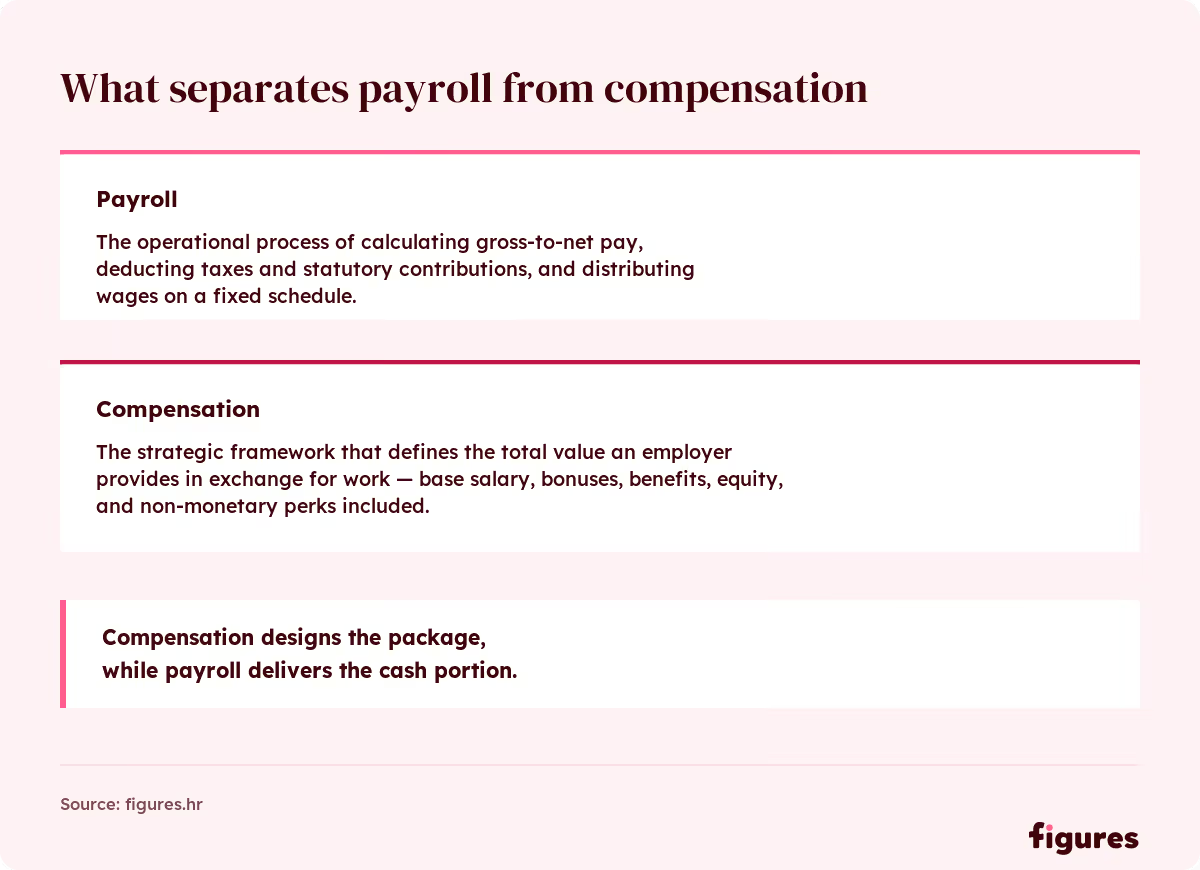
- Payroll is the operational process of calculating gross-to-net pay, deducting taxes and statutory contributions, and distributing wages on a fixed schedule.
- Compensation is the strategic framework that defines the total value an employer provides in exchange for work – base salary, bonuses, benefits, equity, and non-monetary perks included.
The simplest way to think about it is that compensation designs the package, while payroll delivers the cash portion.
So why do so many people use these terms interchangeably? Because in a lot of mid-market companies, the same person handles both functions. Job postings don't help either – "payroll and compensation" gets treated as a single phrase so often that it's easy to assume they're the same thing.
They're not. And the difference matters more than most organisations realise.
In the sections ahead, we'll break down what each function actually includes, compare them side by side, and – most importantly – look at what it costs a business when it treats them as one.
Payroll and compensation side by side
The easiest way to see the difference? Put them next to each other.
As you can see, the failure modes are completely different. A payroll error creates an immediate, visible crisis – someone's rent doesn't get paid. A compensation failure is slower, quieter, and often mistaken for something else entirely. When strong performers leave, and exit interviews cite "better opportunities," that's usually a compensation problem wearing a payroll-shaped disguise.
One reason why that happens is that in smaller companies, both functions often collapse into a single role. One person running payroll and setting salary bands and reviewing benefits. That's where the terminology confusion starts – and, honestly, where both functions are most likely to be under-resourced.
“If the same person in your company handles pay runs and reward strategy, it's worth asking: which function is getting the most attention? Usually, it's payroll, because missed payments create fires. Compensation strategy, by contrast, tends to get pushed to "when we have time." Spoiler: there is never time, and meanwhile, your best people are already interviewing elsewhere.”
– Virgile Raingeard, CEO at Figures
What total compensation includes beyond the payslip
Salary is only one piece of the picture. Total compensation is the full value an employer provides in exchange for work – and it's almost always significantly more than what lands in someone's bank account each month.
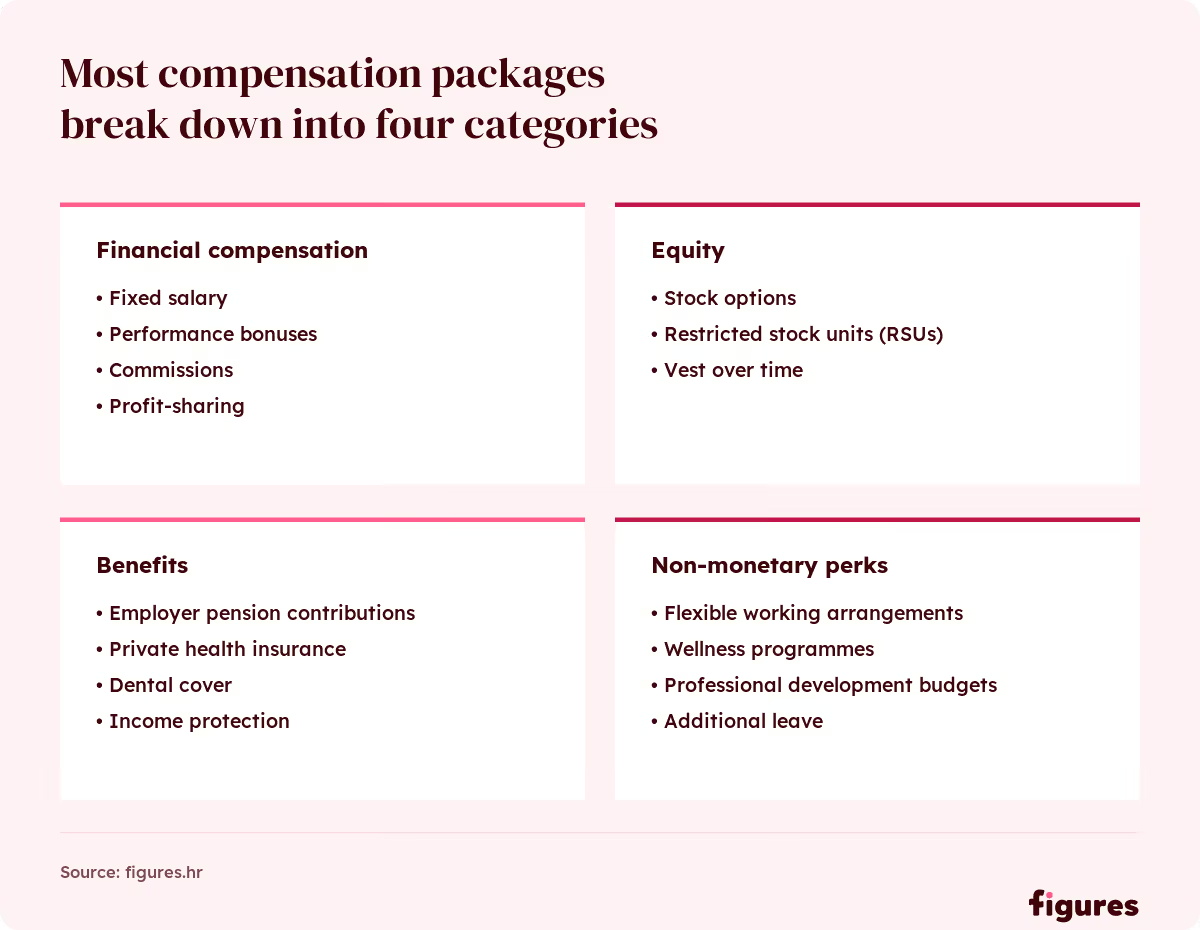
Most compensation packages break down into four categories:
- Financial compensation: Fixed salary, performance bonuses, commissions, and profit-sharing. This is the cash portion – the part that payroll actually processes.
- Equity: Stock options or RSUs (Restricted Stock Units) that vest over time. These don't flow through regular payroll until they convert, which is why they're easy to overlook in day-to-day pay conversations.
- Benefits: Employer pension contributions, private health insurance, dental cover, and income protection. Your employer is paying for these – they just don't show up on your payslip.
- Non-monetary perks: Flexible working arrangements, wellness programmes, professional development budgets, and additional leave. Hard to put a number on, but very much part of what compensation strategy designs.
Here’s an example:
That's a 36% gap between "salary" and "total compensation" – and the net pay hitting their account after PAYE and National Insurance will be lower still.
You'll sometimes hear these split into direct and indirect compensation.
- Direct is anything paid in cash: salary, bonuses, commissions.
- Indirect is the non-cash value: pension contributions, insurance, equity, perks.
Indirect components often run on completely different schedules from payroll – equity vests quarterly or annually, pension contributions are processed separately – and they're frequently invisible to employees unless you communicate them clearly.
💡 If your team doesn't have a clear view of what total compensation actually includes for each role, Figures' compensation review module can help you map the full picture – from salary bands to benefits to equity – in one place.
The cost of treating payroll and compensation as one function
When organisations lump payroll and compensation together – same budget line, same person, same level of attention – three things tend to happen. Spoiler: none of them are good.
1. Pay gaps go undetected
Payroll keeps wages arriving on time. It does nothing to surface structural inequities in how those wages were set in the first place.
82% of companies joining Figures already have pay gaps exceeding the 5% threshold. That's not a payroll failure – payroll did its job perfectly. It's a compensation failure, because nobody was looking at whether packages were designed fairly across roles, levels, and genders.
2. Retention fails through the wrong mechanism
Payroll accuracy prevents dissatisfaction. But it doesn't generate loyalty or prevent employee turnover.
An employee paid correctly every month – right amount, right date, every time – will still leave if the total package is uncompetitive. These are different failure modes that need different investments. If the compensation is right, they have a reason to stay. If all you're offering is "we pay you on time" – congratulations, you've met the legal minimum. (A lot of jobs actually do list this as a benefit, and we find this mildly crazy.)
🤔 If your exit interviews keep citing "better opportunities elsewhere," that's rarely a payroll problem. It's almost always a compensation one.
3. Regulatory exposure sits in the compensation layer
Directive (EU) 2023/970, the EU Pay Transparency Directive, takes effect in June 2026. It requires salary ranges in job postings, documented pay decisions, and action plans when unexplained gender pay gaps exceed 5%.
Every single one of those obligations belongs to the compensation function, not payroll. Figures' guide to the Directive breaks down the full set of employer requirements – and none of them can be met by running payroll more efficiently.
Here's the good news, though: companies that already treat compensation as a strategic function are ahead. They're building salary bands, collecting benchmarking data, and running structured compensation reviews – exactly the infrastructure the Directive demands. For them, compliance is a byproduct of good practice, not a scramble.
Building a compensation strategy into your HR operations
If your company doesn't yet have a structured compensation function, the three building blocks we mentioned just now will get you most of the way there:
- Salary bands – defined pay ranges for each role, level, and location, so every pay decision starts from a consistent framework rather than a guess.
- Market benchmarking – regular comparison against external data so your packages stay competitive, not just internally consistent.
- Structured compensation reviews – a repeatable process for reviewing and adjusting pay across the organisation, rather than reacting to resignations one at a time.
None of these can replace payroll. They work alongside it – giving the operational side something well-designed to execute.
If you're looking for a place to start, Figures' compensation review module brings all three together in one platform. Book a free demo and see how it works for your team.
Common questions about payroll and compensation
What are the three types of payroll?
Manual (spreadsheet-based), software-managed (dedicated payroll tools), and outsourced (third-party provider).
- Manual works for very small teams but carries the highest error risk.
- Software suits mid-market companies that want control without the admin burden.
- Outsourcing hands the entire function to a third-party provider, which reduces internal workload but adds a layer of dependency.
The right choice depends on your company's size, complexity, and risk tolerance.
Note: Figures is a compensation management platform – it doesn't process payroll.
Who manages payroll vs. compensation?
Payroll teams own pay cycles, tax data, and compliance reporting. C&B professionals own reward policy design, market benchmarking, and internal pay equity. In smaller companies, these roles merge into a single position, which is exactly where the terminology blurring starts and where both functions are most likely to be stretched thin.
What is the difference between remuneration, reimbursement, and compensation?
Remuneration is the total reward for work – salary plus taxable benefits like company cars. Reimbursement is repaying expenses incurred on the company's behalf and isn't compensation at all. Compensation is the broadest term: it covers all value provided in exchange for work, including non-monetary elements like flexible working and professional development.
How do compensation decisions flow into payroll?
Compensation designs the policy, and then payroll turns that into numbers.
When C&B introduces a new bonus scheme – say, a quarterly bonus worth 15% of salary for high performers – payroll receives the eligibility list, confirms amounts, calculates the bonus net of PAYE and National Insurance, schedules it within the correct pay cycle, and generates the tax documentation.
A miscommunication at any step creates discrepancies, delayed payments, or compliance exposure.
Can compensation be used to mean salary?
People use them interchangeably in conversation, but they're not the same thing. Salary is the fixed cash amount paid on a recurring schedule. Compensation includes salary plus bonuses, equity, benefits, and non-monetary perks. An employee's salary might be £70,000, but their total compensation could be £95,000 or more. Using "compensation" when you mean "salary" risks undervaluing the full package – or overvaluing it, depending on the context.